

CIE Syllabus focus:
'Use first ionisation energies of successive elements to provide evidence for electron subshells and changes in electronic structure.'
Plots of first ionization energy across a period do not rise perfectly smoothly.
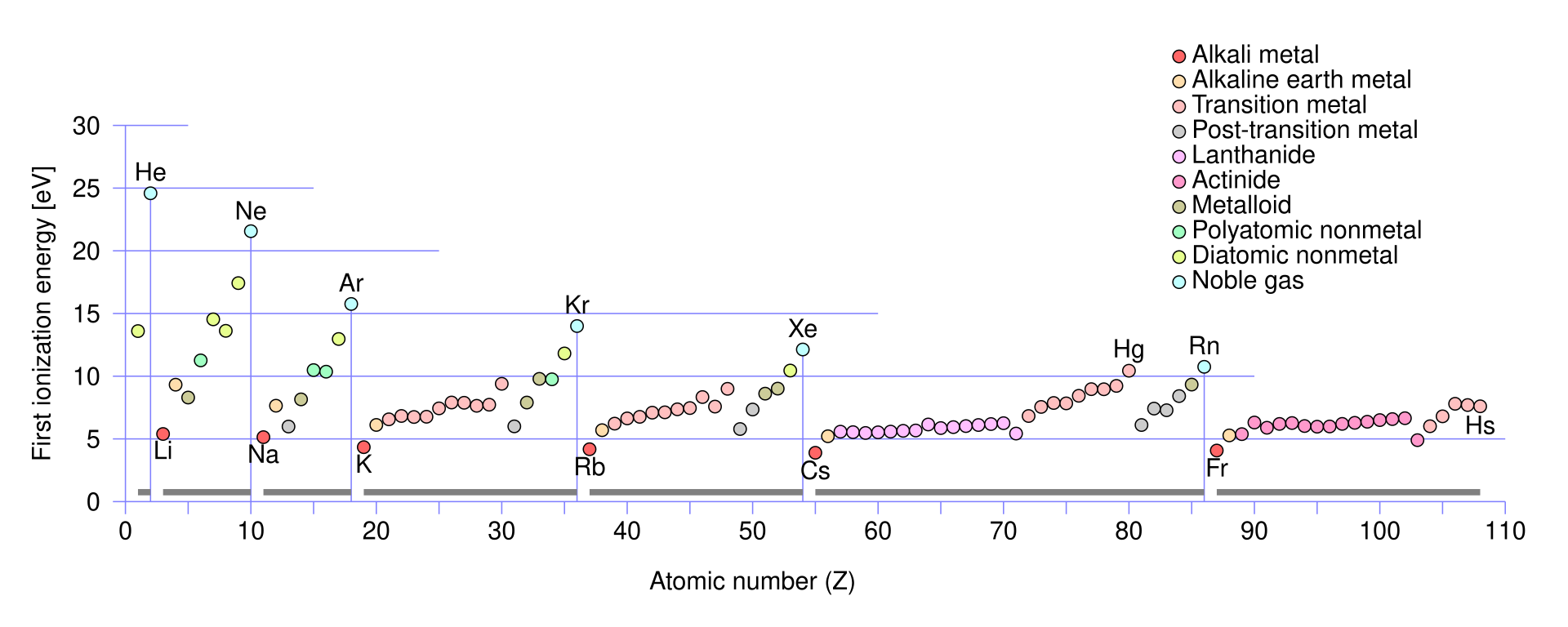
First ionization energy plotted against atomic number across many elements, showing the repeating sawtooth pattern across periods. The local dips within each period are the key visual evidence that the overall increase is interrupted by electronic-structure effects (e.g., entry into a higher-energy subshell and electron pairing repulsion). Source
These small irregularities are important because they reveal the existence of subshells and show changes in electron arrangement between successive elements.
Why first ionization energy data is useful
When comparing successive elements in the same period, there is an overall increase in first ionization energy because nuclear charge increases. However, the increase is not perfectly regular. Some elements have a slightly lower first ionization energy than the element before them.
These small drops are valuable evidence because they cannot be explained by proton number alone. Instead, they show that:
electrons occupy different subshells
subshells have different energies
electron arrangement within a subshell can change the ease of electron removal
This means first ionization energy data supports a more detailed picture of atomic structure than a simple model with only shells.
Subshell: A division within a main electron shell, such as s or p, containing orbitals of similar energy.
Evidence for subshells in Period 2
The drop from beryllium to boron
The first clear evidence for subshells appears between beryllium and boron.
Be:
B:
From Be to B, the extra electron goes into the 2p subshell, not the 2s subshell. Although boron has a greater nuclear charge, its first ionization energy is lower than beryllium’s.
This shows that the electron removed from boron is in a different type of subshell. A 2p electron is easier to remove than a 2s electron because:
the 2p subshell is at higher energy
the electron is slightly less strongly attracted to the nucleus
it experiences slightly more shielding than a 2s electron in the same shell
So, the drop from Be to B is evidence that the second shell is split into at least two subshells with different energies.
The drop from nitrogen to oxygen
Another important pattern appears between nitrogen and oxygen.
N:
O:
Nitrogen has three electrons in the 2p subshell. These occupy separate p orbitals before pairing. Oxygen has one more 2p electron, so one orbital now contains a pair of electrons.
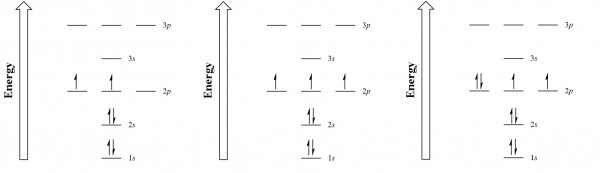
Orbital (box) diagrams for second-period filling illustrate Hund’s rule and where electron pairing begins. Comparing nitrogen () with oxygen () shows that oxygen must contain one paired set in a single orbital, increasing repulsion and lowering the first ionization energy relative to nitrogen. Source
The first ionization energy of oxygen is lower than that of nitrogen, even though oxygen has a higher nuclear charge. This happens because:
paired electrons in the same orbital repel each other
this repulsion makes one of the paired electrons easier to remove
This drop does not provide evidence for a new subshell. Instead, it provides evidence for a change in electronic structure within the same subshell.
Evidence for subshells in Period 3
The same pattern appears again in Period 3.
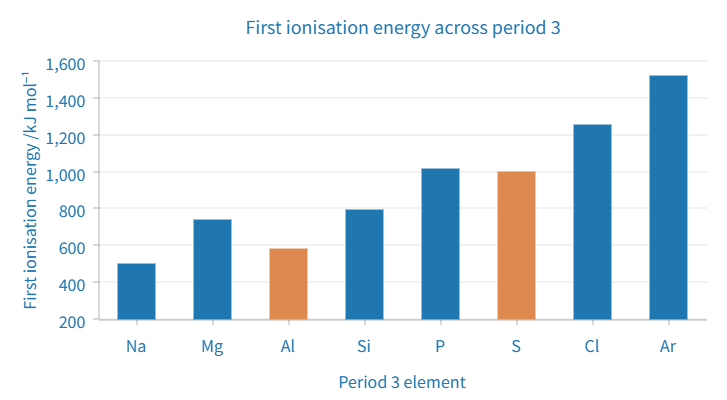
First ionisation energy across Period 3 (Na→Ar) with the characteristic dips at Mg→Al and P→S highlighted by the shape of the curve. The Mg→Al dip corresponds to removal of a higher-energy electron rather than a electron, while the P→S dip reflects increased electron–electron repulsion when pairing starts in the subshell. Source
Repetition across periods strengthens the evidence.
The drop from magnesium to aluminum
Mg:
Al:
Aluminum has a lower first ionization energy than magnesium because the electron removed from aluminum is in the 3p subshell, which is higher in energy than the 3s subshell.
This is strong evidence that the third shell also contains separate subshells with different energies.
The drop from phosphorus to sulfur
P:
S:
Phosphorus has three unpaired 3p electrons. Sulfur has one paired 3p orbital. The repulsion between paired electrons makes sulfur’s outer electron easier to remove, so sulfur has a lower first ionization energy than phosphorus.
Again, this supports the idea that first ionization energy depends not only on shell and subshell, but also on the arrangement of electrons within orbitals.
What the data shows about electronic structure
From these patterns, chemists can infer several key ideas:
s and p subshells exist within the same main shell
p subshells are higher in energy than s subshells in the same shell
electrons do not all have exactly the same energy within one shell
pairing of electrons can reduce first ionization energy because of repulsion
The repeated drops from:
Be to B
N to O
Mg to Al
P to S
are especially important. They show that first ionization energy data gives evidence for both subshell structure and changes in electron arrangement as atomic number increases.
How to interpret first ionization energy graphs
When using first ionization energy data, do not focus only on the overall rise across a period. The most useful evidence often comes from the exceptions.
A strong explanation should:
identify the pair of successive elements being compared
state the relevant electron configurations
identify whether the electron removed is from an s or p subshell
explain whether the drop is caused by higher subshell energy or electron repulsion in a pair
A weak explanation usually says only that the trend “goes down” without linking it to electronic structure. In this topic, the value of the data is that it reveals where the electronic structure changes and what kind of change has occurred.
Practice Questions
Explain why the first ionization energy of aluminum is lower than that of magnesium. (2 marks)
1 mark: Aluminum’s outer electron is removed from the 3p subshell, whereas magnesium’s is removed from the 3s subshell.
1 mark: The 3p electron is higher in energy / less strongly attracted to the nucleus / more shielded, so it is easier to remove.
The first ionization energies of the Period 2 elements show small drops from Be to B and from N to O.
Explain how these drops provide evidence for subshells and changes in electronic structure. (5 marks)
1 mark: Be is and B is .
1 mark: The electron removed from B is in a 2p subshell, which is higher in energy than 2s, so it is easier to remove.
1 mark: This gives evidence that the second shell contains different subshells.
1 mark: N is and O is , so O has one paired 2p orbital.
1 mark: Repulsion between paired electrons makes an electron in O easier to remove, showing a change in electronic structure within the same subshell.
FAQ
The Be to B drop happens because the electron removed changes from a 2s electron to a 2p electron. That means the electron is now in a different subshell with a different energy.
The N to O drop happens within the same 2p subshell. The difference is caused by electron pairing and repulsion, not by moving into a new subshell.
So one drop shows subshell energy differences, while the other shows changes within a subshell.
They repeat because the same filling pattern happens again in higher shells.
For example:
$2s \rightarrow 2p$ gives the Be to B pattern
$3s \rightarrow 3p$ gives the Mg to Al pattern
Likewise, the half-filled to paired change happens again:
$2p^3 \rightarrow 2p^4$
$3p^3 \rightarrow 3p^4$
This repetition matters because it suggests the pattern is a real feature of atomic structure, not an isolated irregularity.
A half-filled p subshell means one electron occupies each of the three p orbitals before any pairing occurs.
This arrangement reduces repulsion because:
the electrons are in separate orbitals
no orbital contains a pair yet
As a result, an atom such as nitrogen or phosphorus can have a slightly higher first ionization energy than expected. Removing one electron breaks that especially stable arrangement.
No. The drops are usually similar in pattern, but not identical in size.
The exact size depends on several factors, including:
how strongly the nucleus attracts the outer electron
how much shielding is present
how big the energy gap is between the relevant subshells
how important electron-electron repulsion is in that shell
So the pattern repeats, but the numerical change can vary.
Not by itself. First ionization energy data gives strong supporting evidence, especially for:
different subshell energies
electron pairing effects
repeating electronic patterns across periods
But chemists use multiple types of evidence together, such as line spectra and other experimental results, to build the full model.
So first ionization energy is best seen as one important piece of evidence rather than a complete proof on its own.

