

CIE Syllabus focus:
'Know the shapes of s and p orbitals and the numbers of electrons that can occupy s, p and d subshells.'
Understanding subshells and orbital shapes helps explain how electrons are arranged around the nucleus and why electron configurations are written the way they are in chemistry.
Orbitals and subshells
An electron in an atom occupies an orbital. Orbitals do not show fixed paths; instead, they describe regions where an electron is most likely to be found.
Orbital: A region of space around the nucleus where there is a high probability of finding an electron.
Orbitals are grouped into subshells, and each subshell has a characteristic shape pattern and electron capacity.
Subshell: A group of orbitals of the same type and similar energy within a shell.
The subshell letter tells you the type of orbital present:
s
p
d
In electron configuration notation, the number shows the shell and the letter shows the subshell. For example, 2p means a p subshell in the second shell.
The s subshell and s orbital shape
An s subshell contains one s orbital. This means the s subshell can hold a maximum of 2 electrons.
The key shape to learn is that an s orbital is spherical.
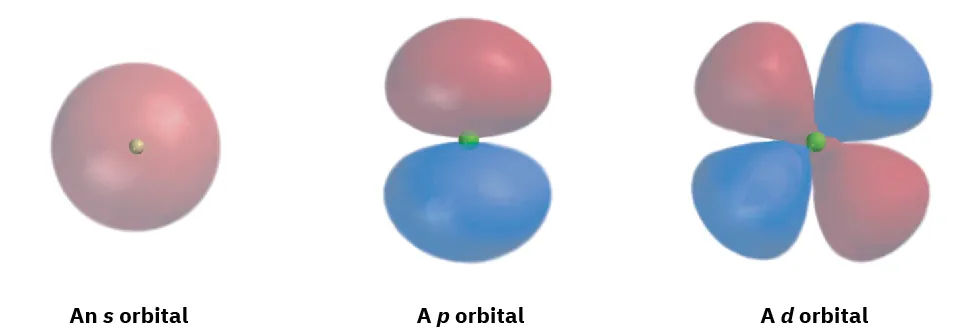
This figure compares the characteristic shapes of the s and p atomic orbitals. The s orbital is shown as a sphere of electron density centered on the nucleus, while the p orbital is shown as two lobes (a dumbbell) separated by a nodal plane through the nucleus. Use it to anchor the exam wording “spherical” (s) and “dumbbell-shaped” (p). Source
The electron density is arranged symmetrically around the nucleus, so the orbital looks the same from every direction.
Important points about s orbitals:
every s orbital is spherical
the size of an s orbital increases in higher shells
because there is only one orbital in an s subshell, the maximum number of electrons in any s subshell is 2
When sketching an s orbital at this level, draw it as a sphere or a simple circular outline to represent a three-dimensional spherical region.
The p subshell and p orbital shape
A p subshell contains three p orbitals. Together, these three orbitals can hold a maximum of 6 electrons.
Each p orbital has a dumbbell shape. This means it has two lobes with the nucleus at the center between them. The two lobes lie on opposite sides of the nucleus.
The three p orbitals have the same shape and same energy within the same subshell, but they point in different directions in space. They are commonly labeled:
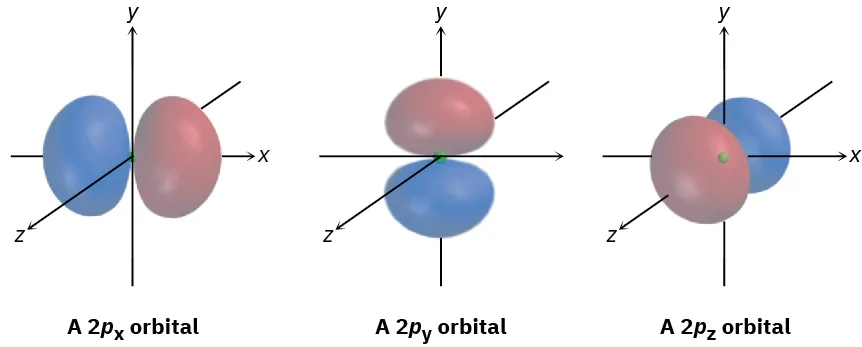
This diagram shows the three degenerate 2p orbitals oriented along perpendicular axes: , , and . Each orbital has the same dumbbell shape (two lobes) but points in a different direction in space. This supports the idea that a p subshell contains three orbitals with identical shape and energy but different orientations. Source
These three orientations are at right angles to one another.
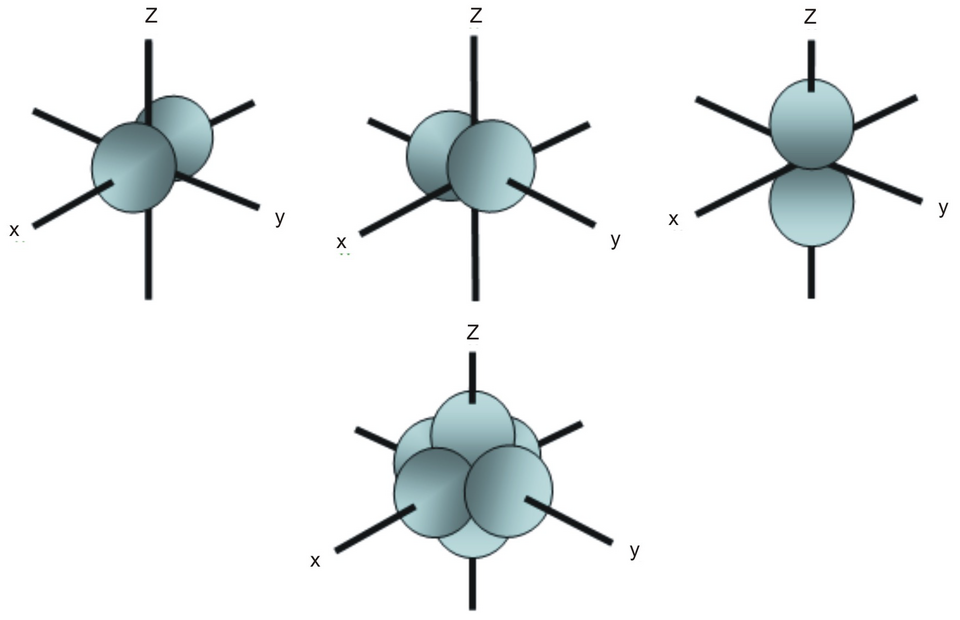
This figure presents the three p orbitals separately and then together on the same atom, emphasizing their mutually perpendicular orientations. It visually reinforces that a p subshell contains three orbitals of the same shape but different spatial directions. This is the geometric reason the p subshell can accommodate 6 electrons total (2 per orbital). Source
This helps explain why there are three p orbitals in every p subshell.
A p orbital is not spherical. This is a very common point of confusion. If a question asks for the shape of a p orbital, dumbbell-shaped is the expected answer.
The d subshell
A d subshell contains five d orbitals, so it can hold a maximum of 10 electrons.
For this specification point, you need to know the electron capacity of the d subshell, but not the detailed shapes of the d orbitals. The essential fact to remember is:
s subshell: 2 electrons
p subshell: 6 electrons
d subshell: 10 electrons
This pattern is often tested in short recall questions and in questions linked to electron configurations.
Linking subshells, orbitals, and electron numbers
The difference between orbital and subshell must be kept clear.
An orbital is a single region of space where an electron is likely to be found.
A subshell is a set of orbitals of the same type.
This is why the capacities are different:
s subshell = 1 orbital = 2 electrons
p subshell = 3 orbitals = 6 electrons
d subshell = 5 orbitals = 10 electrons
You should be able to connect the letter of the subshell to both its shape information and its maximum occupancy:
s → spherical orbital → 2 electrons
p → dumbbell-shaped orbitals → 6 electrons
d → capacity of 10 electrons
Although s and p shapes are required, avoid inventing extra details. In exam answers, use the accepted words spherical and dumbbell-shaped.
Common mistakes to avoid
Students often lose marks through small vocabulary errors rather than lack of understanding.
Do not confuse these pairs:
shell and subshell
orbital and subshell
shape of an orbital and number of electrons in a subshell
Typical mistakes include:
saying a p subshell is dumbbell-shaped rather than saying a p orbital is dumbbell-shaped
forgetting that there are three p orbitals in one p subshell
giving the d subshell a shape description when the key fact needed is usually its capacity of 10 electrons
writing that an s subshell holds 1 electron instead of 2 electrons
A good memory aid is to learn the capacities as 2, 6, 10 for s, p, d. Pair these with the shape words sphere for s and dumbbell for p. This keeps the required knowledge precise and exam-ready.
Practice Questions
State the shape of an s orbital and the maximum number of electrons that can occupy a d subshell. [2]
s orbital is spherical. [1]
d subshell holds 10 electrons. [1]
Explain the difference in shape between an s orbital and a p orbital. State the maximum number of electrons that can occupy the s, p, and d subshells. [6]
s orbital is spherical. [1]
p orbital is dumbbell-shaped / has two lobes. [1]
p orbitals can have different orientations / there are three p orbitals at right angles. [1]
s subshell holds 2 electrons. [1]
p subshell holds 6 electrons. [1]
d subshell holds 10 electrons. [1]
FAQ
The letters come from early spectroscopy.
Scientists described groups of spectral lines as:
s = sharp
p = principal
d = diffuse
These historical labels were kept even after modern atomic theory explained electron arrangements more fully.
They are the same type of orbital, so their basic probability pattern is the same.
The only difference is orientation in space:
one along the x-axis
one along the y-axis
one along the z-axis
In an isolated atom, these three orientations are equal in energy, which is why they belong to the same p subshell.
The first shell can contain only an s subshell.
This happens because the first shell has too little available energy structure to support a p subshell. A p subshell first appears in the second shell, so the lowest p subshell is 2p, not 1p.
That is why electron configurations begin with 1s and not 1p.
No. The five d orbitals are not all identical in appearance.
Four are often drawn as cloverleaf-shaped
One, usually written as $d_{z^2}$, has a different shape with a doughnut-like region around the middle
At Edexcel A-Level, you usually do not need to memorize these detailed d-orbital shapes for this specification point.
Not in the sense of seeing a solid object with a sharp boundary.
Orbitals are mathematical models that describe probability. Scientists infer their shapes from evidence such as:
spectroscopy
electron density measurements
quantum mechanical calculations
So the familiar sphere and dumbbell drawings are useful models, not literal pictures of tiny objects inside the atom.

