

CIE Syllabus focus:
'Explain how atomic emission spectra provide evidence for discrete quantum shells, and use observations from flame tests or hand-held spectroscopes to investigate line spectra.'
Atomic emission spectra show that electron energies in atoms are not continuous. Observing flame colors and line spectra gives direct experimental evidence that electrons occupy fixed quantum shells rather than any energy value.
Atomic emission spectra
When atoms are supplied with energy, some of their electrons move to higher energy levels. These excited electrons do not remain there permanently. When they fall back to lower energy levels, energy is released as light.
Atomic emission spectrum: A set of discrete wavelengths of light emitted by excited atoms as electrons move from higher to lower energy levels.
This light is not produced as every possible wavelength. Instead, atoms emit only certain wavelengths, so the spectrum appears as separate lines rather than a continuous spread of color.
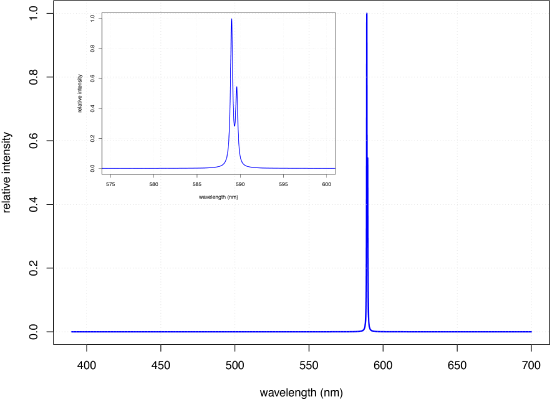
Atomic emission spectrum of sodium plotted as relative intensity versus wavelength, showing sharp peaks at specific wavelengths. The dominant yellow emission near (a close doublet) illustrates how a single observed flame color can arise from one or more discrete spectral lines. This type of graph makes the “quantized energy levels \rightarrow
between levels, so only particular photon energies (and therefore wavelengths) can be emitted. This directly visualizes why atomic emission spectra appear as separate lines rather than a continuum. Source
Each bright line corresponds to a particular energy change inside the atom. Because each energy change is fixed, each line appears at a fixed wavelength.
Evidence for discrete quantum shells
The key idea is that electrons in atoms can only exist in certain allowed energy levels.
Quantum shell: A main energy level within an atom that can hold electrons at a particular fixed energy.
Atomic emission spectra provide evidence for this because the emitted light is not continuous. If electrons could have any energy, then atoms would emit a continuous range of wavelengths. That is not what is observed.
Instead, the spectrum contains distinct lines:
each line represents one allowed electron transition
each transition has a fixed energy difference
only certain energy differences are possible
therefore only certain wavelengths are emitted
This is strong evidence that electron energies are quantized, meaning they exist in separate values rather than as a smooth range.
Why separate lines matter
The spacing between lines shows that the energy gaps between shells are also specific. An electron cannot stop halfway between two allowed shells. It must move between one allowed shell and another.
This means:
electrons occupy discrete quantum shells
energy is absorbed in fixed amounts to move electrons to higher shells
energy is emitted in fixed amounts when electrons return to lower shells
A line spectrum is therefore experimental evidence for the shell model of the atom.
Why each element has its own spectrum
Different elements have different nuclear charges and different arrangements of electrons. As a result, the energy gaps between their quantum shells are different.
Because of this:
each element emits a unique pattern of lines
the position of the lines acts like a fingerprint for that element
the color seen in a flame depends on which wavelengths are most intense
This is why sodium, potassium, lithium, and copper compounds can give different visible emissions when heated.
Investigating line spectra with flame tests
A flame test is a simple way to excite atoms and observe the light they emit. A small sample of a compound is placed in a hot flame, which provides energy to the electrons.
Typical observations include:
lithium: crimson red
sodium: yellow
potassium: lilac
barium: apple green
copper: blue-green
These visible colors are useful first observations, but they do not show the full detail of the spectrum. A flame color is the overall appearance to the eye, while the actual emission consists of individual lines.
Why use a hand-held spectroscope?
A hand-held spectroscope gives more detailed evidence than the naked eye because it separates the emitted light into individual wavelengths.
Using a spectroscope allows you to:
see distinct bright lines on a dark background
compare the pattern of lines from different elements
distinguish substances with similar-looking flame colors more reliably
observe that one flame color can come from several separate emission lines
This makes the spectroscope much more useful for linking observation to the idea of discrete quantum shells.
Points to remember when interpreting observations
Flame tests and line spectra support the same model, but the spectroscope gives stronger evidence.
Important points:
a flame color is a broad visual impression
a line spectrum shows the separate wavelengths actually emitted
the existence of separate lines supports quantized electron energies
the same element always produces the same line pattern under the same conditions
In practice, sodium contamination can easily produce a strong yellow flame, so careful observation is important. A spectroscope helps reduce confusion by revealing the actual line pattern rather than just the overall flame color.
Do not describe atomic emission spectra as random colored bands. The lines are fixed and meaningful because they come from specific electron transitions between quantum shells.
Practice Questions
Explain why atomic emission spectra provide evidence for discrete quantum shells. [2 marks]
Atomic emission spectra contain separate lines, not a continuous range of wavelengths. [1]
This shows electrons can only occupy fixed energy levels or shells and move between them. [1]
A student carries out flame tests on lithium chloride and sodium chloride, then observes the light through a hand-held spectroscope. Explain how the observations support the idea of quantum shells, and why the spectroscope is more useful than looking at flame color alone. [5 marks]
Heating excites electrons in the atoms. [1]
Electrons fall from higher to lower energy levels and emit light. [1]
Only certain wavelengths are emitted, giving a line spectrum. [1]
This shows electron energies are quantized or in discrete quantum shells. [1]
A spectroscope is more useful because it separates the light into individual lines, allowing clearer identification than overall flame color alone. [1]
FAQ
Brightness depends on how many atoms are making a particular transition and how likely that transition is.
A line appears stronger when:
many excited electrons fall through that energy gap
the emitted wavelength is detected well by the eye or instrument
the sample contains enough of the element to produce a strong signal
So line position tells you about energy differences, while line intensity depends more on how often the transition happens.
Sodium compounds are widespread in the environment and can be present in tiny traces on equipment, glassware, or even fingers.
Its emission is also very intense, so even a small amount can dominate what you see.
This means:
a yellow flame may come from contamination rather than the sample
cleaning equipment carefully is important
a spectroscope can help by showing whether other lines are also present
In gases, atoms are relatively far apart, so their emitted light is less disturbed by neighboring particles.
In solids and liquids, interactions between particles can broaden or blur the lines, making the spectrum less sharp.
That is why:
isolated gaseous atoms give clearer line spectra
discharge tubes are useful for studying atomic spectra
sharp lines are easier to link to discrete energy levels
An emission spectrum is produced when excited atoms release light at specific wavelengths.
An absorption spectrum is produced when white light passes through cooler atoms, which absorb certain wavelengths. Those missing wavelengths appear as dark lines.
Both types support quantized energy levels because only specific energy changes are allowed.
So:
emission spectra show bright lines
absorption spectra show dark lines
both are linked to electron transitions between allowed shells
The positions are fixed because the energy gaps in the atoms of that element are fixed.
If the element is the same, the allowed electron transitions are the same, so the emitted wavelengths stay the same.
The brightness may change if conditions change, but the pattern remains characteristic.
This makes line spectra useful for:
identifying elements
checking sample purity
comparing unknown samples with known reference spectra
