

CIE Syllabus focus:
'Apply the rules that electrons occupy orbitals singly before pairing, and that paired electrons in the same orbital must have opposite spins.'
Electron filling rules explain how electrons are arranged within orbitals and why electron diagrams follow a predictable pattern. These rules are essential for drawing accurate electronic structures and understanding atomic behavior.
Why electron filling rules matter
An atom does not place electrons randomly. Electrons occupy orbitals in ways that give the atom the lowest possible energy while also following strict quantum rules. When you draw electrons-in-boxes diagrams, two ideas matter most: electrons fill equal-energy orbitals one at a time before any pairing happens, and any two electrons sharing a single orbital must have opposite spins. If either rule is broken, the diagram is incorrect.
Orbital: A region of space around the nucleus that can hold a maximum of two electrons.
In box notation, an orbital is shown as a box, and each electron is shown as an arrow.
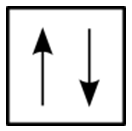
A minimal orbital-filling symbol diagram showing that one box (one orbital) can contain two electrons only if their spins are opposite. The up- and down-arrow notation is the standard convention used in electron-in-box diagrams to represent the two allowed spin states. Source
Opposite spins: Two electrons in the same orbital must have different spin states, shown as one upward arrow and one downward arrow.
The first rule: single occupancy before pairing
The rule that electrons occupy equal-energy orbitals singly before pairing is often called Hund’s rule. It applies when a subshell contains more than one orbital of the same energy, such as the three orbitals in a p subshell or the five orbitals in a d subshell.
Instead of putting two electrons into the first orbital immediately, the atom places one electron into each equal-energy orbital first. Only after each orbital has one electron does pairing begin. This arrangement lowers repulsion between electrons and gives a more stable arrangement.
For example, if three electrons are being placed into three p orbitals, the correct arrangement is one electron in each orbital.
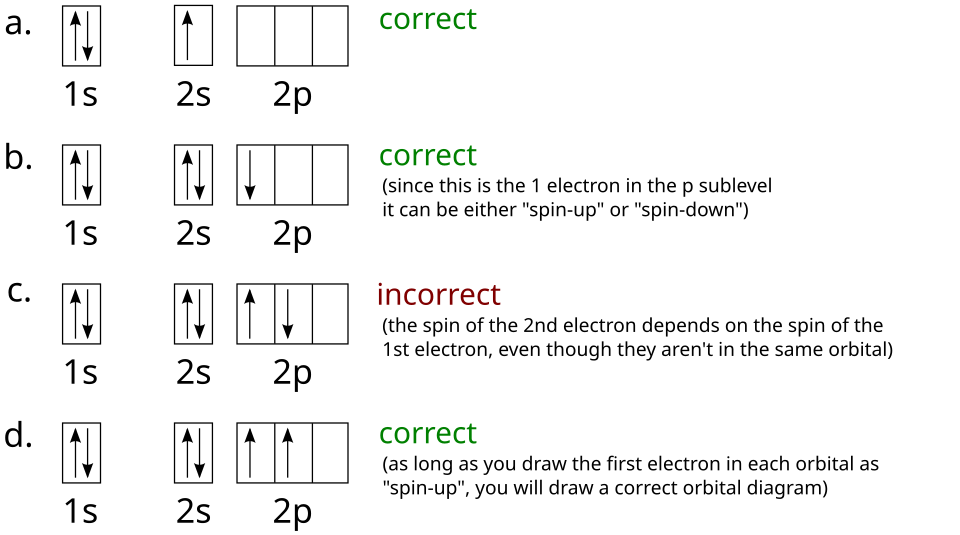
Orbital-box diagrams illustrating Hund’s rule across sets of equal-energy orbitals. The figure emphasizes that electrons occupy degenerate orbitals singly (with parallel spins) before any pairing occurs, producing the maximum number of unpaired electrons in the lowest-energy arrangement. Source
If four electrons are present, the first three occupy separate orbitals and the fourth then pairs up in one of them.
When applying this rule, remember the following:
fill one electron into each equal-energy orbital first
keep these electrons unpaired until every orbital has one electron
start pairing only when no empty orbital of the same energy remains
apply the rule only within orbitals of the same energy
A common mistake is to pair electrons too early because it seems quicker or simpler. In chemistry, the correct arrangement is the one with the lowest energy, not the one that uses the fewest boxes first.
The second rule: opposite spins in the same orbital
When two electrons occupy the same orbital, they must have opposite spins. This idea comes from the Pauli exclusion principle. In electrons-in-boxes diagrams, this is shown as one arrow pointing up and one arrow pointing down.
You should never draw two electrons in the same box with arrows in the same direction. A pair of identical arrows in one orbital would mean the electrons are in the same quantum state, which is not allowed. Opposite spins allow two electrons to share the same orbital without breaking this rule.
This means that every full orbital must contain one up arrow and one down arrow. If you see two arrows in the same direction in a single box, the diagram is automatically wrong, even if the total number of electrons is correct.
Applying the rules in electron-box diagrams
These rules are easiest to see in electrons-in-boxes notation. To fill a set of orbitals correctly:
identify how many orbitals are present in the subshell you are filling
place electrons into empty orbitals one at a time
use arrows in the same direction for the singly occupied orbitals
only begin pairing after every equal-energy orbital has one electron
when pairing happens, reverse the second arrow so the spins are opposite
The choice of whether you draw the first single electrons as upward arrows or downward arrows is a convention. What matters is consistency. Singly occupied orbitals are usually drawn with parallel spins, and paired electrons must be opposite.
This is why a p subshell with three electrons is shown as three separate arrows in three boxes, not as one pair and one single electron. A p subshell with four electrons is shown as one paired box and two singly occupied boxes, not as two paired boxes and one empty box.
What the arrows really show
The arrows in box diagrams do not mean electrons are literally spinning upward or downward in space. They are a simple way of representing two possible spin states. In A-Level Chemistry, you mainly use the arrows as symbols that help you apply the rules correctly.
For exam purposes, all first electrons placed into equal-energy orbitals are normally drawn with parallel arrows. It does not matter whether they are all up or all down. What matters is that they match until pairing begins, and that any paired electrons are opposite.
Common errors and examiner points
Common mistakes include:
pairing electrons too early in a set of equal-energy orbitals
drawing two electrons with the same spin in one orbital
leaving an orbital empty while pairing has already started in the same subshell
forgetting that the rule is about equal-energy orbitals
giving the correct number of electrons but the wrong arrow pattern
In exams, marks are often awarded for both arrangement and spin direction. A student may lose marks even if the number of electrons is correct but the arrows are drawn incorrectly. Read the subshell carefully, count the electrons accurately, and check every box at the end.
A useful final check is to ask two questions. Has every equal-energy orbital been occupied once before any pairing? If two electrons share a box, are the arrows opposite? If both answers are yes, the filling pattern is usually correct.
Practice Questions
State how the three electrons in the 2p subshell of a nitrogen atom should be arranged in electrons-in-boxes notation. (2 marks)
One electron in each of the three 2p orbitals / three separate boxes each containing one electron. (1)
All three electrons shown with parallel spins, for example three upward arrows. (1)
A student places the four electrons in the 2p subshell of an oxygen atom as two pairs in two orbitals, leaving the third orbital empty.
Explain why this arrangement is incorrect and describe the correct arrangement. (5 marks)
The three 2p orbitals are equal in energy. (1)
Electrons occupy equal-energy orbitals singly before pairing. (1)
One electron should be placed into each of the three 2p orbitals first. (1)
The fourth electron then pairs in one of the orbitals. (1)
The pair in one orbital must have opposite spins. (1)
FAQ
The word spin is a historical name for a quantum property of electrons.
In A-Level Chemistry, you do not need a full quantum explanation. You only need to know that electrons can exist in two spin states, and these are shown as up and down arrows in box diagrams.
The arrows are symbols, not pictures of physical motion.
Electrons all have negative charge, so they repel one another.
If electrons spread out into separate orbitals first, that repulsion is reduced. Lower repulsion means lower energy, and lower energy means a more stable arrangement.
That is why early pairing is not favored when empty equal-energy orbitals are still available.
No. Hund’s rule applies only to orbitals that have the same energy.
It does not compare orbitals in different subshells. So you use it within a set such as the three p orbitals, not between an s orbital and a p orbital.
First decide which subshell is being filled, then apply the single-occupancy rule inside that set of equal-energy orbitals.
No. Within a single set of equal-energy orbitals, the boxes are equivalent.
For example, the three boxes in a p subshell represent three orbitals of the same energy. It does not matter which box receives the paired electrons first.
What matters is:
single occupancy before pairing
correct total number of electrons
opposite spins for any pair
Unpaired electrons can make a substance paramagnetic, which means it is attracted into a magnetic field.
If all electrons are paired, the substance is usually diamagnetic, meaning it is weakly repelled by a magnetic field.
This is one reason electrons-in-boxes diagrams are useful: they show unpaired electrons immediately, which ordinary electron configuration notation may hide more easily

