

CIE Syllabus focus:
'Know the maximum number of electrons in the first four quantum shells and understand that an orbital holds up to two electrons with opposite spins.'
These notes explain how electrons are arranged in the first four quantum shells and why each orbital can contain only two electrons, provided those electrons have opposite spins.
Quantum shells
Electrons in atoms are arranged in main energy levels called quantum shells. These shells are not fixed circular tracks. Instead, they represent allowed energy levels for electrons around the nucleus.
The first idea to understand is the quantum shell.
Quantum shell: A main energy level in an atom that can contain electrons.
The shells closest to the nucleus have the lowest energy, and shells farther from the nucleus have higher energy. For the first four shells, the shell numbers are:
first shell:
second shell:
third shell:
fourth shell:
An electron in the first shell is, on average, closer to the nucleus than an electron in the fourth shell. Because of this, the first shell is lower in energy and is filled before higher shells in simple cases.
It is important to think of shells as allowed energy regions, not as exact electron paths. This helps connect the shell model to the more accurate orbital model used in modern atomic theory.
Maximum electron capacities
Each quantum shell has a maximum number of electrons that it can hold. For the first four shells, these maximum capacities are:
first shell: 2 electrons
second shell: 8 electrons
third shell: 18 electrons
fourth shell: 32 electrons
These values must be memorized.
The word maximum is important. It tells you the greatest possible number of electrons in that shell, not the number that must always be present. A shell can contain fewer electrons than its full capacity.
Higher-numbered shells can hold more electrons because they contain more available orbitals. As the shell number increases, the number of possible electron arrangements within that shell also increases.
A very common mistake is to use the simplified school-level pattern 2, 8, 8 and assume that the third shell can hold only 8 electrons. For A-Level chemistry, the correct maximum capacity of the third shell is 18. The fourth shell can hold 32.
Knowing these capacities is useful when checking whether an electron arrangement is physically possible. If more electrons are placed into a shell than its maximum allows, that arrangement must be wrong.
Atomic orbitals
Within each shell, electrons occupy orbitals. An orbital is a more detailed idea than a shell and gives a better description of where an electron is likely to be found.
Within each shell, electrons occupy orbitals.
Orbital: A region of space around the nucleus where there is a high probability of finding an electron.
An orbital is not a little orbit like a planet moving around the Sun. Instead, it is a three-dimensional probability region. This means chemistry cannot predict the exact path of an electron, but it can describe the region where the electron is most likely to be.
The connection between shells and orbitals explains shell capacities.
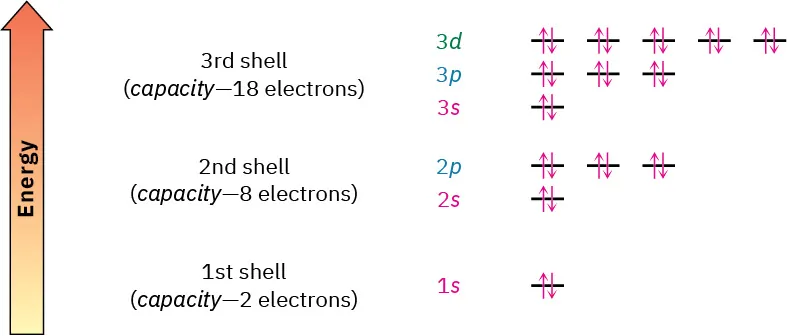
Energy-level diagram for the first few shells showing how many orbitals occur in each shell (e.g., 1s; 2s and 2p; 3s, 3p and 3d) and how electron pairs are represented with opposite-spin arrows. This provides a visual rationale for the shell capacities (2, 8, 18, …) by linking capacity to “number of orbitals × 2 electrons per orbital.” Source
The first shell contains 1 orbital, the second contains 4 orbitals, the third contains 9 orbitals, and the fourth contains 16 orbitals. Since each orbital can hold up to two electrons, the shell capacities become 2, 8, 18, and 32.
This shows the difference between the two ideas:
a shell is a main energy level
an orbital is a smaller region within that shell
Two electrons in one orbital
An orbital can hold a maximum of two electrons. It can never hold three.
If two electrons are in the same orbital, they must have opposite spins. Spin is a quantum property of electrons and is usually shown in diagrams by arrows pointing in opposite directions.
So, a full orbital contains:
one electron with one spin
one electron with the opposite spin
This is why orbital diagrams often show a filled orbital as one upward arrow and one downward arrow.
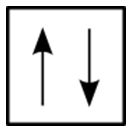
Orbital filling (box) diagram showing a single orbital drawn as a square containing two electrons represented by opposite-spin arrows. The figure illustrates the Pauli exclusion principle in diagram form: a single orbital can hold at most two electrons, and they must have opposite spins. Source
If two electrons in the same orbital had the same spin, that arrangement would not be allowed. Therefore:
one orbital = up to two electrons
if there are two electrons, their spins must be opposite
This rule applies to every orbital, no matter which shell the orbital belongs to. The capacity of an orbital is always 2.
Representing orbitals in diagrams
In electron-box diagrams:
one box represents one orbital
one arrow represents one electron
two opposite arrows in one box represent a full orbital
more than two arrows in one box is impossible
This visual method is helpful because it makes the occupancy rule very clear. You can quickly see whether an orbital is empty, half-filled, or full.
Key distinctions to keep clear
The following differences are essential:
Quantum shell and orbital are not the same thing.
A shell has a larger overall capacity than a single orbital.
The first four shell capacities are 2, 8, 18, 32.
An orbital always holds a maximum of 2 electrons.
Two electrons in the same orbital must have opposite spins.
A shell or orbital does not need to be full; these values are only maximum capacities.
Keeping these ideas separate makes later electron configuration work much easier and helps prevent errors in orbital diagrams.
Practice Questions
State the maximum number of electrons in: (a) the second quantum shell (b) the third quantum shell
(2 marks)
(a) 8 [1]
(b) 18 [1]
Explain the difference between a quantum shell and an orbital. State the maximum number of electrons that can occupy one orbital, including the spin requirement, and give the maximum number of electrons in the first four quantum shells.
(5 marks)
quantum shell described as a main energy level in an atom [1]
orbital described as a region of space with a high probability of finding an electron [1]
one orbital holds a maximum of two electrons [1]
the two electrons must have opposite spins [1]
first four shell capacities given as 2, 8, 18, 32 [1]
FAQ
The pattern comes from quantum mechanics. A shell with principal quantum number $n$ contains $n^2$ orbitals.
Since each orbital can hold 2 electrons, the maximum number of electrons in a shell is $2n^2$. For example:
when $n=1$, the maximum is 2
when $n=2$, the maximum is 8
when $n=3$, the maximum is 18
when $n=4$, the maximum is 32
This formula is useful, but for A-Level chemistry you should still know the first four values directly.
In chemistry, spin is a quantum property, not a literal spinning motion in the everyday sense.
It is represented by two possible states, often written as:
spin up
spin down
These are convenient labels for two allowed quantum states. When two electrons share one orbital, they must be in opposite spin states. That is why orbital diagrams use one upward arrow and one downward arrow.
Modern atomic theory does not treat electrons as particles moving in neat, predictable tracks.
Instead, the electron is described by a wavefunction, which gives the probability of finding it in different regions of space. An orbital is the region where that probability is high.
So an orbital is not a path. It is a map of where the electron is likely to be found if measurements are made.
These are older names for the first four quantum shells:
K shell = first shell
L shell = second shell
M shell = third shell
N shell = fourth shell
You may see these labels in older diagrams or reference materials. In most A-Level chemistry work, shells are more commonly identified by numbers such as first, second, third, and fourth, or by $n=1$ to $n=4$.
No. The edge drawn for an orbital is not a hard boundary in space.
It is usually a chosen surface that encloses a large percentage of the electron probability, often around 90% to 95%. There is still some chance of finding the electron outside that boundary.
So orbital diagrams show a useful approximation, not a sharply defined outer wall.
