

CIE Syllabus focus:
'Know that a covalent bond is the strong electrostatic attraction between two nuclei and their shared pair of electrons, and draw dot-and-cross diagrams for single, double and triple bonds.'
Atoms can achieve full outer shells by sharing electrons. These notes explain what a covalent bond is and how to represent single, double, and triple bonds with clear dot-and-cross diagrams.
The nature of covalent bonding
A covalent bond forms when two atoms share a pair of electrons, usually because both atoms need extra electrons in their outer shells.
Covalent bond is the strong electrostatic attraction between two nuclei and their shared pair of electrons.
This definition is important because it explains why the bond is strong. The nuclei in atoms are positively charged, and electrons are negatively charged. When a pair of electrons is shared between two atoms, both nuclei attract that same shared pair. The result is a strong attraction that holds the atoms together.
Covalent bonding is most commonly found between non-metal atoms. Each shared pair of electrons counts toward the outer shell of both bonded atoms. This means that atoms can become more stable by sharing electrons rather than by losing or gaining them.
In simple molecules, a covalent bond involves:
two nuclei
one shared pair of electrons
attraction between the positive nuclei and the negative shared electrons
It is important to focus on the idea of a shared pair. One covalent bond always contains two electrons, not one.
Single, double, and triple bonds
When atoms share one pair of electrons, they form a single bond. When they share two pairs, they form a double bond. When they share three pairs, they form a triple bond. Double and triple bonds are both called multiple bonds.
Single bonds
A single bond contains one shared pair of electrons. Many simple molecules contain only single bonds.
Examples include:
H–H in H₂
Cl–Cl in Cl₂
four C–H bonds in CH₄
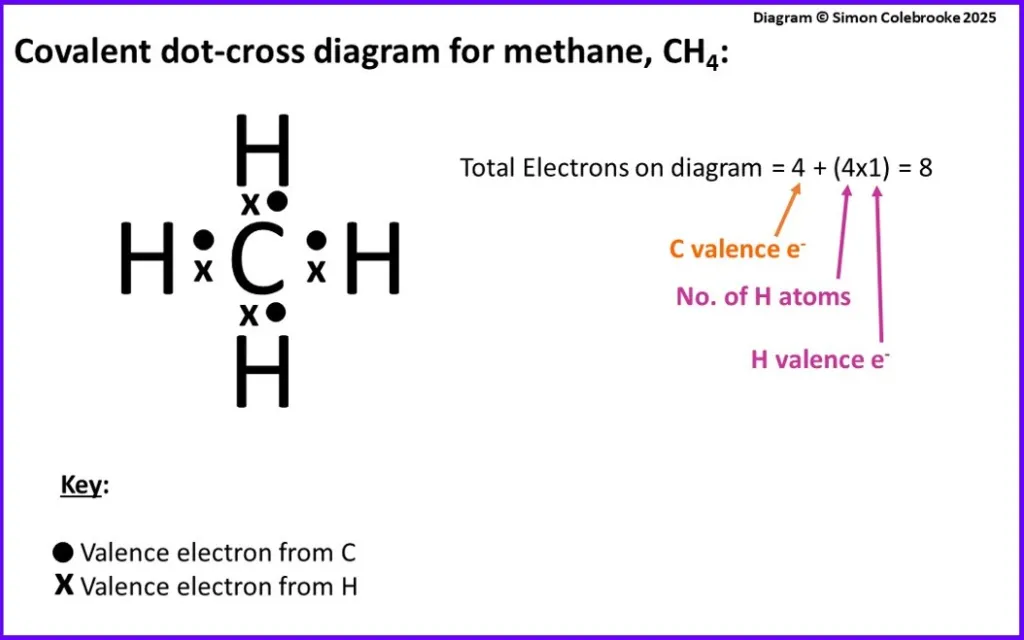
Dot-and-cross (Lewis) diagram for methane, CH₄, showing four C–H single covalent bonds. Each bond contains one shared pair of electrons (one from C and one from H), so carbon reaches an octet while each hydrogen reaches a duet. Source
Hydrogen is a useful special case. It only needs two electrons in its outer shell, so it forms one single covalent bond. Many other non-metals aim for eight outer electrons.
Double bonds
A double bond contains two shared pairs of electrons, so there are four electrons shared in total between the same two atoms.
A common example is O=O in O₂. Each oxygen atom has six outer electrons. By sharing two pairs, each oxygen can count eight electrons in its outer shell. After bonding, each oxygen still has two lone pairs of electrons that are not shared.
Double bonds should not be described as “two electrons shared.” That would only be one shared pair. A double bond means two pairs are shared.
Triple bonds
A triple bond contains three shared pairs of electrons, so there are six shared electrons between the same two atoms.
A common example is N≡N in N₂.
Each nitrogen atom has five outer electrons. By sharing three pairs, each nitrogen reaches an outer shell of eight electrons. After bonding, each nitrogen has one lone pair left.
Triple bonds are easy to miscount in diagrams. Remember that a triple bond is not three electrons between the atoms. It is three pairs, which means six electrons.
Drawing dot-and-cross diagrams
A dot-and-cross diagram shows the outer-shell electrons in a covalently bonded molecule. Dots are used for the electrons from one atom, and crosses are used for the electrons from the other atom. This helps you see which electrons were contributed by which atom.
When drawing these diagrams:
show outer-shell electrons only
use a different symbol for each atom’s electrons
show each covalent bond as a shared pair
include any lone pairs that are not involved in bonding
check that the total number of electrons shown is correct
A method you can follow
Write the symbols of the atoms involved.
Count the number of outer-shell electrons each atom has.
Decide how many pairs of electrons must be shared.
Place the shared electrons between the atoms.
Add the remaining electrons as lone pairs.
Recheck that each atom has the correct outer-shell total.
This final check is especially useful in larger molecules, where it is easy to leave out a lone pair or place too many electrons around one atom.
For a single bond, there should be one dot and one cross in the shared region.
For a double bond, there should be two dots and two crosses in the shared region.
For a triple bond, there should be three dots and three crosses in the shared region.
If the two atoms are the same, as in O₂ or N₂, you should still use dots for one atom and crosses for the other. The atoms are identical, but the symbols help show where the electrons came from before sharing.
Common mistakes in bond diagrams
Examiners often look for accuracy in small details. Common mistakes include:
showing the wrong number of outer electrons before bonding
forgetting lone pairs
drawing a double bond with only one shared pair
drawing a triple bond with only three shared electrons instead of three shared pairs
changing the total number of electrons during the drawing
forgetting that each shared pair contains two electrons
A good dot-and-cross diagram is not mainly about artistic neatness. It must show the correct electron arrangement. If the bonding pairs and lone pairs are accurate, the diagram clearly represents the covalent bonding in the molecule.
Practice Questions
State what is meant by a covalent bond. (2 marks)
1 mark for stating that it is a strong electrostatic attraction
1 mark for stating that the attraction is between two nuclei and a shared pair of electrons
Oxygen and nitrogen both form simple diatomic molecules.
Draw a dot-and-cross diagram for O₂ and a dot-and-cross diagram for N₂. Show outer-shell electrons only. (6 marks)
For O₂:
1 mark for showing two shared pairs between the oxygen atoms
1 mark for showing two lone pairs on each oxygen atom
1 mark for using dots and crosses correctly to show electron origin
For N₂:
1 mark for showing three shared pairs between the nitrogen atoms
1 mark for showing one lone pair on each nitrogen atom
1 mark for using dots and crosses correctly to show electron origin
FAQ
Inner-shell electrons usually do not take part in covalent bonding.
Dot-and-cross diagrams are designed to show the electrons involved in bond formation, so only the outer-shell electrons are included. Leaving out inner electrons makes the diagram clearer and easier to read.
A displayed formula shows which atoms are connected and how many bonds are present, usually by using lines.
A dot-and-cross diagram gives more detail because it shows the actual outer electrons, including bonding pairs and lone pairs, and it shows which atom each bonding electron came from.
Hydrogen only has the first electron shell, and that shell can hold a maximum of two electrons.
A single covalent bond gives hydrogen access to two electrons, so its shell is full after forming one bond. There is no space for extra shared pairs around hydrogen in a normal covalent molecule.
No. They are a model.
They help you keep track of outer electrons and shared pairs, but they do not show the exact movement of electrons or the true three-dimensional shape of the molecule. They are useful for bonding patterns, not for showing the real positions of electrons at every moment.
A single bond allows the bonded atoms to rotate more easily around the bond axis.
In a double or triple bond, the extra shared electron pairs create additional bonding interactions that would be disrupted by rotation. Because of that, multiple bonds are more rigid and help lock atoms into a more fixed arrangement.
