

CIE Syllabus focus:
'Draw dot-and-cross diagrams for species with dative covalent, or coordinate, bonds, including the ammonium ion and aluminium chloride dimer, Al₂Cl₆.'
Dative covalent bonding extends ordinary covalent bonding by allowing one atom to supply both electrons in a shared pair. Recognizing this electron donation is essential when drawing accurate dot-and-cross diagrams.
What a dative covalent bond is
The key idea in dative covalent bonding is that one atom provides both bonding electrons. This still produces a covalent bond, because the bond is a shared pair of electrons between two nuclei.
Dative covalent bond: A covalent bond in which both electrons in the shared pair are donated by the same atom.
A dative covalent bond is also called a coordinate bond. Before the bond forms, one species must have a lone pair available to donate, and the other species must be able to accept that pair. The acceptor is often:
a positive ion, such as H⁺
an electron-deficient atom, such as Al in AlCl₃
Once formed, a coordinate bond is not a separate kind of attraction. It is a normal covalent bond whose electron pair originally came from one atom. In dot-and-cross diagrams, that origin must be shown clearly.
How to show a dative bond in a dot-and-cross diagram
A dot-and-cross diagram shows where the bonding electrons came from. For an ordinary covalent bond, one electron usually comes from each bonded atom. For a dative bond, both electrons in one shared pair come from the same atom, so that pair must be shown with the same symbol.
When drawing these diagrams:
choose dots for one atom and crosses for the other, or any other consistent pair of symbols
show outer-shell electrons only
show the donated pair in the coordinate bond as two dots or two crosses from the donor atom
include lone pairs that remain on atoms
put ions in square brackets with the charge outside the brackets
The exact choice of dots and crosses does not matter. What matters is that the symbols are used consistently enough to show which atom supplied each electron.
The ammonium ion
The ammonium ion, NH₄⁺, forms when ammonia, NH₃, donates its lone pair to H⁺.
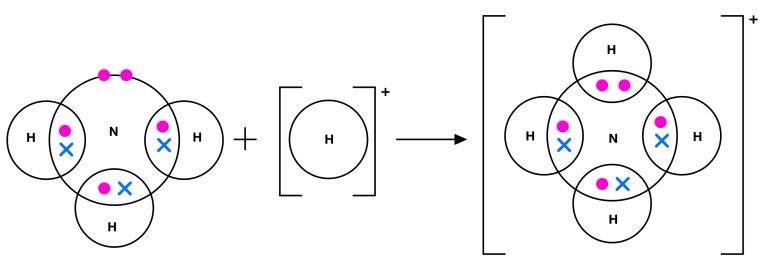
Dot-and-cross formation diagram for showing ammonia’s nitrogen donating a lone pair to . The final ion is correctly bracketed with an overall positive charge, and the coordinate bond is identifiable because both electrons in that shared pair come from nitrogen. Source
Nitrogen in ammonia has three bonding pairs and one lone pair. The hydrogen ion has no electrons to contribute, so nitrogen must supply both electrons for the new N-H bond.
In the dot-and-cross diagram for ammonium:
start from the ammonia arrangement, with three ordinary N-H bonds and one lone pair on N
show the lone pair from N being used to make a fourth N-H bond
in that bond, both electrons should be shown as coming from nitrogen
draw the whole ion in square brackets
place the overall + charge outside the brackets
A common mistake is to show one electron from H⁺ in the coordinate bond. That is incorrect because H⁺ has no electron to share. Another common mistake is forgetting the brackets and positive charge.
The purpose of the diagram is to show how the ion forms. It tracks the source of the bonding pair rather than just the final arrangement of atoms.
The aluminum chloride dimer, Al₂Cl₆
The aluminum chloride dimer, Al₂Cl₆, is an important example of coordinate bonding in a covalent substance. In AlCl₃, aluminum forms only three bonds, so it has only six electrons around it. This makes it electron deficient and able to accept a lone pair.
Two AlCl₃ units combine to form Al₂Cl₆.

Schematic of the aluminium chloride dimer highlighting coordination (dative) bonds from bridging chlorine atoms to electron-deficient aluminium atoms. The two bridges are explicitly shown, making it easy to see why each Al reaches a coordination number of four in the dimer. Source
A chlorine atom from one unit donates a lone pair to the aluminum atom in the other unit. The same happens in the opposite direction, so there are two coordinate bonds altogether.
This creates:
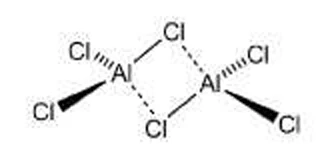
Displayed/structural representation of the dimer showing the two bridging chlorines linking the aluminium centers. Use this as a quick connectivity check (two bridges, four terminal chlorines) before adding lone pairs and dot-and-cross electron origins in a full exam-style diagram. Source
two bridging chlorine atoms
two Al-Cl coordinate bonds
a dimer made from two linked AlCl₃ units
When drawing Al₂Cl₆:
show two aluminum atoms
show six chlorine atoms in total
include four terminal chlorine atoms bonded normally to aluminum
include two bridging chlorine atoms between the aluminum atoms
for each coordinate bond, show both bonding electrons as coming from the chlorine donor
show the remaining lone pairs on each chlorine atom
A frequent error is drawing only one bridging chlorine. The correct dimer has two bridges. Another error is failing to show that the donated pair comes from chlorine rather than aluminum. Aluminum is the acceptor because it is electron deficient.
What examiners look for
Examiners usually award credit for two linked ideas:
identifying the donor atom with the lone pair
showing that both electrons in the coordinate bond come from that donor
For ammonium, the donor is nitrogen. For Al₂Cl₆, the donors are the bridging chlorine atoms.
To keep your diagrams accurate:
check whether the species is neutral or ionic
check that every coordinate bond has a pair of identical symbols
check that lone pairs have not disappeared unless they were used to form a bond
check that the total number of atoms and the overall charge are correct
In this topic, success depends on carefully showing the source of each bonding electron pair.
Practice Questions
Explain how a coordinate bond forms when ammonia reacts with H⁺ to form NH₄⁺. [2]
Lone pair on nitrogen is donated to H⁺. [1]
Both electrons in the new N-H bond come from nitrogen / H⁺ contributes no electrons. [1]
Aluminum chloride exists as the dimer Al₂Cl₆. Describe how coordinate bonding is involved in this dimer and state what a correct dot-and-cross diagram should show. [5]
Each Al in AlCl₃ is electron deficient / has only six electrons around it. [1]
A lone pair from a chlorine atom is donated to an aluminum atom. [1]
This happens twice, forming two coordinate bonds / two bridging chlorine atoms. [1]
In each coordinate bond, both electrons are shown as coming from chlorine. [1]
Diagram shows the correct overall arrangement: two Al atoms, six Cl atoms, four terminal chlorines, and two bridges / remaining lone pairs shown correctly. [1]
FAQ
H⁺ is just a hydrogen nucleus with an empty space where bonding electrons can be placed.
When ammonia donates a lone pair, that pair is attracted to both the nitrogen nucleus and the hydrogen nucleus, so a bond forms. H⁺ does not need to contribute an electron because the donor atom provides both electrons.
AlCl₃ tends to dimerize when aluminum can increase its electron count by accepting lone pairs from chlorine atoms.
At higher temperatures, especially in the gas phase, Al₂Cl₆ can split into simpler AlCl₃ units. The balance depends on conditions, but the driving force for dimer formation is the electron deficiency of aluminum.
Not always.
What matters is the overall electron accounting in the species. In NH₄⁺, nitrogen donates a lone pair to H⁺, but the whole ion carries the positive charge. In other species, formal charges may appear on particular atoms, but you must judge them from the full structure, not from the word “donate” alone.
After formation, both types are shared pairs of electrons between two nuclei.
That means bond length, bond strength, and behavior may be very similar to ordinary covalent bonds. The main difference is historical: a coordinate bond tells you where the two bonding electrons originally came from.
The charge confirms the total number of electrons present.
For a species like NH₄⁺, leaving out the brackets and positive charge can make a correct bonding pattern look incomplete or misleading. Examiners use the charge to check whether you have represented the species itself, not just the atoms joined together.
