

CIE Syllabus focus:
'Understand the relationship between the lengths and strengths of covalent bonds, including how bond order affects these properties.'
Covalent bond length and bond strength are closely linked. Understanding this relationship helps you compare single, double, and triple bonds and explain important trends in how strongly atoms are held together.
Bond length and bond strength
A covalent bond is not just a line drawn in a structure. In a real molecule, bonded atoms have a measurable distance between their nuclei and a measurable strength that shows how difficult the bond is to break.
Bond length: The distance between the nuclei of two bonded atoms.
Bond lengths are usually given in picometers (pm). A smaller bond length means the nuclei are closer together.
Chemists usually describe bond strength using bond enthalpy data, because stronger bonds need more energy to break.
Bond enthalpy: The enthalpy change required to break one mole of a stated covalent bond in gaseous molecules.
A bond with a larger bond enthalpy is stronger than a bond with a smaller bond enthalpy. Breaking a strong bond requires a greater energy input than breaking a weak bond.
Why a covalent bond has a particular length
A covalent bond does not keep getting shorter forever. As two atoms move closer together, the attraction between each nucleus and the shared electrons increases, which favors bond formation.
However, there are also repulsive forces. The two positive nuclei repel each other, and the electrons around the atoms also repel one another. If the atoms are pushed too close together, these repulsions become very large.
The actual bond length is the distance at which the attractive and repulsive forces balance in the most stable arrangement.
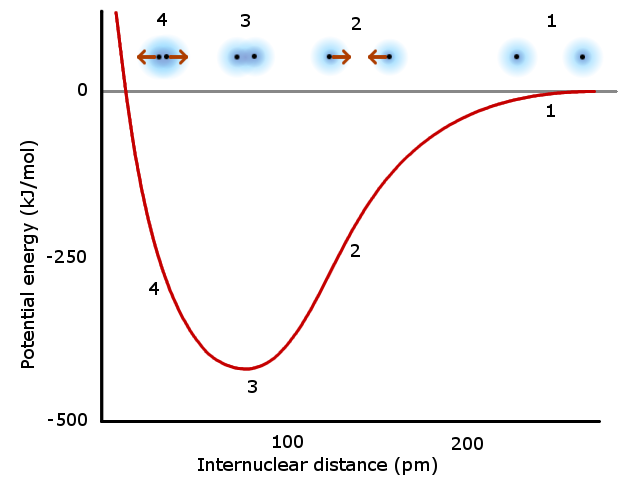
Potential energy curve for a diatomic covalent bond (illustrated with H–H), plotted against internuclear distance. The minimum corresponds to the equilibrium bond length, where attraction and short-range repulsion balance most stably. The depth of the potential well is linked to bond energy, helping connect bond length to bond strength. Source
This gives each covalent bond a characteristic length.
This idea is useful because it explains why bond length is a real physical property, not just a diagram feature. Different covalent bonds settle at different distances depending on how strongly the atoms attract the shared electrons.
Why shorter bonds are usually stronger
In a covalent bond, both nuclei are attracted to the shared electrons. If the nuclei are held closer to that shared negative charge, the electrostatic attraction is stronger.
Because of this, shorter covalent bonds are usually stronger. More energy is needed to separate the atoms completely, so the bond enthalpy is higher.
If the nuclei are farther apart, the attraction to the shared electrons is weaker. These bonds are usually easier to break, so they have lower bond enthalpies.
This is a general trend, not a shortcut that should be applied without thought. It works best when comparing bonds between the same two atoms, because atom size also affects bond length.
Bond order and its effect
Bond order means the number of shared pairs of electrons between two atoms.
Single, double, and triple bonds
As bond order increases, the amount of electron density between the nuclei increases. This strengthens the attraction between the nuclei and the shared electrons, so the nuclei are pulled closer together.
Single bond: one shared pair of electrons; usually the longest and weakest
Double bond: two shared pairs of electrons; shorter and stronger than a single bond
Triple bond: three shared pairs of electrons; usually the shortest and strongest
For carbon-carbon bonds, the trend is clear:
Bond length decreases from C–C to C=C to C≡C
Bond strength increases from C–C to C=C to C≡C
The same general pattern is seen with other pairs of atoms. A higher bond order usually means a shorter bond and a stronger bond.
It is important to describe this carefully. A double bond is not exactly twice as strong as a single bond, and a triple bond is not exactly three times as strong. The relationship is a trend, not a simple multiplication.
Using bond length and bond strength data
If a question gives bond length values, the shorter bond is usually the stronger one. If a question gives bond enthalpy values, the bond with the larger bond enthalpy is the stronger bond.
You should also remember that the size of the bonded atoms matters. Larger atoms usually form longer bonds because their nuclei are farther from the region where the electrons are shared. This is why the clearest comparisons are made within a set of bonds involving the same atoms.
When explaining a trend, do not only state that one bond is shorter or stronger. You should link the answer to bond order and electrostatic attraction.
A strong explanation usually includes these ideas:
identify the bond order
state whether the bond is shorter or longer
state whether the bond is stronger or weaker
explain that more shared electron pairs give greater electron density between the nuclei
explain that this causes stronger attraction between the nuclei and the shared electrons
explain that stronger attraction pulls the nuclei closer and means more energy is needed to break the bond
Avoid vague statements such as “a triple bond is stronger because it has more bonds.” A better answer explains that the greater electron density between the nuclei produces stronger electrostatic attraction, so the bond is both shorter and stronger.
Practice Questions
Ethene contains a C=C bond and ethane contains a C–C bond.
State which bond is shorter and give a reason. (2 marks)
C=C is shorter than C–C. (1)
A double bond has a higher bond order / more shared electron pairs / greater electron density between the nuclei, so the attraction is stronger and the nuclei are pulled closer together. (1)
Explain the relationship between bond order, bond length, and bond strength for C–C, C=C, and C≡C bonds. (5 marks)
Bond order increases from C–C to C=C to C≡C. (1)
Bond length decreases from C–C to C=C to C≡C. (1)
Bond strength increases from C–C to C=C to C≡C. (1)
Higher bond order means more shared electron pairs / greater electron density between the nuclei. (1)
This gives stronger electrostatic attraction between the nuclei and the shared electrons, so the nuclei are held closer and more energy is needed to break the bond. (1)
FAQ
The strength of a bond can vary slightly depending on the rest of the molecule around it.
For example, a C–H bond in one compound is not always exactly the same strength as a C–H bond in another. Average bond enthalpies are mean values taken from several gaseous molecules, so they are useful for trends but not always exact for one specific bond.
Bond lengths are measured using physical techniques that detect the positions of atoms very accurately.
Common methods include:
X-ray diffraction for solids
electron diffraction for gases
microwave spectroscopy for small gaseous molecules
These methods give the average distance between bonded nuclei, which is the bond length used in chemistry data.
This usually happens when electrons are delocalized over more than one bond.
In such cases, the bonding is spread out, so no single bond in the structure is a pure single or pure double bond. Each bond gets some extra bonding character, making it shorter than a normal single bond but longer than a normal double bond.
Yes, slightly.
Atoms in a bond vibrate all the time, and at higher temperatures the vibration is greater. This can make the measured average bond length a little larger. However, this does not usually change the basic trend that higher bond order gives shorter, stronger bonds.
Bond strength does not increase in a perfectly linear way with bond order.
The first shared pair of electrons forms the basic bond, and additional bonding changes the electron distribution and repulsions in a more complex way. So triple bonds are clearly stronger than single bonds, but not by an exact factor of three.

