

CIE Syllabus focus:
'Understand that molecular and ionic shapes are determined by repulsion between electron pairs around a central atom, including combinations of bonding pairs and lone pairs.'
Electron-pair repulsion theory explains why atoms in molecules and ions are arranged in definite three-dimensional shapes. By considering the number and type of electron pairs around a central atom, shapes can be understood logically.
The basic idea
Electron-pair repulsion theory is the model used to explain the shapes of molecules and polyatomic ions.
Electron-pair repulsion theory: Electron pairs in the valence shell of a central atom repel one another and arrange themselves as far apart as possible.
This theory applies to the central atom only. The important electrons are the pairs of electrons surrounding that atom, because these determine how strongly different regions of electron density push each other apart.
Repulsion occurs in three dimensions, so the arrangement that gives the greatest separation is the most stable.
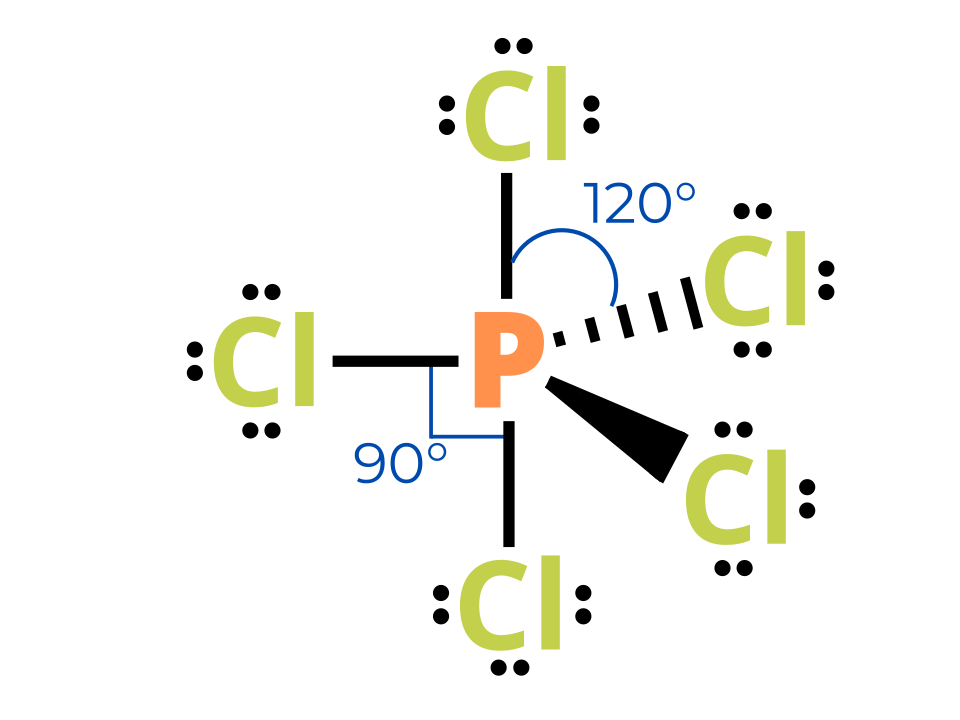
Trigonal bipyramidal molecular geometry (shown for phosphorus pentachloride), illustrating the two distinct positions (axial vs equatorial) that arise when there are 5 electron regions around a central atom. This helps explain why certain bond angles and repulsions differ depending on where bonding pairs (or lone pairs) sit in 3D space. Source
This is why real shapes are not flat unless the electron pairs can be most widely separated in one plane.
For shape determination, each bond around the central atom is treated as one region of electron density. This means that a single bond, double bond, or triple bond usually counts as one region when deciding the overall arrangement of electron pairs.
Bonding pairs and lone pairs
A bonding pair is a pair of electrons shared between two atoms in a covalent bond.
Bonding pair: A pair of electrons shared between two bonded atoms.
This type of electron pair helps connect the central atom to surrounding atoms.
A lone pair is a pair of electrons in the valence shell of the central atom that is not used in bonding.
Lone pair: A pair of electrons on an atom that is not shared in a bond.
Both bonding pairs and lone pairs repel other electron pairs. However, they do not repel equally strongly, so the final shape depends not just on the number of pairs but also on their type.
Relative strength of repulsions
A lone pair causes more repulsion than a bonding pair. This is because the electron density of a lone pair is held by only one nucleus, so it is more spread out around the central atom. A bonding pair is shared between two nuclei, so its electron density is pulled into a smaller region.
The order of repulsion strength is:
lone pair-lone pair repulsion is greatest
lone pair-bonding pair repulsion is intermediate
bonding pair-bonding pair repulsion is least
This has an important effect on shape. If lone pairs are present, they push bonding pairs closer together. As a result, the positions of bonded atoms are slightly compressed compared with an arrangement containing only bonding pairs.
The presence of lone pairs therefore changes both the shape and the spacing of bonds around the central atom.
From electron-pair arrangement to molecular shape
The first step is to decide how all electron pairs around the central atom are arranged to minimize repulsion. This gives the electron-pair arrangement.
The second step is to describe the molecular shape, which depends only on the positions of the atoms, not the lone pairs. Lone pairs influence the shape, but they are not included when naming the visible arrangement of atoms.
If all electron pairs are bonding pairs, the molecular shape matches the electron-pair arrangement.
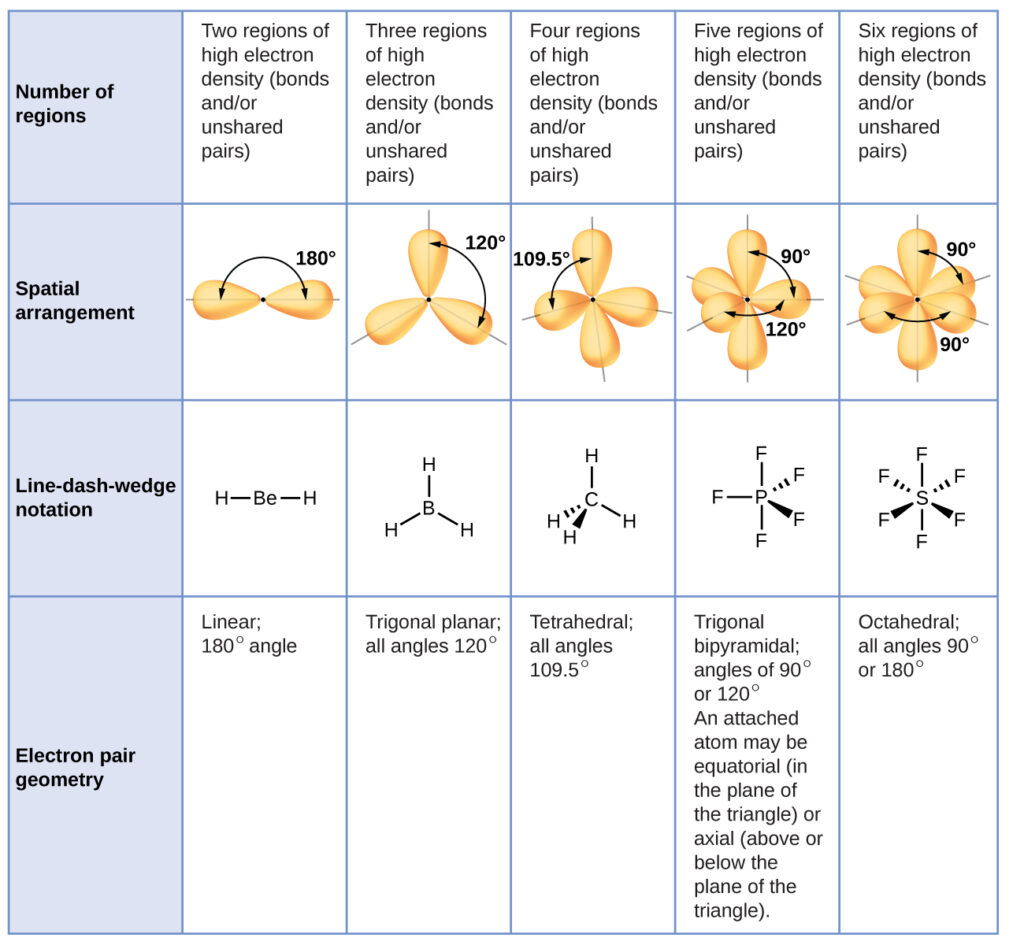
Electron-pair (electron-domain) geometries predicted by VSEPR for 2–6 regions of electron density around a central atom. This is the core reference diagram for moving from “count electron pairs” to the 3D arrangement that maximizes separation (linear, trigonal planar, tetrahedral, trigonal bipyramidal, octahedral). Source
For example:
2 electron pairs give a linear arrangement
3 electron pairs give a trigonal planar arrangement
4 electron pairs give a tetrahedral arrangement
If lone pairs are included, the electron-pair arrangement is still based on maximum separation, but the molecular shape changes because one or more positions are occupied by lone pairs rather than atoms. Common patterns include:
3 electron pairs with 2 bonding pairs and 1 lone pair give a bent shape
4 electron pairs with 3 bonding pairs and 1 lone pair give a trigonal pyramidal shape
4 electron pairs with 2 bonding pairs and 2 lone pairs give a bent shape
The key idea is that two species can have the same total number of electron pairs but different shapes if the balance between bonding pairs and lone pairs is different.
Molecular shapes and ionic shapes
The same theory applies to polyatomic ions as well as neutral molecules. A charged species can still have a central atom with surrounding bonding pairs and lone pairs, so its shape is determined in exactly the same way.
The overall charge affects the total number of electrons available, which may change how many lone pairs are present on the central atom. Once the electron pairs have been identified, the shape follows from the same repulsion rules.
This means that molecular shapes and ionic shapes are both controlled by electron-pair repulsion around a central atom.
How to apply the theory
When using electron-pair repulsion theory, follow this sequence:
identify the central atom
count the electron pairs around that atom
decide how many are bonding pairs and how many are lone pairs
arrange the electron pairs as far apart as possible
describe the shape using the positions of the bonded atoms only
This method makes it possible to explain why different molecules and ions adopt different three-dimensional forms.
Common points to remember
Shape is determined by repulsion between electron pairs, not by the atoms alone.
Only electron pairs around the central atom are used to decide the shape.
Lone pairs are not part of the named molecular shape, but they strongly affect it.
Shapes must be thought of in three dimensions.
Different combinations of bonding pairs and lone pairs give different shapes, even when the total number of electron pairs is the same.
Practice Questions
Explain why a lone pair repels more strongly than a bonding pair. [2]
Lone pair electron density is more spread out / occupies more space. [1]
Lone pair is attracted to one nucleus only, so it repels other electron pairs more strongly than a bonding pair. [1]
A central atom in three different species has four electron pairs around it.
Species A has 4 bonding pairs and 0 lone pairs.
Species B has 3 bonding pairs and 1 lone pair.
Species C has 2 bonding pairs and 2 lone pairs.
Use electron-pair repulsion theory to explain why the shapes of A, B, and C are different. [5]
Electron pairs repel one another and arrange themselves as far apart as possible. [1]
Four electron pairs have a tetrahedral electron-pair arrangement. [1]
Species A is tetrahedral because all four pairs are bonding pairs. [1]
Lone pairs repel more strongly than bonding pairs, so they push bonding pairs closer together. [1]
Species B is trigonal pyramidal and Species C is bent because molecular shape is based on the positions of atoms only, not lone pairs. [1]
FAQ
A double bond is treated as one region of electron density for basic shape prediction, so it usually does not change the main shape name.
However, a double bond contains more electron density than a single bond, so it can repel neighboring regions a little more strongly. This can cause small distortions from the ideal arrangement.
Many structural formulas show only the arrangement of atoms and bonds, not every non-bonding pair of electrons.
Because of this, a molecule may look as if it should have one shape on paper, but the real shape is different once lone pairs are included. Dot-and-cross or full Lewis structures are more useful when checking shape.
No. It is a very useful model, but it is mainly a shape-prediction tool.
It works well for many simple covalent molecules and polyatomic ions, but real molecules can show small deviations because of:
multiple bonds
differences in surrounding atoms
electron delocalization
more complex bonding effects
If electrons are delocalized over several atoms, the exact location of a bond may not match a single Lewis structure.
For shape prediction, you still count the number of electron regions around the central atom. Delocalization may change bond lengths and electron distribution, but the basic three-dimensional arrangement is usually predicted from the same repulsion idea.
Yes. The overall charge does not directly decide the shape.
If a neutral molecule and a polyatomic ion have the same number of electron pairs around the central atom, arranged in the same way, they can have the same shape. In these cases, electron count and pair arrangement matter more than whether the species is neutral, positive, or negative.

