

IB Syllabus focus: 'Low energy availability occurs when the body has insufficient energy for physiological functions and optimal health. Relative energy deficiency in sport is a consequence of prolonged low energy availability.'
Athletes may train hard yet still underfuel their bodies. When energy intake does not meet exercise demands and basic body needs, health and performance can decline, especially if the mismatch becomes chronic.
Understanding low energy availability
Low energy availability happens when an athlete does not consume enough energy to cover both exercise and the body’s normal physiological needs.
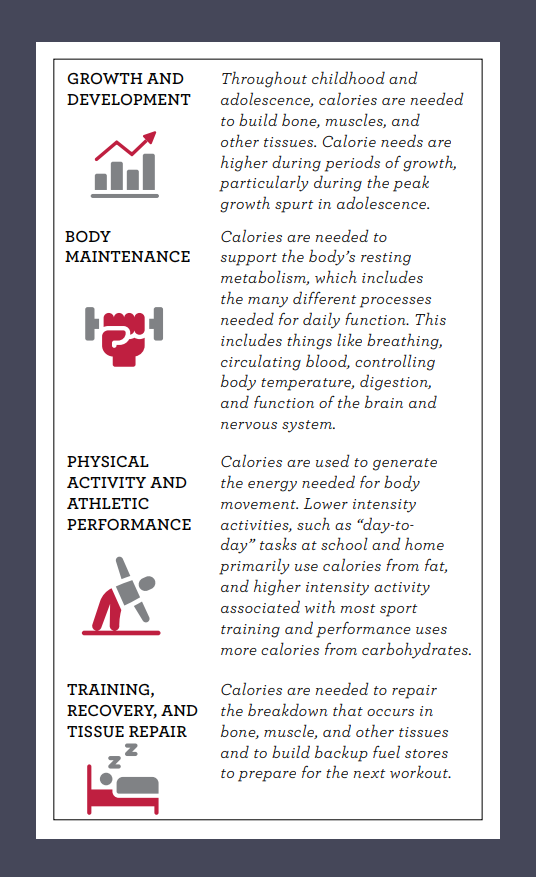
Diagram illustrating the major physiological “budget categories” that require energy (growth/development, body maintenance, physical activity/performance, and training recovery/tissue repair). It reinforces the core concept that when intake is insufficient, the body must prioritize survival-related processes, which helps explain common RED-S/LEA symptoms such as fatigue, impaired recovery, and increased injury risk. Source
Low energy availability: A state in which too little dietary energy remains to support normal body functions after the energy cost of exercise is accounted for.
The key issue is not simply eating less or training more on one day. The problem is the mismatch between energy intake and energy demand, especially when it happens repeatedly. When this shortfall persists, the body begins to conserve energy by reducing or altering processes that are not immediately necessary for survival. Functions such as hormone production, tissue repair, immune defense, and reproduction may be affected. This can protect the athlete in the short term, but it damages health and training quality over time.
How low energy availability develops
Low energy availability can be intentional or unintentional.
Intentional causes include restrictive dieting, rapid weight-loss goals, or pressure to stay lean for performance or appearance.
Unintentional causes include heavy training schedules, poor meal planning, busy routines, appetite suppression after exercise, or misunderstanding actual energy needs.
Adolescents may be at added risk because energy is also needed for growth and maturation.
It can occur in male and female athletes, in recreational or elite sport, and in athletes of any body size.
A single hard training day does not automatically mean a person has low energy availability. The main concern is a prolonged period of underfueling relative to activity demands. It may also develop gradually, so athletes and coaches may mistake early signs for normal training fatigue.
From low energy availability to RED-S
If low energy availability continues, it may lead to relative energy deficiency in sport (RED-S). This describes the wider pattern of disrupted health and performance that develops when the body remains underfueled over time.
Relative energy deficiency in sport (RED-S): A syndrome caused by prolonged low energy availability that impairs multiple physiological functions and sporting performance.
It is important to separate the two terms.
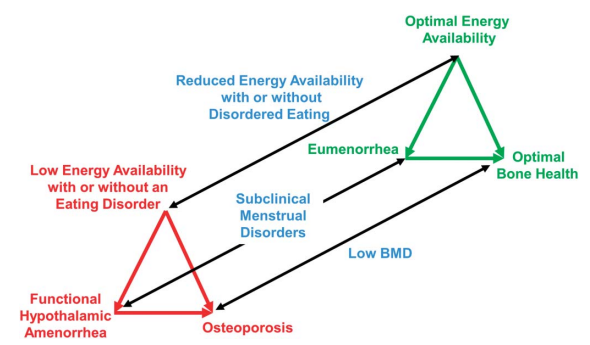
Spectra model of the Female Athlete Triad showing how energy availability, menstrual status, and bone health each exist on a continuum from optimal function to clinical endpoints. The arrows emphasize that low energy availability can disrupt reproductive function and, together, these changes can reduce bone health—illustrating a pathway from underfueling to injury risk (e.g., stress fractures). Source
Low energy availability is the underlying energy problem. RED-S is the broader consequence of that problem when it becomes chronic enough to affect body systems. RED-S is not limited to one type of athlete or one type of sport; it can occur anywhere prolonged underfueling is present.
Effects on physiological function and health
Because the body is trying to conserve energy, several systems may be affected at the same time.
Hormonal and reproductive effects
Energy deficiency can disrupt normal hormone production. In females, this may contribute to menstrual disturbances or loss of the menstrual cycle. In males, it may be associated with reduced levels of key reproductive hormones. These changes matter because hormones help regulate recovery, growth, and overall health.
Bone health
Long-term underfueling can reduce the body’s ability to build and maintain strong bone tissue. This increases the risk of low bone mineral density and stress fractures. Bone problems are especially concerning in young athletes because inadequate energy during key growth years may interfere with long-term skeletal development.
Metabolic and immune function
The body may slow aspects of metabolism to conserve energy. Athletes may feel unusually tired, cold, or unable to recover well between sessions. Immune function may also be impaired, increasing the risk of frequent illness and interrupted training.
Psychological and general well-being
Low energy availability may be linked with irritability, low mood, difficulty concentrating, and increased anxiety around food or body weight. These changes can make healthy training behaviors harder to maintain and may strengthen the cycle of underfueling.
Effects on sporting performance
Even if an athlete initially appears to maintain performance, prolonged underfueling usually reduces the ability to train and compete effectively.
Common performance effects
Reduced recovery between sessions
Lower training adaptation, so fitness improvements slow or stop
Increased fatigue and reduced ability to sustain high-quality training
Decreased strength, power, or endurance
Poorer concentration, decision-making, and coordination
Greater injury and illness risk, leading to missed training
Technical execution and motivation may also decline, especially late in training or competition. An athlete with RED-S may therefore struggle not only with health but also with consistency. Missed sessions, slower recovery, and repeated setbacks often have a larger effect on performance than the athlete expected when trying to reduce energy intake.
Recognizing and addressing the issue
Low energy availability and RED-S can be difficult to identify because some athletes still look fit and continue training. Warning signs may include persistent fatigue, repeated injuries, declining performance, menstrual dysfunction, frequent illness, low mood, or an unusual preoccupation with body weight and food control. Because symptoms may appear slowly, they are sometimes misread as poor motivation or lack of fitness.
Early recognition matters. The main aim is to restore adequate energy intake relative to training load so the body can support both exercise and normal physiological function. This often requires:
honest review of training demands and eating patterns
support from coaches, parents, or teammates
medical and nutrition guidance when symptoms are significant or persistent
Practice Questions
State what is meant by low energy availability.
Energy intake is insufficient relative to exercise or training demands. (1)
Too little energy remains to support normal physiological functions or optimal health. (1)
Explain how prolonged low energy availability can lead to RED-S and describe two effects on health and two effects on sporting performance.
Defines low energy availability as insufficient remaining energy for normal body function after exercise demands are met. (1)
States that prolonged or chronic low energy availability can lead to RED-S. (1)
One valid health effect explained, such as hormonal disruption, menstrual dysfunction, reduced reproductive hormones, impaired immunity, or poor bone health. (1)
A second valid health effect explained, such as low bone mineral density, stress fracture risk, fatigue, or reduced well-being. (1)
One valid performance effect explained, such as poorer recovery or reduced training adaptation. (1)
A second valid performance effect explained, such as decreased endurance, strength, concentration, coordination, or increased injury/illness leading to missed training. (1)
FAQ
No. The female athlete triad is an older model centered on three linked issues in females: low energy availability, menstrual dysfunction, and low bone mineral density.
RED-S is broader. It includes:
athletes of all sexes
more body systems
direct effects on performance as well as health
So, the triad can be seen as part of the wider RED-S concept.
Yes. Body weight alone is a poor indicator of energy availability.
An athlete may maintain a “normal” or even higher body weight while still lacking enough available energy for recovery, hormones, bone health, and other functions. The body can adapt in ways that hide the problem for a while.
This is one reason RED-S may be missed unless coaches and health professionals look at symptoms, training load, eating patterns, and recovery status rather than appearance alone.
Adolescents need energy not only for sport, but also for:
growth
puberty
bone development
brain development
If training load is high and food intake is too low, the energy gap may be larger than expected.
This matters because underfueling during adolescence may affect long-term development, not just current performance. Early identification is especially important in young athletes who are still maturing physically.
Recovery time varies a lot depending on:
how long the athlete has had low energy availability
how severe the deficiency is
which body systems are affected
Some symptoms, such as low energy or poor recovery, may improve within weeks once fueling improves. Hormonal function and bone health often take much longer, sometimes months or more.
Because recovery is not always quick, athletes may need a gradual return to full training while health markers improve.
Risk may rise in environments that emphasize:
low body mass or leanness
weight categories
appearance scoring
very high training volumes
frequent body composition monitoring
Examples often include endurance, aesthetic, and weight-class sports, but RED-S is not limited to those settings.
Any sport culture that normalizes chronic fatigue, skipped meals, or aggressive weight control can increase risk.
