

AP Syllabus focus:
‘The endomembrane system of ER, Golgi, lysosomes, vacuoles, vesicles, nuclear envelope, and plasma membrane coordinates modifying, packaging, and transporting proteins, lipids, and polysaccharides.’
Cells rely on an integrated membrane network to sort, alter, and move macromolecules.
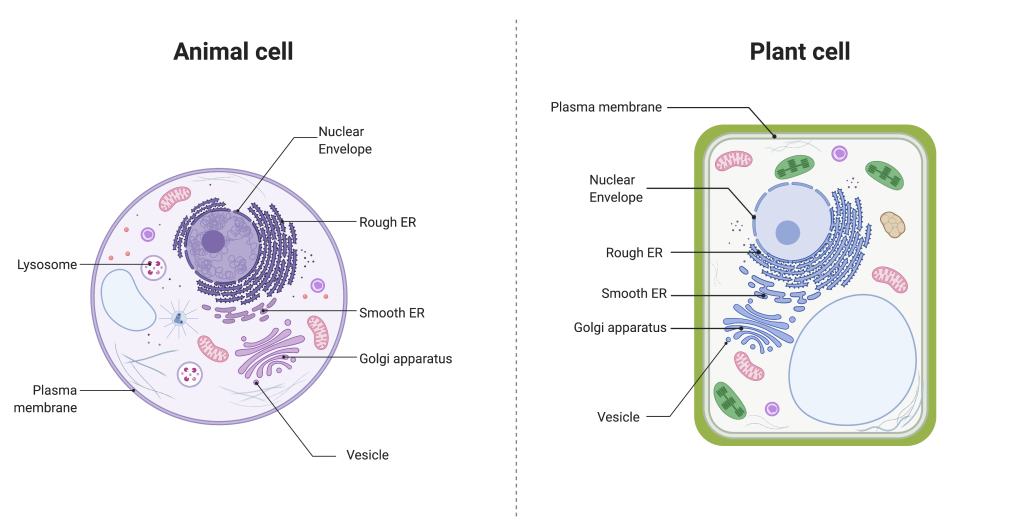
Labeled animal- and plant-cell diagrams highlighting the endomembrane system components (nuclear envelope, rough/smooth ER, Golgi, vesicles, plasma membrane; plus lysosomes in animals and a large vacuole in plants). This image helps you visually map where the trafficking network sits inside a eukaryotic cell and which organelles are emphasized in AP Biology. Source
Understanding how these organelles connect explains secretion, membrane renewal, and internal digestion while maintaining distinct chemical environments inside one cell.
Core Idea: One Connected Trafficking Network
The endomembrane system is a set of membrane-bound structures that work together through direct membrane continuity and by exchanging membrane segments in vesicles.
Endomembrane system: A coordinated group of membranes in eukaryotic cells that modifies, packages, and transports proteins, lipids, and polysaccharides via connected membranes and vesicle trafficking.
Although each organelle has specialised conditions (pH, enzymes, membrane proteins), the system functions as a dynamic flow of membranes and cargo.
Components You Must Recognise
Organelles included in the AP description
Endoplasmic reticulum (ER) (rough and smooth regions)
Golgi apparatus
Lysosomes
Vacuoles
Transport vesicles
Nuclear envelope
Plasma membrane
What “connected” means
Nuclear envelope ↔ ER: the outer nuclear membrane is continuous with the ER, allowing a physical pathway for membrane and newly made proteins.
ER ↔ Golgi ↔ other destinations: most exchange occurs by vesicles that bud and fuse, transferring both cargo and membrane.
What Gets Moved and Why It Matters
The system coordinates three major macromolecule classes:
Proteins (especially secreted proteins, lysosomal enzymes, and membrane proteins)
Lipids (membrane phospholipids, cholesterol-related components, signalling lipids)
Polysaccharides (often as parts of glycoproteins and glycolipids used for recognition and protection)
Key outcomes include:
Modification: chemical changes that affect function and destination (for example, adding carbohydrate groups to form glycoproteins).
Packaging: concentrating cargo into vesicles and sorting it to the correct location.
Transport: delivery to internal compartments, insertion into membranes, or secretion outside the cell.
Vesicle Trafficking: The Common Mechanism
Vesicles are the primary “shipping containers” of the endomembrane system.
Vesicle: A small membrane-bound sac that transports substances within a cell by budding from one membrane and fusing with another.
Vesicle-based transport is specific and regulated:
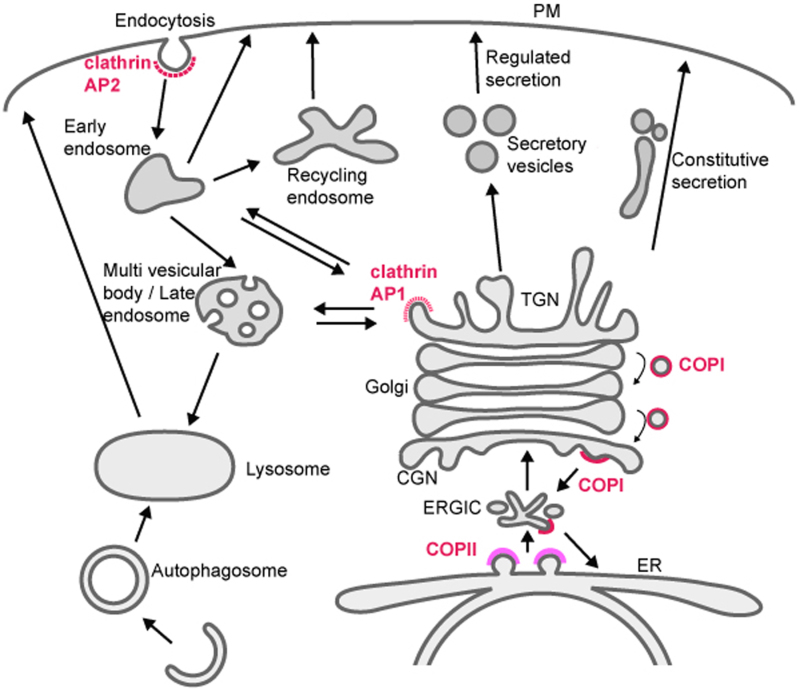
Diagram of membrane trafficking pathways showing how cargo moves by vesicle budding and fusion among endomembrane compartments (including secretory and endocytic routes). It reinforces that trafficking is directional and selective, and that specific coat proteins help shape vesicles for different transport steps. Source
Budding selects cargo (often via receptor proteins) and forms a vesicle with a particular membrane composition.
Targeting relies on recognition between vesicle and destination membranes (surface proteins help ensure correct delivery).
Fusion adds vesicle membrane to the target membrane and releases soluble cargo into the appropriate compartment.
Functional Flow (High-Level)
Typical pathway for many proteins and polysaccharide-containing products
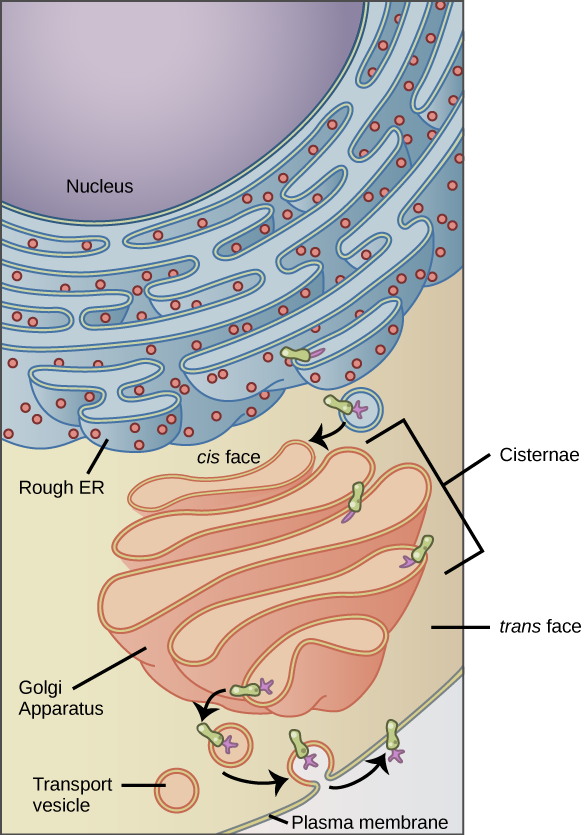
Stepwise pathway diagram showing a membrane/secretory protein moving from rough ER to the Golgi for processing and sorting, then leaving in a vesicle to fuse with the plasma membrane. It highlights how cargo modifications (such as added carbohydrate groups) are coupled to vesicle-mediated transport and membrane insertion. Source
Synthesis/entry into the endomembrane pathway at the ER
Modification and sorting through the Golgi
Delivery to:
Plasma membrane (membrane insertion or secretion)
Lysosomes/vacuoles (digestive or storage compartments)
Other vesicles for specialised cellular locations
Membrane recycling and homeostasis
Because vesicles move membrane as well as cargo, cells must balance:
Membrane added to the plasma membrane during secretion
Membrane retrieved by internalisation routes (conceptually maintaining surface area and composition)
This coordinated flow preserves distinct internal environments while enabling rapid responses to changing cellular demands.
Practice Questions
State two organelles that are part of the endomembrane system and give one shared function of the system. (2 marks)
Any two correct organelles (ER, Golgi, lysosome, vacuole, vesicle, nuclear envelope, plasma membrane) (1)
Coordinates modifying/packaging/transporting proteins, lipids, and/or polysaccharides (1)
Describe how vesicles allow the endomembrane system to coordinate the movement and processing of macromolecules. (5 marks)
Vesicles bud from a donor membrane and fuse with a target membrane (1)
Transport both cargo and membrane components between organelles (1)
Cargo is sorted/packaged for correct destinations (1)
Macromolecules are modified as they move through the system (e.g., proteins and polysaccharides) (1)
Coordination maintains distinct compartment conditions while enabling secretion or delivery to lysosomes/vacuoles/plasma membrane (1)
FAQ
Vesicles and target membranes carry complementary recognition proteins.
“Docking” steps increase specificity before fusion
Incorrect matches are less likely to proceed to stable fusion
No. Many proteins remain in the cytosol or are targeted to non-endomembrane organelles.
Proteins that enter the endomembrane pathway are typically destined for secretion, membranes, or internal compartments such as lysosomes/vacuoles.
Secretion adds vesicle membrane to the plasma membrane. Cells counterbalance this by retrieving membrane through internalisation and recycling pathways, stabilising surface area and maintaining membrane composition.
Many polysaccharides are attached to proteins or lipids during processing, producing glycoproteins and glycolipids. These are important for cell recognition, protection, and interactions with the extracellular environment.
Cells regulate transport selectivity and maintain distinct enzyme sets and ion conditions in each compartment. Vesicle cargo selection and controlled fusion help preserve compartment identity despite continual trafficking.
