

AP Syllabus focus:
‘Mitochondria have double membranes with highly folded inner membranes, creating compartments that maximize efficiency of aerobic respiration and ATP production.’
Mitochondria are central to energy conversion in eukaryotic cells, coupling the oxidation of food molecules to ATP synthesis. Their membrane architecture creates specialised compartments that make aerobic respiration efficient and highly regulatable.
Mitochondrial structure supports ATP production
Double membrane and compartments
Mitochondria have an outer membrane and an inner membrane, forming distinct spaces that enable concentration gradients and spatial separation of reactions.
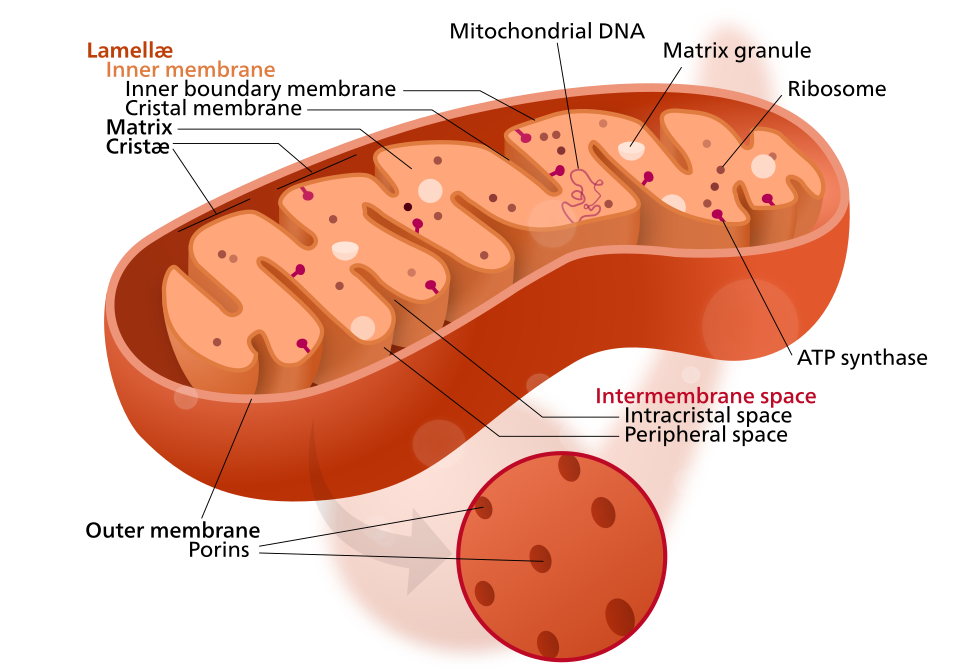
Labeled cross-sectional diagram of a mitochondrion highlighting the double membrane, intermembrane space, matrix, and cristae. Use it to visually connect how cristae increase inner-membrane surface area for electron transport chain proteins and ATP synthase, while the compartments support a proton gradient. Source
Mitochondrion: A double-membrane organelle where aerobic respiration transfers energy from electrons to generate ATP.
Key compartments and their roles:
Intermembrane space: region between membranes where H⁺ can accumulate.
Matrix: internal fluid containing enzymes for key steps of respiration and mitochondrial DNA/ribosomes.
Inner membrane: selectively permeable membrane containing proteins for electron transport and ATP synthesis.
Cristae: folds of the inner membrane that increase surface area for membrane-bound reactions.
Cristae: Infoldings of the inner mitochondrial membrane that increase surface area, allowing more electron transport chain complexes and ATP synthase to operate simultaneously.
Why folds and compartments matter (the syllabus emphasis)
The highly folded inner membrane and separated compartments:
increase available membrane area for protein complexes that drive ATP production
allow a steep H⁺ gradient to form between the matrix and intermembrane space
localise enzymes and substrates to reduce diffusion distance and improve reaction efficiency
Aerobic respiration inside mitochondria (overview)
Major stages (where they occur)
Within mitochondria, the energy in electrons is captured in a controlled, stepwise way:
Pyruvate oxidation (matrix): pyruvate is converted to acetyl-CoA; high-energy electrons are transferred to carriers.
Citric acid cycle (matrix): acetyl-CoA is oxidised; more electrons are loaded onto carriers, and CO₂ is released.
Oxidative phosphorylation (inner membrane): electrons power H⁺ pumping and ATP synthesis.
These stages are coordinated so that electron carriers are continually recycled, keeping respiration running when oxygen is available.
Oxidative phosphorylation: main ATP source
Electron transport chain and oxygen
The electron transport chain (ETC) consists of membrane protein complexes that transfer electrons through a series of redox reactions. As electrons move through the ETC:
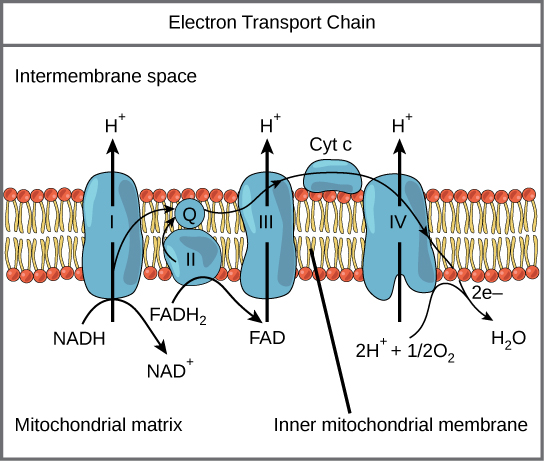
Diagram of the mitochondrial electron transport chain in the inner membrane, showing electron flow through complexes I–IV and the associated pumping of H⁺ into the intermembrane space. This visual reinforces why oxygen is required as the terminal electron acceptor and how electron transfer energy is converted into a proton gradient. Source
energy released is used to pump H⁺ from the matrix into the intermembrane space
O₂ acts as the final electron acceptor, combining with electrons and H⁺ to form water
without oxygen, electron flow stalls and the H⁺ gradient cannot be maintained
Electron transport chain (ETC): A series of inner-membrane protein complexes that transfer electrons and use released energy to pump H⁺, establishing a gradient.
Chemiosmosis and ATP synthase
The H⁺ gradient across the inner membrane stores potential energy. H⁺ then moves back into the matrix through ATP synthase, a membrane enzyme that couples ion flow to ATP formation.
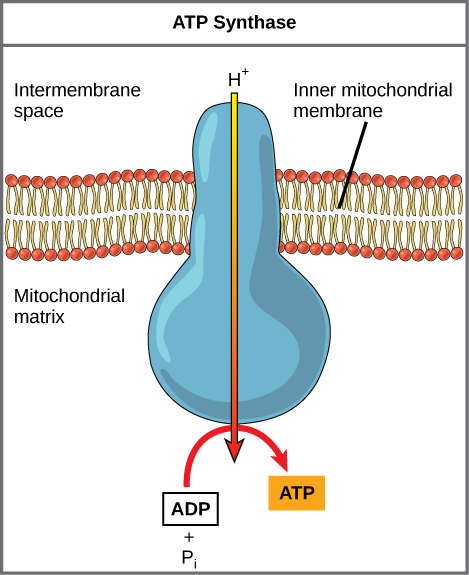
Simplified schematic of ATP synthase in the inner mitochondrial membrane with H⁺ movement down the electrochemical gradient into the matrix. The figure emphasizes coupling: proton flow through the enzyme drives conformational/rotational changes that catalyze ATP formation from ADP + Pᵢ. Source
Chemiosmosis: The use of an H⁺ gradient across a membrane to drive ATP synthesis via ATP synthase.
ATP synthase: An inner-membrane enzyme that uses the energy of H⁺ diffusion to phosphorylate ADP into ATP.
This mechanism explains how mitochondrial compartmentalisation directly maximises ATP output: the inner membrane’s low H⁺ permeability helps preserve the gradient, and cristae provide abundant sites for ATP synthase.
Factors that affect mitochondrial ATP production
Inner membrane integrity: leaks reduce the H⁺ gradient and decrease ATP synthesis.
Availability of O₂: limits electron acceptance at the end of the ETC.
ADP supply: ATP synthase requires ADP; high ATP/low ADP slows respiration (cellular demand control).
Surface area of cristae: more cristae generally supports higher maximal ATP production in energy-demanding cells.
Practice Questions
Explain how the inner mitochondrial membrane contributes to ATP production. (2 marks)
Inner membrane contains ETC and/or ATP synthase proteins (1)
Folding into cristae increases surface area, allowing more ATP production and/or more sites for oxidative phosphorylation (1)
Describe how mitochondrial compartments and membranes enable oxidative phosphorylation to produce ATP in aerobic conditions. (5 marks)
ETC located on the inner mitochondrial membrane transfers electrons through carriers (1)
Energy released pumps H⁺ from matrix to intermembrane space (1)
This creates an electrochemical (proton) gradient across the inner membrane (1)
H⁺ diffuses back into the matrix through ATP synthase (1)
ATP synthase uses this energy to convert ADP + Pi into ATP; oxygen is the final electron acceptor forming water (1)
FAQ
Uncouplers increase inner-membrane H⁺ permeability or shuttle H⁺ across the membrane. Electron transport may continue (and oxygen consumption can rise), but the gradient is dissipated, so ATP synthase makes less ATP.
Cristae density often correlates with sustained ATP demand. Cells with continuous, high energy use can maintain more inner-membrane surface area for ETC proteins and ATP synthase, increasing maximal oxidative capacity.
Key control is “acceptor control”: when ADP rises, ATP synthase activity increases, drawing down the H⁺ gradient and accelerating the ETC. When ATP is abundant and ADP is low, electron flow slows.
It is a stress-activated channel that can increase inner-membrane permeability. Prolonged opening collapses the H⁺ gradient, impairs ATP synthesis, and can contribute to cell injury pathways.
A small fraction of electrons can prematurely reduce oxygen, especially when the ETC is highly reduced. This forms ROS (e.g., superoxide), which cells counter using mitochondrial antioxidants and repair systems.

