

AP Syllabus focus:
‘The Golgi complex, a stack of flattened membrane sacs, folds and chemically modifies proteins, then packages them into vesicles for intracellular trafficking.’
The Golgi complex is a central processing and distribution center for many cell products. It receives materials from other internal membranes, modifies them into functional forms, and sorts them into vesicles headed to precise destinations.
Core structure of the Golgi complex
Golgi complex (Golgi apparatus): A polarized stack of flattened membrane sacs (cisternae) that modifies, sorts, and packages proteins (and some lipids) into transport vesicles.
Cisternae and polarity
The Golgi is typically described as a series of flattened sacs arranged in a stack.
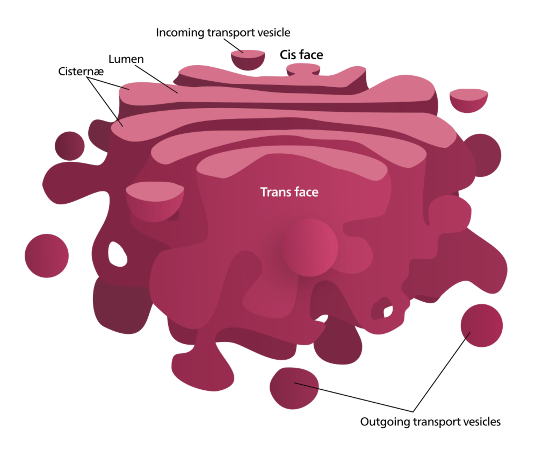
Textbook-style figure and explanation emphasizing the Golgi as a stack of flattened membranous sacs with distinct cis (receiving) and trans (releasing) faces. This supports the idea that proteins and lipids are modified as they move through the stack before being packaged into vesicles for specific destinations. Source
It is polarized, meaning different regions perform different tasks:
cis face: the “receiving” side, generally closest to incoming transport vesicles
trans face: the “shipping” side, where products are packaged for delivery
Small vesicles continually bud from and fuse with Golgi membranes, supporting high-volume intracellular trafficking.
What the Golgi does to proteins
Folding and quality control (functional emphasis)
The specification highlights that the Golgi folds and modifies proteins. In practice, many proteins arrive already folded, but the Golgi contributes to functional maturation by:
maintaining conditions that support proper protein conformation
enabling final processing steps that stabilise structure or activate function
sorting improperly processed cargo away from standard export routes (a key idea: only correctly processed products are efficiently shipped)
Chemical modification (major AP focus)
The Golgi performs chemical modifications that can change a protein’s stability, activity, and destination. Common categories include:
Glycosylation (addition or trimming of carbohydrate chains)
Glycosylation: Enzyme-directed addition and modification of carbohydrate groups on proteins, producing glycoproteins that can affect folding, recognition, and targeting.
A sentence-level way to think about this: the Golgi changes the “labels” and “finishing details” on proteins so they work correctly and reach the correct location.
Phosphorylation of specific residues or carbohydrate groups can contribute to sorting signals.
Proteolytic processing can activate proteins by cutting them into mature forms.
Sulfation of certain amino acids or sugars can alter interactions and stability.
Packaging and vesicle-based trafficking
Sorting: deciding where proteins go
A key Golgi role is sorting, which depends on molecular “address labels” on cargo:
Some proteins are destined for the plasma membrane (often embedded as membrane proteins).
Some are destined for secretion outside the cell.
Some are sent to other internal destinations via distinct vesicle routes.
Vesicle formation and targeting
The Golgi “ships” cargo by producing vesicles with selective contents.
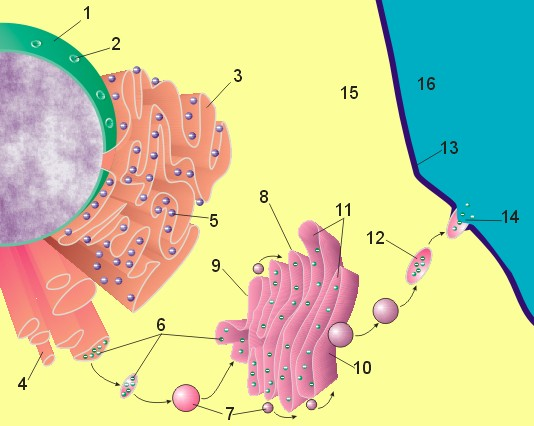
Secretory pathway diagram showing how transport vesicles move cargo from the endoplasmic reticulum to the Golgi apparatus (entering at the cis face and exiting at the trans face). It also depicts formation of secretory vesicles and fusion with the plasma membrane, connecting Golgi sorting/packaging to delivery and exocytosis. Source
Cargo selection: Golgi membranes concentrate specific proteins into budding regions.
Budding: a vesicle forms and pinches off, enclosing cargo inside its lumen or within its membrane.
Targeting and fusion: vesicles recognise the correct target membrane and fuse, delivering cargo for use or further transport.
Why stacking matters
The stacked arrangement supports stepwise processing:
Different cisternae contain different sets of enzymes.
As cargo progresses from cis to trans regions, it can undergo a predictable sequence of modifications.
This organisation increases efficiency and reduces random mixing of unfinished and finished products.
Practice Questions
Describe two features of the Golgi complex that enable it to modify and distribute proteins within a eukaryotic cell. (2 marks)
Identifies Golgi as a stack of flattened membrane sacs/cisternae (1)
Explains packaging into vesicles for transport/intracellular trafficking OR describes cis-to-trans polarity for receiving/shipping (1)
Explain how the Golgi complex modifies a newly synthesised protein and ensures it is delivered to an appropriate destination. (5 marks)
States that the Golgi chemically modifies proteins (e.g. glycosylation/phosphorylation/proteolytic processing) (1)
Links modification to changes in protein function/stability/recognition (1)
Describes sorting based on targeting signals or “address labels” on the protein (1)
Describes packaging into vesicles that bud from the Golgi (1)
Describes vesicle targeting and fusion with the correct membrane to deliver cargo (1)
FAQ
COPII typically mediates transport towards the Golgi, COPI commonly supports retrograde trafficking within/away from the Golgi, and clathrin is often used for selective sorting from the trans-Golgi.
These coats help curve membranes and concentrate specific cargo.
It proposes that cisternae themselves mature from cis to trans identity while cargo remains within them.
This helps explain how very large cargo can pass through the Golgi without needing to fit into small transport vesicles.
Some soluble enzymes receive an M6P tag on their carbohydrate chains.
Golgi receptors bind M6P-tagged proteins, package them into specific vesicles, and release them in more acidic compartments.
Different Golgi regions maintain distinct pH conditions.
These pH differences influence enzyme activity and can regulate when cargo binds or releases from sorting receptors.
Brefeldin A disrupts key steps in vesicle formation and can cause Golgi membranes to redistribute.
Observing these changes helps identify transport pathways and the directionality of trafficking steps.

