

AP Syllabus focus:
‘Endoplasmic reticulum provides mechanical support, maintains cell shape, and forms rough and smooth regions that synthesize proteins, detoxify cells, and produce lipids.’
The endoplasmic reticulum (ER) is a dynamic membrane network central to cell architecture and biosynthesis. AP Biology emphasizes how its structure supports cell shape and enables specialized functions in distinct rough and smooth regions.
ER structure: an internal membrane network
Endoplasmic reticulum (ER): An interconnected system of membranous tubules and flattened sacs (cisternae) forming a continuous lumen used for synthesis, processing, and transport of cellular products.
The ER membrane encloses the ER lumen, creating a compartment that separates certain reactions from the cytosol. The ER is often extensive, and its shape shifts as cellular demands change.
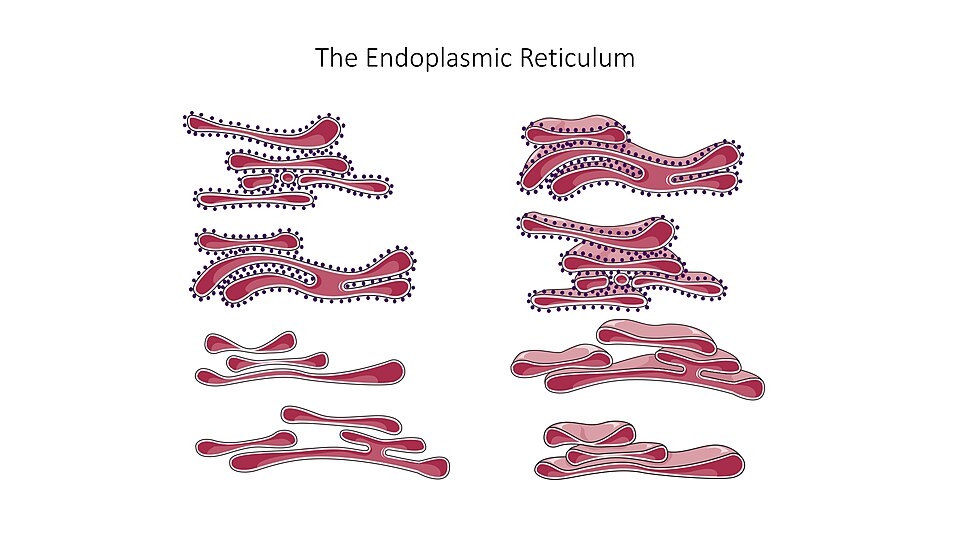
This diagram identifies the endoplasmic reticulum as a continuous membrane system with distinct rough and smooth regions. It highlights key structural features (membrane sheets/tubules and their internal space) and reinforces how ER organization supports different biosynthetic roles. Source
Mechanical support and maintaining cell shape
The ER contributes to the cell’s internal architecture by acting as a widespread membrane scaffold.
The ER’s physical presence helps support the cytoplasm, resisting deformation.
Its interactions with the cytoskeleton help maintain cell shape, especially in cells with high internal organisation (e.g., secretory cells).
Rough ER (RER): protein synthesis and early processing
The rough ER is defined by ribosomes attached to its cytosolic surface, giving it a “rough” appearance.
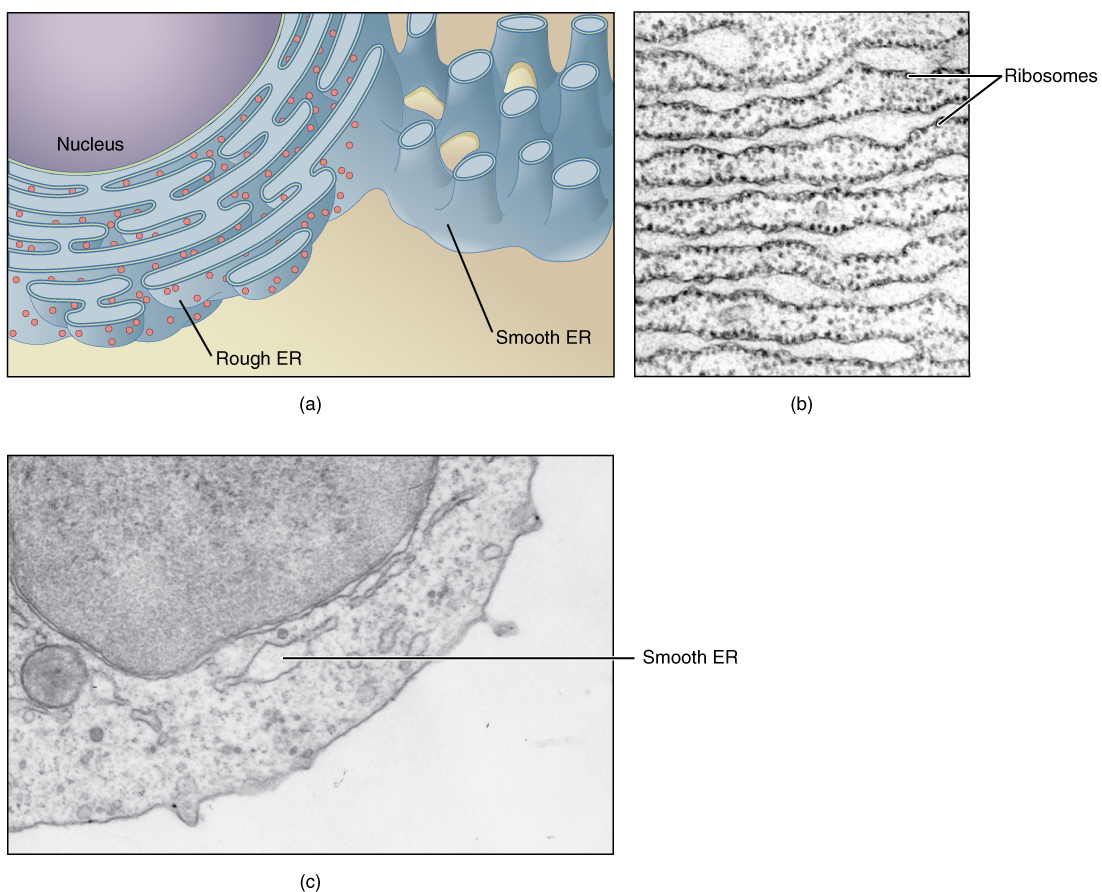
This figure pairs a labeled overview of ER organization with electron micrographs showing how rough ER appears “studded” with ribosomes while smooth ER lacks ribosomes and appears more tubular. The micrographs connect structure to function by visually linking RER to protein production and SER to lipid synthesis and detox-related metabolism. Source
Rough ER (RER): ER regions with bound ribosomes that synthesise proteins destined for secretion, membranes, or specific internal compartments, with initial folding and modification occurring in the ER lumen.
Protein production on the RER supports the specification focus on ER regions that synthesise proteins.
Ribosomes translate mRNA; many proteins enter the ER lumen during synthesis.
The RER provides an environment for protein folding and early chemical changes (commonly including carbohydrate additions).
Producing proteins within/at the RER helps organise trafficking by concentrating newly made proteins near sites where they can be packaged for transport.
Smooth ER (SER): lipid production and detoxification
The smooth ER lacks bound ribosomes and is typically more tubular. AP Biology highlights two major SER roles: it produces lipids and detoxifies cells.
Lipid synthesis
The SER synthesises lipids needed for cellular membranes and signalling.
Produces phospholipids and other membrane components that expand or repair internal membranes.
Supports cells that require large membrane production by increasing SER abundance.
Detoxification
The SER contains enzymes that chemically modify hydrophobic molecules, often making them easier to eliminate.
Detoxification reactions can reduce the toxicity of drugs and metabolic by-products.
These reactions are especially important in cells frequently exposed to toxins.
Rough vs smooth ER: functional regions of one system
Although described as “rough” and “smooth,” these are regions of the same ER network.
RER specialises in protein synthesis and early processing.
SER specialises in lipid production and detoxification.
Together, these regions help the ER meet the syllabus emphasis on both mechanical support/shape and biosynthetic specialisation.
Practice Questions
State two roles of the endoplasmic reticulum described in the specification. (2 marks)
Any two: mechanical support (1), maintains cell shape (1), protein synthesis in rough ER (1), detoxification in smooth ER (1), lipid production in smooth ER (1).
Explain how rough and smooth regions of the ER are structurally adapted to their different functions. (5 marks)
Rough ER has ribosomes attached (1)
Ribosomes enable protein synthesis (1)
Rough ER has a lumen/compartment supporting early folding/processing of proteins (1)
Smooth ER lacks ribosomes and is adapted for enzyme-based pathways (1)
Smooth ER contains enzymes for lipid synthesis or detoxification (1)
FAQ
Secretory cells upregulate rough ER to increase throughput of proteins destined for export or membranes, increasing cisternae surface area and ribosome-binding capacity.
Many have an N-terminal signal sequence recognised by targeting factors that bring the ribosome to the ER membrane, coupling translation with entry into the ER.
Cells can activate ER stress responses that slow translation and increase chaperone production. Persisting stress can trigger programmed cell death pathways.
Specialised smooth ER membranes can sequester and release $Ca^{2+}$, enabling rapid changes in cytosolic calcium used in processes like contraction and signalling.
Microsomes are vesicle-like fragments formed from ER membranes during cell disruption; they let scientists study ER enzymes (e.g., detoxification pathways) in isolation.

