

AP Syllabus focus:
‘Earth system processes occur over different time scales; changes may be periodic, episodic, or random in timing.’
Ecosystems are shaped by disturbances that occur on different schedules and over different durations. Recognising whether a change is repeating, occasional, or unpredictable helps explain patterns in biodiversity, productivity, and recovery potential.
Understanding disruptions across time scales
Time scales in Earth system processes
Earth system processes (atmosphere, hydrosphere, geosphere, biosphere) operate over multiple time scales, from hours to millennia.
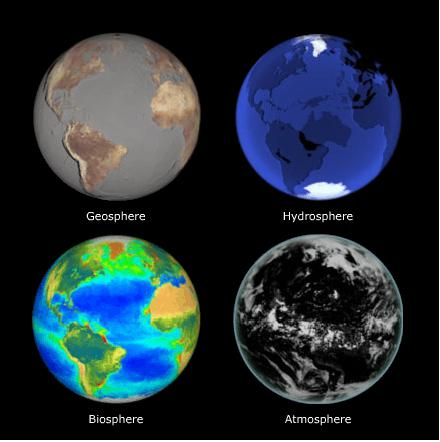
Diagram of Earth’s major spheres (geosphere, hydrosphere, biosphere, and atmosphere) shown as interacting subsystems of a single Earth system. Use it to anchor the idea that a disturbance often begins in one sphere (e.g., geosphere) but can cascade into others (e.g., atmosphere and biosphere) across different time scales. Source
The same type of disruption can have different ecological effects depending on its frequency, duration, and predictability.
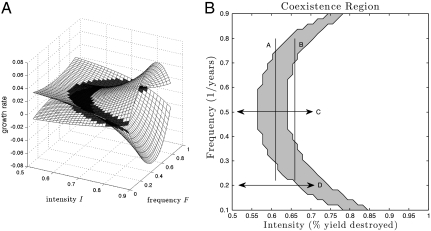
Scientific figure showing a coexistence region in the disturbance frequency–intensity plane, illustrating how different combinations of how often a disturbance happens and how severe it is can change biodiversity outcomes. The plotted guide lines emphasize that changing intensity can flip the shape of a frequency–diversity relationship (e.g., from hump-shaped to U-shaped), underscoring why timing and magnitude must be considered together. Source
Time scale: The typical length of time over which a process or disruption occurs or repeats (e.g., days, seasons, decades).
In AP Environmental Science, it is especially useful to classify timing as periodic, episodic, or random, because organisms and ecosystems respond differently to each pattern.
Periodic: Occurring at regular, predictable intervals (often driven by cycles such as seasons).
Predictability matters because it affects whether species can evolve life histories or behaviours that “fit” a disturbance pattern.
Episodic: Occurring irregularly but as distinct events separated by relatively stable periods.
Even when a disturbance is episodic, its impacts can accumulate if events cluster closer together than an ecosystem can recover.
Random: Occurring unpredictably in timing, with no reliable cycle or recurrence interval.
Periodic disruptions (predictable timing)
Periodic disruptions are tied to regular environmental cycles. Because their timing is predictable, ecosystems often show seasonal rhythms in growth, reproduction, and resource use.
Key features:
High predictability: organisms can anticipate conditions via cues (day length, temperature trends).
Repeated exposure: communities may develop stable adaptations and tolerance ranges.
Cyclical resource availability: productivity and food webs often “pulse” on a schedule.
Ecological implications:
Disturbance effects may be less catastrophic if species are adapted to the cycle.
Population sizes may fluctuate regularly without indicating long-term decline.
Management can plan around expected low/high-risk periods (e.g., seasonal low water).
Episodic disruptions (event-based timing)
Episodic disruptions occur as discrete events with variable return times. Examples include severe storms, multi-year droughts, or unusually intense wildfire seasons (timing varies even if conditions that enable them are understood).
Key features:
Irregular intervals: not strictly predictable, but often influenced by broader climate patterns.
Event magnitude varies: small events may have minor effects; rare extreme events can reorganise communities.
Recovery windows matter: time between events can determine whether soils, vegetation, and populations rebound.
Ecological implications:
If events become more frequent, ecosystems can shift to a new “state” because recovery is incomplete.
Species with slow reproduction or specialised habitat needs may be disproportionately affected.
Legacies such as altered soil structure, seed banks, or nutrient pools can persist beyond the event itself.
Random disruptions (unpredictable timing)
Random disruptions have no reliable schedule, so organisms cannot time life cycles around them. Some random events are inherently unpredictable (e.g., certain geologic events), while others appear random at ecological time scales even if physical drivers exist.
Key features:
Low predictability: risk is difficult to forecast precisely.
Potentially high severity: some random events can cause abrupt habitat changes.
Preparedness relies on resilience: diversity, redundancy in food webs, and broad tolerance ranges can reduce long-term damage.
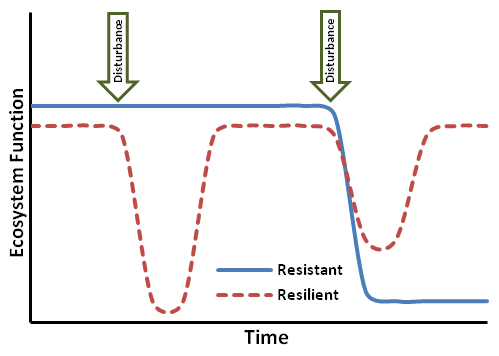
Conceptual diagram contrasting resistant vs resilient ecosystem responses, where resistance shows smaller functional change during disturbance and resilience shows faster recovery after impact. This supports interpreting disturbances as short-term shocks versus longer-term pressures by focusing on the shape of the recovery trajectory over time. Source
Ecological implications:
Random timing can increase extinction risk for small or isolated populations because “bad luck” events may strike during vulnerable life stages.
Systems may prioritise traits that buffer uncertainty (generalist diets, dispersal ability), but outcomes depend on local conditions.
Linking timing to ecological responses
Disturbance timing influences whether change is experienced as a short-term shock or a long-term pressure:
Short time scales (hours–years): impacts often involve immediate mortality, reduced growth, displacement, and temporary resource scarcity.
Long time scales (decades+): impacts more often involve gradual community turnover, shifting dominance patterns, and persistent changes to ecosystem functioning.
Practical interpretation:
Periodic timing supports planning and adaptation.
Episodic timing highlights the importance of recovery time and event clustering.
Random timing underscores uncertainty and the value of maintaining ecosystem resilience (e.g., diverse functional roles).
Practice Questions
State two ways that periodic disruptions differ from random disruptions in their timing and ecological predictability. (2 marks)
Any two valid contrasts, 1 mark each:
Periodic occur at regular intervals; random have unpredictable timing.
Periodic are predictable and can be anticipated; random cannot be reliably anticipated.
Periodic allow species to synchronise behaviours/life cycles; random do not.
Explain how the timing category of a disruption (periodic, episodic, or random) can influence ecosystem impacts and recovery. Include at least one point about frequency or recovery time. (6 marks)
Mark scheme (any six points, 1 mark each):
Periodic disruptions occur on regular cycles and are relatively predictable.
Predictability can allow behavioural or life-history alignment, reducing long-term impact.
Episodic disruptions occur as discrete events separated by stable periods.
Recovery depends on the time between episodic events; short intervals can prevent full recovery.
Episodic event magnitude can vary widely, influencing severity and legacy effects.
Random disruptions have unpredictable timing, increasing uncertainty for populations.
Random events can cause severe impacts if they coincide with vulnerable life stages.
Across categories, higher frequency relative to recovery time increases cumulative impact.
FAQ
They use long-term records to test for patterns.
If events correlate with identifiable drivers (e.g., particular climate oscillations) but still occur irregularly, they’re often treated as episodic.
If timing shows no detectable structure at the relevant time scale, it may be treated as random.
A return interval is the average time between events of a given type/magnitude.
Rare events have limited historical observations, so estimates are uncertain and sensitive to the length/quality of records and how “event magnitude” is defined.
The “effective” time scale depends on recovery rates.
Fast-growing systems may recover in months, making an event short-term, while slow-growing systems may require decades, making the same event a long-term disruption in practice.
Repeated events can exhaust recovery mechanisms:
depleted seed banks or breeding populations
reduced soil stability and infiltration
cumulative nutrient losses
This can push the system past thresholds where normal recovery pathways fail.
Short time scales require high-frequency sampling (e.g., weekly) to capture rapid swings, while long time scales require consistent methods over years/decades to detect trends, baseline shifts, and changes in event frequency distributions.
