

AP Syllabus focus:
‘Earth’s climate has changed over geological time for many reasons, creating long-term shifts in ecosystem conditions.’
Earth’s climate has never been static. Across millions of years, natural forces have warmed and cooled the planet, shifting rainfall, seasonality, and extreme events, which in turn reshapes where ecosystems can persist.
What “geological time” climate change means
Climate variation over geological time spans thousands to billions of years and includes repeated warm (“greenhouse”) and cool (“icehouse”) states. These changes matter in APES because they set the background conditions under which species evolve, migrate, or go extinct, and they reorganise biomes and ecosystem processes.
How scientists know past climates changed
Because direct thermometer records are recent, scientists reconstruct paleoclimate using indirect evidence.
Paleoclimate proxy: a natural record (for example, ice, sediments, fossils) that preserves information used to infer past climate conditions.
Common proxy sources include:
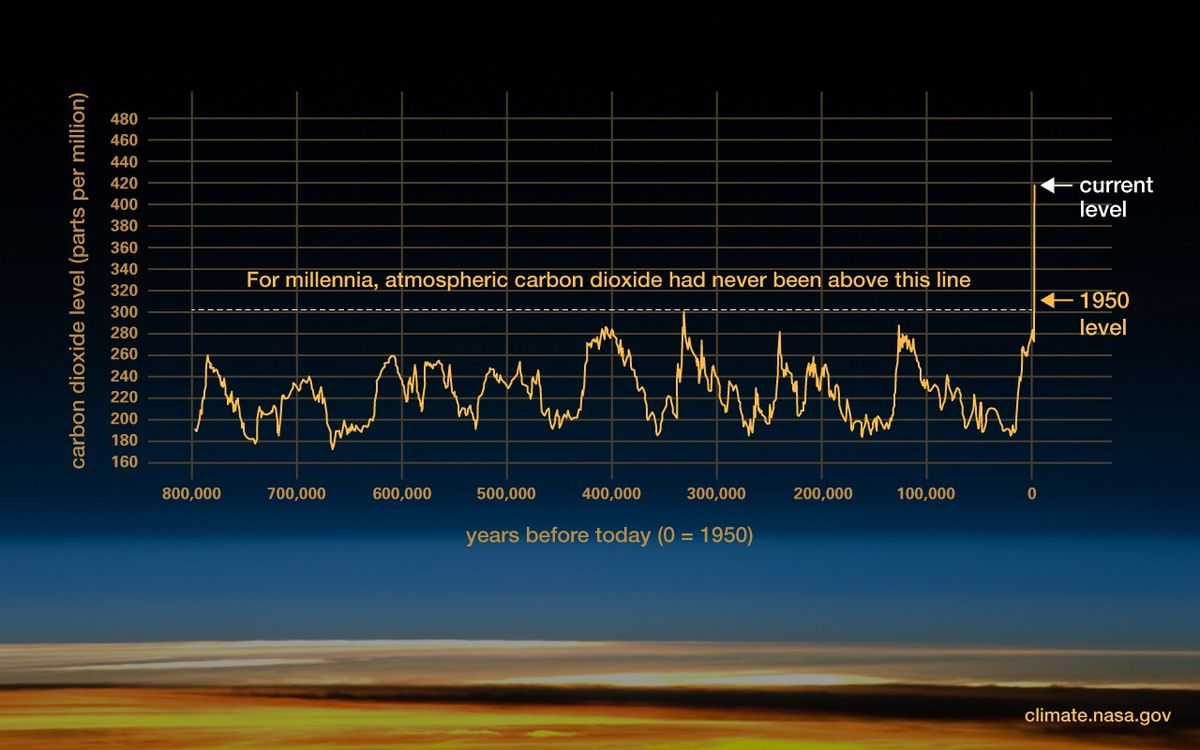
This NASA graph compiles ice-core CO₂ measurements across multiple glacial–interglacial cycles and shows how modern atmospheric CO₂ rises far above the natural range observed in the ice-core record. It illustrates why trapped air bubbles in ice cores are powerful paleoclimate proxies for reconstructing past greenhouse-gas concentrations. Source
Ice cores: trap ancient air (past CO₂ and CH₄) and preserve isotope ratios linked to temperature.
Ocean/lake sediments: layers record past productivity, dust, and chemistry; microfossils indicate water temperature.
Tree rings (shorter geological window): ring width/density reflect moisture and growing-season temperatures.
Fossil pollen: shows past vegetation types, indicating temperature and precipitation patterns.
Interpreting proxies focuses on patterns (timing, magnitude, direction of change) rather than a single “exact” temperature.
Major drivers of climate change over geological time
Multiple mechanisms can act together; the dominant driver often depends on the time scale.
Plate tectonics and continental configuration
Over tens to hundreds of millions of years, plate tectonics alters climate by:
Moving continents across latitudes, changing incoming solar energy and seasonality.
Building mountain ranges that redirect winds and precipitation.
Reconfiguring ocean gateways, reshaping currents that transport heat.
These shifts can gradually transform large regions (for example, wetter to drier) and change which ecosystems can function there.
Long-term carbon cycle changes
On long time scales, climate is strongly influenced by atmospheric greenhouse gases, especially CO₂, through Earth’s carbon reservoirs (atmosphere, oceans, rocks, biosphere).
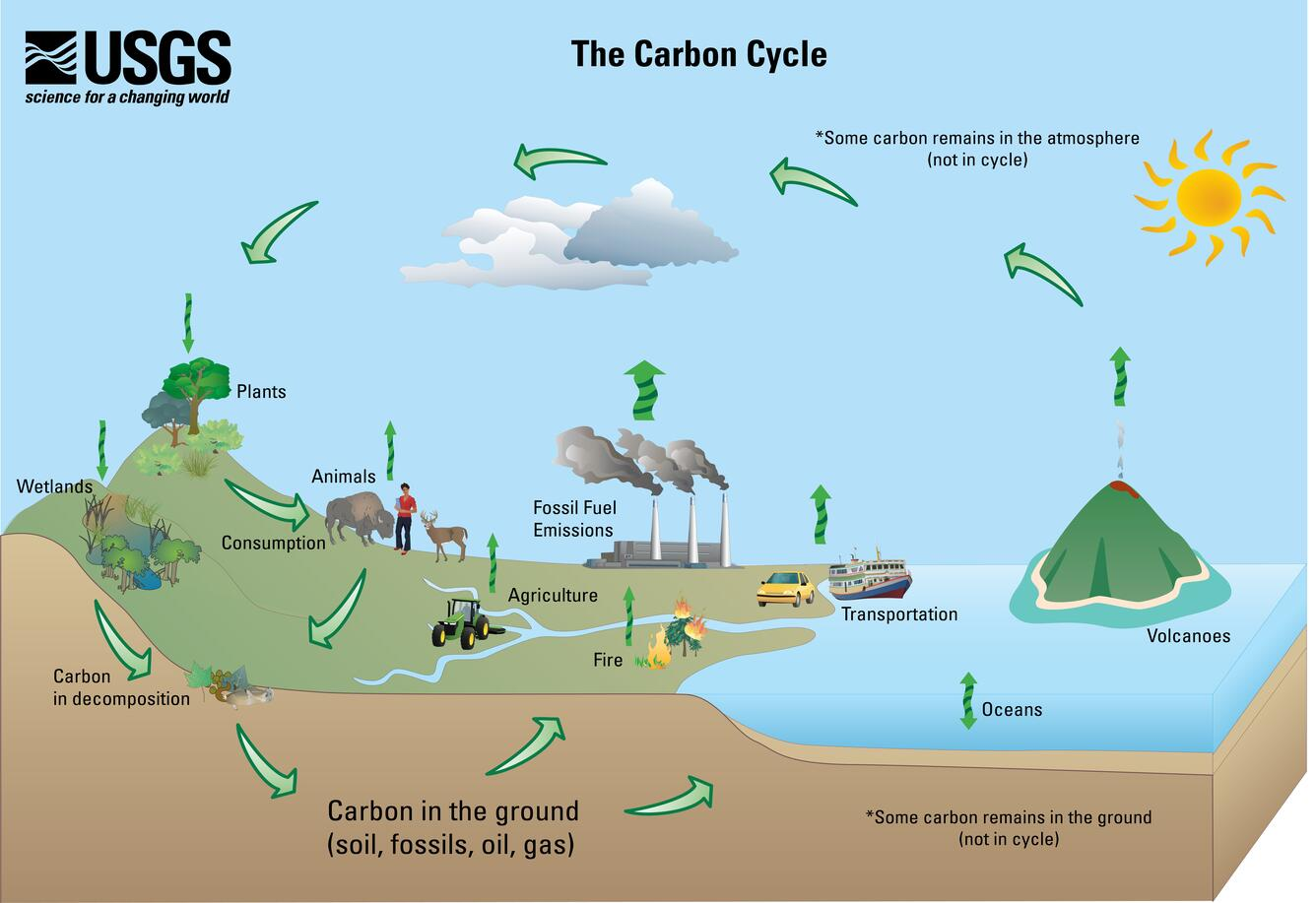
This USGS diagram summarizes the carbon cycle by tracing carbon movement among the atmosphere, living organisms, soils, oceans, and rocks. It highlights how carbon can be rapidly exchanged (e.g., photosynthesis and respiration) or stored for long periods in major sinks, linking carbon-cycle dynamics to long-term greenhouse-gas forcing. Source
Greenhouse gas: an atmospheric gas that absorbs outgoing infrared radiation, helping warm the lower atmosphere (examples include CO₂, CH₄, and H₂O vapour).
Key natural processes include:
Volcanism and seafloor spreading: add CO₂ to the atmosphere over long periods.
Chemical weathering of silicate rocks: removes CO₂ (forming carbonates), a major long-term cooling influence.
Organic carbon burial: can lower atmospheric CO₂ when carbon is stored in sediments.
Orbital (Milankovitch) cycles
On ~10,000–100,000+ year time scales, small changes in Earth’s orbit redistribute sunlight, especially by season and latitude.
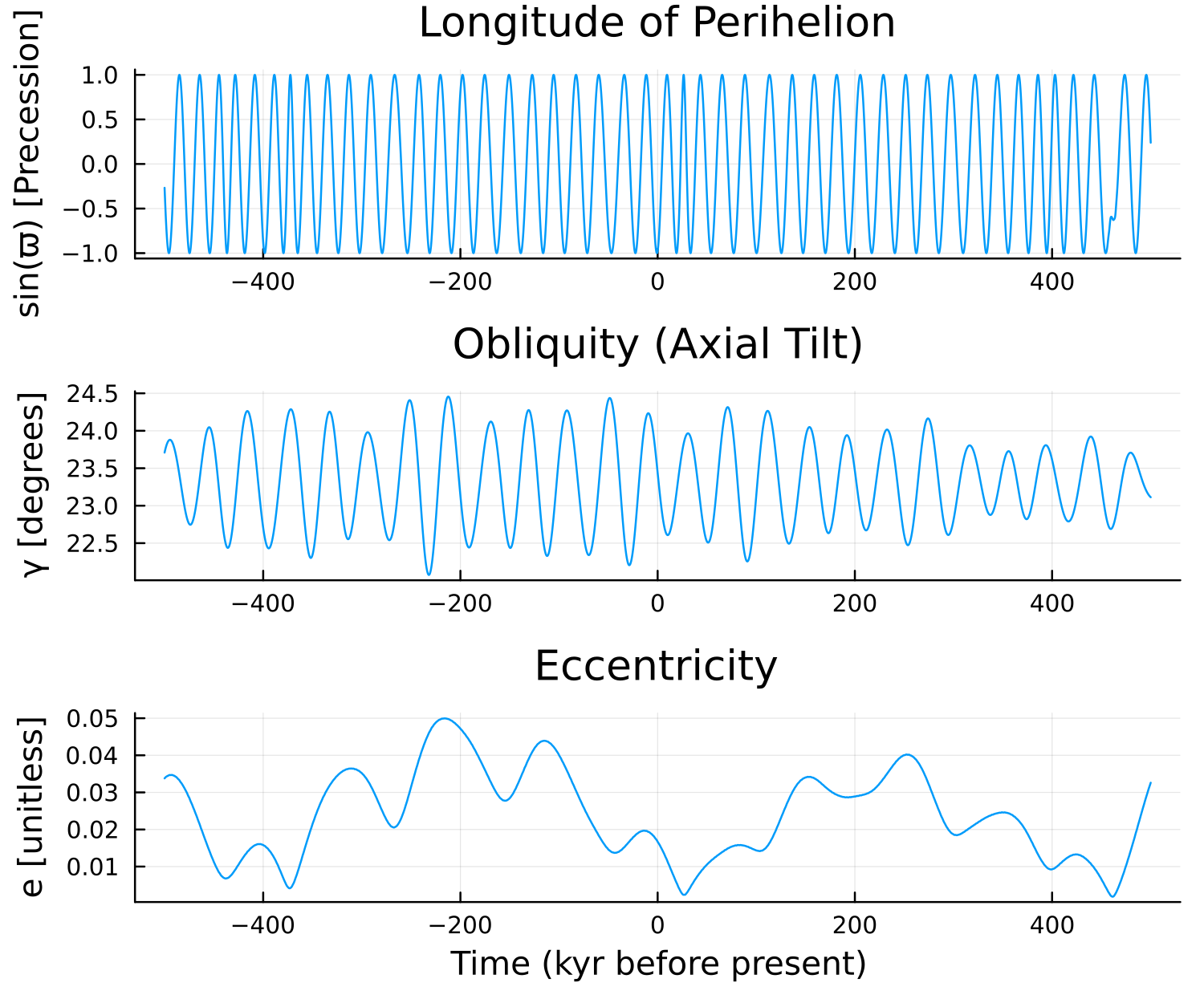
This three-panel plot shows how Earth’s orbital parameters vary through time: precession (seasonal timing), obliquity (axial tilt), and eccentricity (orbital shape). Together, these cyclical changes redistribute incoming solar energy by latitude and season, providing an external “pacemaker” that can help drive glacial–interglacial climate patterns. Source
Milankovitch cycles: predictable variations in Earth’s orbit and tilt that alter the distribution of solar energy and can contribute to glacial–interglacial cycles.
These cycles can amplify or moderate climate shifts by influencing ice cover and carbon feedbacks, even when the global average sunlight change is small.
Solar output and major impact events
Solar variability: small changes in solar energy can influence climate, especially when reinforced by feedbacks.
Large asteroid impacts can inject dust/aerosols, reducing sunlight and rapidly cooling climate for short periods relative to geological time.
Ecosystem effects: long-term shifts in conditions
The syllabus emphasis is that climate change over geological time happens for many reasons and creates long-term shifts in ecosystem conditions. Ecologically, this shows up as:
Biome redistribution: temperature and precipitation zones move, so forests, grasslands, and deserts expand/contract geographically.
Range shifts and isolation: populations track suitable climates or become separated, altering community composition.
Extinction and speciation pressure: rapid or extreme climate transitions can exceed tolerance ranges for some species, while new conditions can open niches for others.
Changes to disturbance regimes: altered drought frequency, storm patterns, and fire weather can reorganise ecosystems over long periods.
These changes are often uneven across regions, producing mosaics of expanding, shrinking, and newly forming habitats over time.
Practice Questions
State two natural mechanisms that can drive Earth’s climate change over geological time. (2 marks)
Any two correctly stated mechanisms (1 mark each), e.g. plate tectonics/continental drift; long-term CO₂ changes via volcanism or weathering; Milankovitch cycles; solar variability; asteroid impacts.
Explain how long-term changes in atmospheric CO₂ can alter climate over geological time and lead to long-term shifts in ecosystem conditions. (5 marks)
CO₂ is a greenhouse gas that affects Earth’s energy balance/temperature (1).
Volcanism (or seafloor spreading) can add CO₂ over long time periods (1).
Silicate weathering and carbonate formation can remove CO₂, promoting cooling (1).
Climate change alters temperature/precipitation patterns (1).
Ecosystem conditions shift (biome redistribution/range shifts/extinctions/community change) as species track or fail to track suitable climates (1).
FAQ
Temperature affects isotope fractionation during evaporation and ice formation.
Measured $\delta^{18}O$ in ice cores or marine carbonates can indicate relative warming or cooling when calibrated.
A short-lived geological warming event linked to rapid carbon release.
It’s studied for ecosystem turnover, ocean chemistry changes, and how the Earth system responds to carbon-cycle shocks.
A hypothesis that ice once covered much of Earth’s surface.
Evidence includes glacial deposits at low palaeolatitudes and distinctive “cap carbonates” suggesting abrupt deglaciation.
Uplift increases erosion and silicate weathering, which can draw down atmospheric CO₂.
It also reshapes atmospheric circulation, affecting regional rainfall patterns over long periods.
They may record different seasons, locations, or parts of the climate system (air vs ocean).
Dating uncertainties and local environmental effects can also shift the apparent timing or magnitude of change.
