

AP Syllabus focus:
‘Sea level has varied significantly over time due to changes in the amount of glacial ice stored on Earth.’
Sea level is not fixed: it rises and falls as water shifts between the ocean and land-based ice.
Understanding this glacial control helps explain past coastal changes and informs interpretation of long-term environmental records.
Core Idea: Glacial Ice as a Water Reservoir
When glacial ice sheets grow on land, they store freshwater that would otherwise be in the ocean, causing global mean sea level to fall. When ice melts, water returns to the ocean and sea level rises.
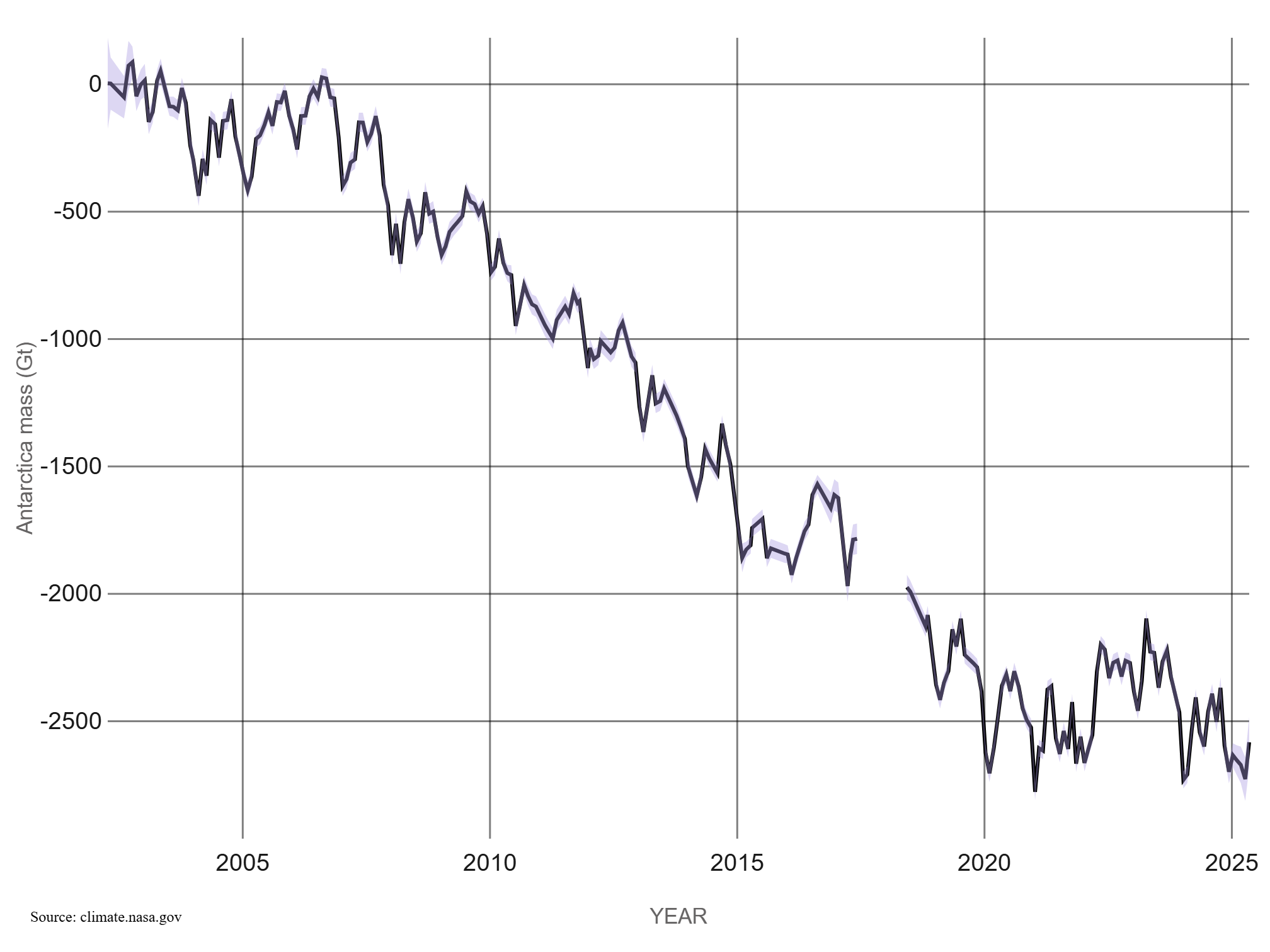
Satellite-gravity-based time series of Greenland and Antarctic ice-sheet mass change since 2002 (GRACE/GRACE-FO), showing sustained net ice loss. This provides direct observational evidence that land-based ice sheets function as a freshwater reservoir and that mass loss contributes to rising ocean volume and global mean sea level. Source
This connection is a major reason that sea level has changed repeatedly over Earth’s history.
Key Term: Global (Eustatic) Sea-Level Change
Eustatic sea-level change: a worldwide change in average sea level mainly driven by changes in ocean water volume, especially from growth or melting of land-based ice.
Eustatic change focuses on global ocean volume; local shorelines can still behave differently because land itself can move.
How Glacial Ice Changes Sea Level
Ice Growth (Sea-Level Fall)
Sea level tends to decrease when climate conditions favor ice accumulation:
Cooler summers reduce seasonal melting, letting snow persist and compact into ice.
Ice-albedo feedback strengthens cooling: expanding ice reflects more sunlight, promoting further ice growth.
More water becomes locked in continental ice sheets, reducing ocean volume.
Ice Melt (Sea-Level Rise)
Sea level tends to increase when warming increases melting or destabilises ice:
Higher air and ocean temperatures enhance surface melting and calving at glacier margins.
Meltwater flows to the ocean, increasing ocean water volume.
Rapid melting can produce comparatively fast rises in sea level on geological timescales.
Land Ice vs Sea Ice
For AP Environmental Science, it is crucial to distinguish ice types:
Land-based ice (glaciers, ice sheets) directly affects sea level when it melts because it adds water to the ocean.
Floating sea ice has a much smaller direct effect on sea level because it already displaces water while floating (its main importance is climate feedbacks, not ocean volume).
Time Patterns and Magnitude Over Earth History
Sea-level change linked to glacial ice is often cyclical over long periods, with repeated advances and retreats of ice sheets. Over many glacial–interglacial cycles, sea level has ranged from much lower than today (when large ice sheets stored water on land) to higher (when ice was reduced).
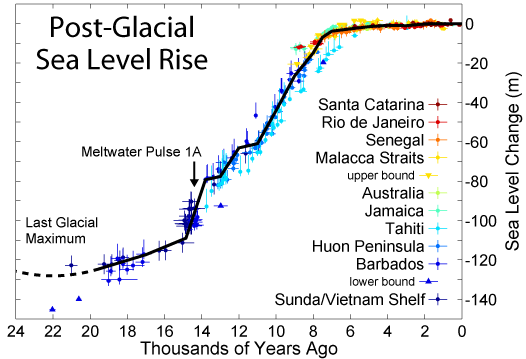
Global sea level through the last deglaciation (roughly the past 24,000 years), showing rapid post–ice age rise from a lowstand near the Last Glacial Maximum toward modern levels. The curve highlights that eustatic sea level can change by over 100 m as land-based ice sheets grow and melt, with especially fast rises during major meltwater-release intervals. Source
Glacial Maximum as a Reference Point
Glacial maximum: a period when continental ice sheets reach their greatest extent, typically associated with lower global sea level due to large volumes of water stored as land ice.
Between ice-growth and ice-melt phases, coastlines can be exposed or flooded, reshaping shallow marine environments such as continental shelves.
Evidence Scientists Use to Infer Past Sea Level (Glacial Link)
Because direct measurements do not exist for most of Earth’s past, scientists infer sea level using multiple lines of evidence tied to ice volume:
Oxygen isotope ratios in marine microfossils as proxies for global ice volume and ocean temperature.
Coral terraces and drowned reef structures indicating former shoreline positions.
Sediment cores showing shifts between coastal, shallow-water, and deeper-water deposition as sea level changes.
Glacial landforms (e.g., moraines) that mark former ice margins, supporting reconstructions of ice extent and stored water.
Why This Matters Environmentally
Changes in sea level driven by glacial ice alter the physical template for ecosystems near coasts:
Sea-level rise can increase saltwater intrusion into coastal aquifers and wetlands, changing salinity conditions for organisms.
Sea-level fall can expose new land, shifting coastal zones seaward and changing nearshore habitat area.
Both directions of change can modify coastal erosion patterns by relocating shorelines and wave energy zones.
Practice Questions
Explain how an increase in land-based glacial ice affects global mean sea level. (2 marks)
States that more land-based ice stores more water on land / reduces ocean water volume. (1)
Concludes that global mean sea level falls / decreases. (1)
A dataset indicates a long-term fall in global sea level followed by a rapid rise. Using glacial ice storage, describe two processes that could cause the fall and two processes that could cause the rise. (5 marks)
Fall: any two distinct, glacially linked processes, e.g. cooler summers reduce melt; increased snowfall leads to ice-sheet growth; ice-albedo feedback promotes further ice accumulation; expansion of continental ice sheets stores water on land. (1+1)
Rise: any two distinct, glacially linked processes, e.g. warming increases surface melt; increased calving/ice-sheet margin loss; meltwater transfer to ocean increases ocean volume; destabilisation of ice sheets accelerates melting. (1+1)
Clear linkage to sea level via changing ocean water volume (eustatic change). (1)
FAQ
They combine multiple records from different regions and compare them.
Common approaches include:
Using far-field coral records (areas less affected by ice-related land uplift)
Correcting for glacial isostatic adjustment with geophysical models
Cross-checking against global ice-volume proxies (e.g., isotope records)
A meltwater pulse is a geologically brief interval of unusually rapid sea-level rise.
It can occur when:
Large ice-sheet sectors become unstable
Ice-dammed lakes drain catastrophically into the ocean
Ocean warming accelerates ice-shelf loss, allowing faster glacier flow
Many corals grow within a limited water-depth range and form reefs near sea level.
If sea level changes, reefs may:
Build upward, forming stepped terraces
Become stranded above sea level
Drown below the photic zone, leaving submerged reef layers datable by radiometric methods
Regional sea level depends on both ocean height and land elevation.
Differences can result from:
Vertical land motion (uplift or subsidence)
Changes in Earth’s gravity field as ice mass redistributes
Ocean circulation patterns that pile water up in certain basins
For deep time, researchers rely on proxies rather than shorelines.
Common archives include:
Deep-sea sediment cores with isotope data indicating ice volume
Sequence stratigraphy (stacked marine sediments reflecting repeated transgressions/regressions)
Fossil shoreline indicators preserved in stable tectonic regions
