

AP Syllabus focus:
‘Major environmental change commonly causes large areas of habitat to shift, altering which species can survive in a region.’
Major environmental upheavals can rapidly reorganise landscapes and climate, forcing habitats to move, shrink, fragment, or disappear. These shifts change local survival conditions, restructuring communities as some species track suitable habitat while others decline.
What “habitat change” means after upheaval
Major environmental change (e.g., abrupt climate shifts, widespread disturbance, long-term changes in temperature or precipitation patterns) can push ecosystems beyond historical conditions, causing large areas of habitat to shift.
Habitat: the physical and biological place where an organism lives, defined by abiotic conditions (e.g., temperature, moisture) and biotic resources (e.g., food, cover, mates).
In APES, the key idea is spatial: as conditions change, the geographic “map” of suitable habitat changes too, and the species that can persist locally changes with it.
Common forms of habitat change
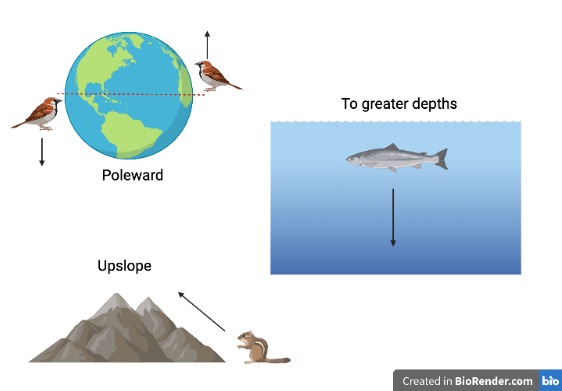
Climate-driven range shifts (conceptual model): This diagram summarizes three widely observed responses to warming or changing conditions: poleward movement to higher latitudes, upslope movement to higher elevations, and shifts to greater depths in aquatic environments. It provides a spatial framework for predicting which species can persist locally versus which must relocate as the “map” of suitable habitat changes. Source
Latitudinal shifts: habitat zones move toward the poles as temperatures increase.
Altitudinal shifts: suitable conditions move upslope on mountains, compressing high-elevation habitats.
Biome conversion: one broad habitat type replaces another (e.g., forest transitioning to grassland under sustained drying).
Patchiness and fragmentation: formerly continuous habitat becomes broken into smaller patches, increasing edge effects and isolation.
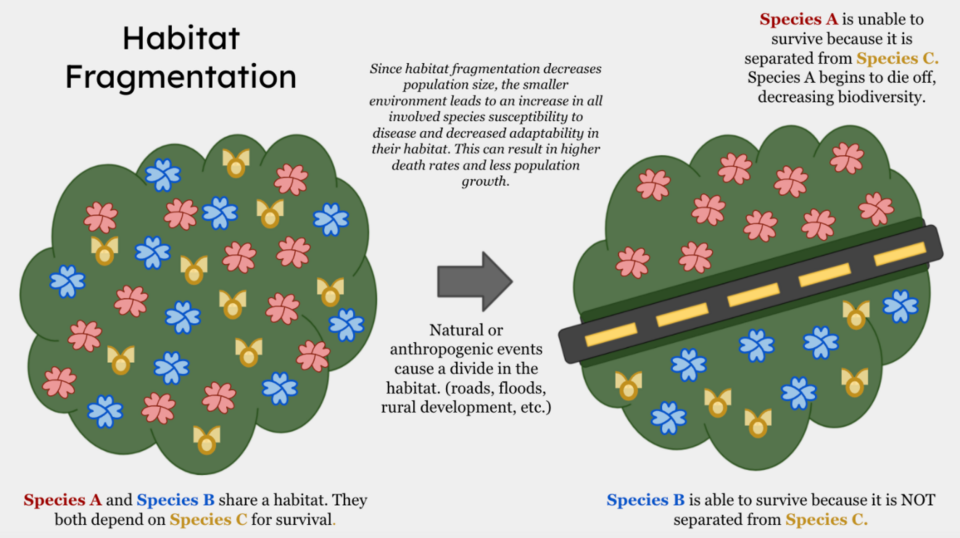
Habitat fragmentation (connectivity loss): This diagram shows how a once-continuous habitat can be subdivided into smaller patches by human land use, reducing total habitat area and increasing isolation among remaining patches. The visual emphasizes why dispersal becomes harder and why populations can become more vulnerable when movement corridors are cut off. Source
Novel habitats and communities: new combinations of conditions can create no-analogue ecosystems where historical species mixes no longer occur.
How shifting habitat alters which species survive
When habitats move or transform, local survival depends on whether a species can (1) tolerate new conditions, (2) relocate to track its habitat, and (3) reproduce successfully in the changed landscape.
Range shifts and local extinctions
If a species can disperse fast enough, it may track shifting habitat and maintain populations elsewhere.
If dispersal is too slow, barriers are present (roads, cities, agriculture), or suitable habitat patches are too far apart, populations may become isolated and decline.
Species with narrow environmental requirements are more likely to experience local extinction when the local habitat no longer meets their needs.
Refugium (plural refugia): a place that remains relatively environmentally stable during regional upheaval, allowing populations to persist and later recolonise surrounding areas.
Refugia matter because they can “seed” recovery, but only if connections or dispersal routes allow recolonisation after conditions stabilise.
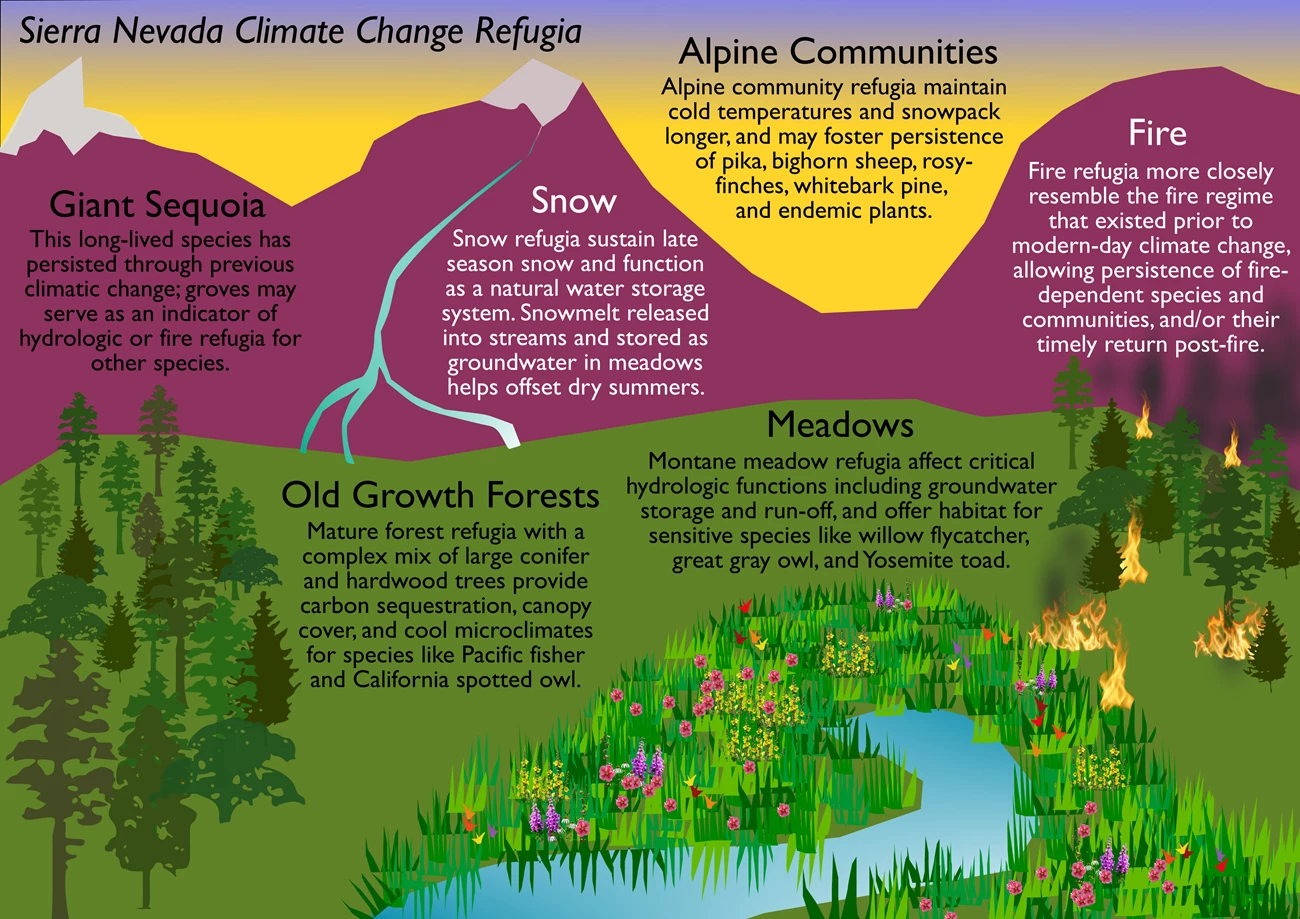
Climate-change refugia types (example landscape): This figure illustrates how different parts of a mountainous landscape can function as refugia by maintaining cooler microclimates, reliable water storage, or disturbance patterns that allow ecosystems to persist. It reinforces that refugia are not one single habitat type, but a set of buffered places that can support survival and later recolonization. Source
Community reassembly and changed interactions
Even if individual species survive, community structure may change because species respond differently to the same upheaval.
Timing mismatches: shifts in seasons can disrupt synchrony (e.g., peak food availability no longer aligns with breeding).
New competitors or predators: species moving into newly suitable areas can alter resource availability and survival.
Disease and pests: altered temperature/moisture can expand the viable area for parasites or vectors, affecting which hosts persist.
Food-web reshuffling: loss of key prey or habitat-forming organisms (e.g., dominant vegetation) can cascade through trophic levels.
Landscape-scale mechanisms that drive habitat shifts
Physical and chemical changes to the environment
Major upheaval can modify the foundational conditions that define habitat:
Moisture balance changes: altered precipitation and evaporation can shift wetlands, riparian zones, and soil moisture regimes.
Soil transformation: erosion, deposition, salinisation, or nutrient loss can change plant communities that support higher trophic levels.
Hydrologic re-routing: changes in drainage patterns can eliminate some aquatic habitats while creating others.
Disturbance regimes: changes in frequency/intensity of large disturbances can prevent re-establishment of prior vegetation states, locking in a new habitat type.
Barriers and “traps” in human-modified regions
In many regions, habitat can shift climatically but not geographically for species due to:
Fragmentation that reduces safe movement corridors.
Hard boundaries (urban areas, intensive agriculture) that prevent tracking suitable conditions.
Ecological traps where cues (e.g., greenery, warmth) attract organisms to sites that no longer support successful reproduction.
Indicators that a region’s “survivor set” is changing
APES students should be able to interpret signs that habitat shift is altering survivorship:
Persistent range-edge expansion for some species alongside range contraction for others.
Increasing dominance of species suited to the new temperature/moisture regime.
Declining recruitment (few juveniles) despite adult presence, suggesting conditions no longer support reproduction.
Growing importance of refugia patches (cool valleys, shaded slopes, spring-fed areas) as population strongholds.
Practice Questions
State two ways that major environmental change can cause large areas of habitat to shift. (2 marks)
Any two valid mechanisms (1 mark each), e.g. latitudinal shift polewards; altitudinal shift upslope; biome conversion; increased fragmentation/patchiness.
Explain how habitat shift after major environmental upheaval can alter which species survive in a region. (5 marks)
Habitat suitability changes so some species can no longer meet tolerance/resource needs locally (1).
Species that can disperse/move can track suitable habitat; others cannot and decline (1).
Fragmentation/barriers reduce successful movement and increase isolation (1).
Community interactions change (new competitors/predators/disease) affecting survival (1).
Refugia allow persistence and potential recolonisation if dispersal/connectivity is possible (1).
FAQ
Microrefugia are small, localised pockets of stable conditions (e.g., shaded ravines, cold-air hollows) within an otherwise unsuitable region.
They can preserve genetic lineages locally and reduce the distance needed for recolonisation once conditions moderate.
Key drivers include the steepness of climate gradients, soil constraints, and whether disturbance repeatedly resets succession.
If change is gradual or patchy, a mosaic transition can persist; abrupt thresholds can cause rapid replacement.
Yes. Regional losses can occur via extirpation while species persist elsewhere.
This still reduces local biodiversity and can change ecosystem function (e.g., altered productivity, changed prey availability).
Mountains have finite area at higher elevations, so habitats can become “compressed” into smaller zones.
Once the habitat boundary reaches the summit, further upslope tracking is impossible.
Approaches include:
Protecting environmental gradients (valley-to-ridge, south-to-north).
Maintaining connected networks of patches.
Prioritising areas likely to remain stable across multiple scenarios (candidate refugia).

