AP Syllabus focus:
'Most Europeans depended on agriculture; in many regions, farmers still paid rent and labor services on their land.'
Early modern Europe remained overwhelmingly rural. For most people, daily survival depended on access to land, seasonal farming, and the obligations that tied peasant households to landlords and long-established local customs.
Agriculture as the Foundation of Daily Life
For the great majority of Europeans, agriculture was not simply one economic sector among many. It was the basic foundation of society. Most people lived in villages, worked the land, and relied on harvests for food, income, and survival. Rural life shaped family structure, local authority, and economic relationships.
Because agriculture dominated:
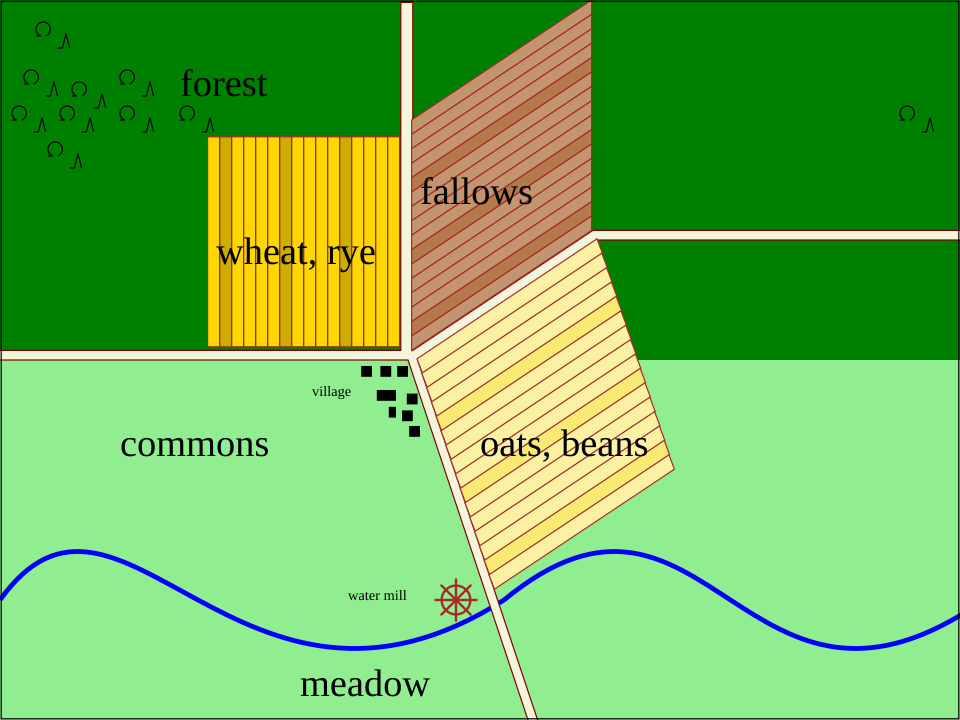
Diagram of the medieval three-field system, showing how villages rotated land between winter grain, spring crops, and fallow to manage soil fertility and risk. This helps illustrate why rural labor followed a predictable annual cycle and why harvest failure in any one year could threaten subsistence. Source
most wealth was linked to landownership
most labor was organized around the agricultural year
bad weather or poor harvests could threaten entire communities
village society was often conservative because survival depended on preserving access to fields, tools, and customary rights
This dependence on agriculture meant that change was often slow. Even as trade expanded in some parts of Europe, many rural communities still operated within older systems of obligation and customary practice.
Land, Tenure, and Obligation
Access to land usually did not mean complete independence. Many peasants held land only by recognizing the rights of a lord or landlord.
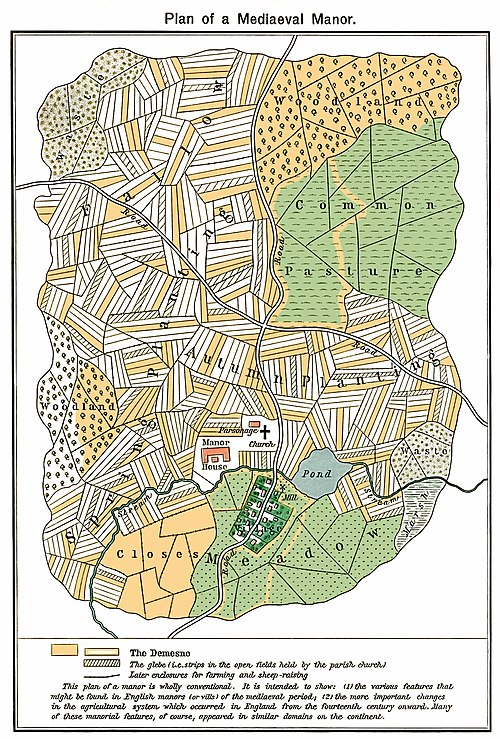
Plan of a (conventional) medieval manor showing the spatial organization that underpinned rent and labor services: the lord’s demesne, peasant strips in the open fields, and communal resources. The labeled features (mill, church, village, pasture, woodland) make visible how economic dependence and local authority were embedded in the landscape. Source
In return for using plots of land, farmers often had to pay rent and perform labor services. These duties reflected the survival of older manorial relationships into the early modern period.
Labor services: Work that peasants were required to perform for a landlord, often on the lord’s own land or on projects under lordly control, as part of the conditions for holding land.
Rural obligations could take several forms:
cash rent, paid at fixed intervals
payments in kind, such as grain, animals, or other produce
labor services, especially at busy agricultural times
customary dues and fees, tied to long-standing local practice
These obligations mattered because they limited how far peasants could act as fully independent producers. A farming household might work hard on its own land, but part of its time, harvest, or income still had to go elsewhere.
What Rent Meant in Rural Society
Rent was one of the most common obligations. It represented the landlord’s claim over the land and the peasant’s dependence on that claim. Rent could be burdensome even when it seemed predictable, because farming income was uncertain. A good harvest made obligations easier to meet; a poor harvest could turn fixed dues into a serious hardship.
Rent also reinforced hierarchy:
landlords controlled valuable access to land
peasants had to maintain their holdings by meeting obligations
failure to pay could produce conflict, penalties, or loss of security
In many places, rent was not simply an economic payment. It was a sign of status and subordination. It reminded everyone in the village that landholding existed within a larger structure of authority.
Labor Services and the Survival of Older Practices
Labor services show especially clearly how traditional agriculture preserved older social relationships. Rather than paying only in money, peasants in many regions still had to give their own time and effort. They might plow, sow, harvest, transport goods, or repair facilities under the direction of the landlord.
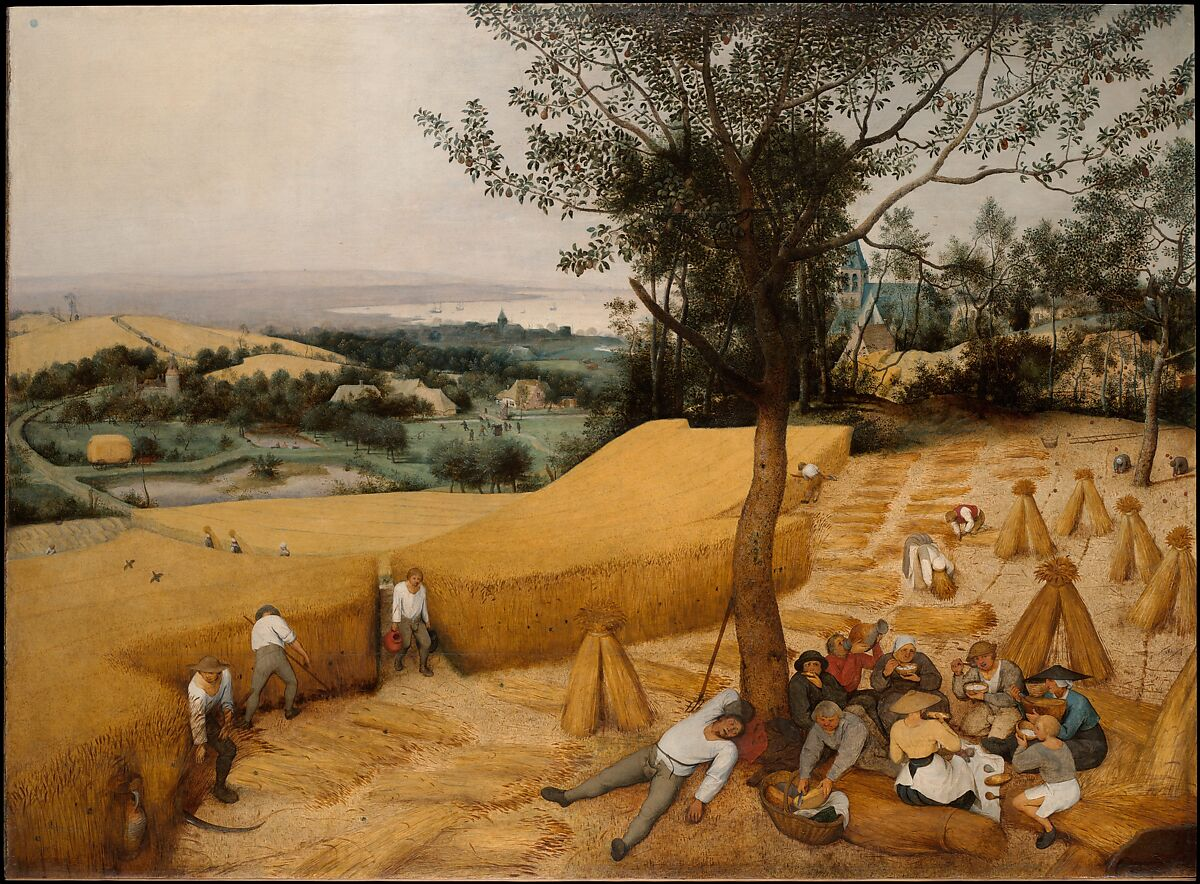
Pieter Bruegel the Elder’s The Harvesters (1565) depicts grain cutting, gathering, and a midday meal, emphasizing the intensity and seasonality of rural labor. As a close observation of work in the fields, it reinforces how early modern livelihoods depended on harvest timing, human effort, and the agricultural calendar. Source
These services were especially significant because they:
reduced the time peasants could spend on their own fields
demonstrated the landlord’s continuing power over rural labor
tied economic life to inherited custom rather than free contract alone
The persistence of labor services shows that rural Europe was not fully organized around wage labor or market exchange. Much of village life still rested on customary obligation, in which duties were accepted because they had long been attached to the holding of land.
Traditional Agriculture and Its Limits
Traditional agriculture was usually marked by low productivity, heavy dependence on human and animal labor, and great vulnerability to natural conditions. Most peasant households worked primarily to sustain themselves. Surpluses could be small, and there was often little protection against crop failure.
This created several long-term pressures:
peasants needed enough land to feed their households
obligations to landlords took away part of what was produced
limited productivity made it hard to build wealth
rural poverty could persist across generations
Because farming was so central, these limits affected the entire social order. When agriculture remained traditional and yields remained modest, many people had little room to escape dependence.
Continuity in Early Modern Rural Life
One of the most important historical points is continuity. Although Europe was entering the early modern era, many rural relationships still carried strong medieval features. Agriculture remained the livelihood of most people, and many farmers still faced obligations that were not fully chosen or negotiated on equal terms.
Conditions varied from region to region, but the broader pattern remained clear: rural society was hierarchical, land was the key to survival, and peasant use of land often came with obligations that benefited landlords. In that sense, early modern Europe was not yet a world of free farmers and open economic mobility. Traditional agriculture and rural obligations helped preserve social inequality at the village level.
These patterns also gave local elites lasting influence. Control over land allowed landlords to extract rent, demand labor, and maintain authority within the countryside. For ordinary farmers, economic life was therefore shaped not only by the soil and the seasons, but also by enduring obligations attached to the land they worked.
Practice Questions
Identify TWO obligations that many early modern European farmers owed in return for access to land. (2 marks)
1 mark for identifying rent as an obligation.
1 mark for identifying labor services as an obligation.
Accept other accurate answers only if clearly linked to landholding obligations, such as payments in kind or customary dues.
Evaluate the extent to which rural obligations reflected continuity with medieval society in early modern Europe. (5 marks)
1 mark for a clear thesis that argues rural obligations showed strong continuity, limited change, or a balanced judgment.
1 mark for explaining that most Europeans still depended on agriculture for survival.
1 mark for explaining that many farmers still owed rent to landlords for the land they held.
1 mark for explaining that labor services preserved older manorial or customary relationships.
1 mark for explaining a nuance, such as regional variation or the fact that some payments were increasingly made in cash even while older obligations survived.
FAQ
Copyhold was land held according to the custom of a manor. A peasant’s rights were recorded in the manorial court roll, and the holding often passed within a family if dues were paid.
Leasehold involved a contract for a fixed term, often with more clearly stated financial conditions.
Copyhold was usually more rooted in custom and local practice, while leasehold was more dependent on an agreed legal arrangement between landlord and tenant.
Common rights allowed villagers to use shared resources that were essential to household survival.
They might include:
grazing animals on common land
collecting firewood
gathering turf or fodder
gleaning leftover grain after harvest
For poorer families, these rights could make the difference between modest security and severe hardship. They supplemented small plots and reduced total dependence on cash.
The farming year shaped nearly every aspect of rural routine.
Key tasks had to be done at the right moment:
ploughing
sowing
haymaking
harvesting
preparing land for the next season
Because labour was seasonal, obligations to a landlord could be especially resented during busy periods. Missing the proper moment for work on one’s own plot could damage the entire household’s food supply.
Village or manorial courts often helped regulate local rural life.
They could deal with:
boundary disputes
unpaid dues
use of common land
inheritance questions
minor breaches of customary rules
These courts were important because they turned custom into something enforceable. They also gave landlords and local officials a practical way to supervise peasant communities without relying on distant central authorities.
Sometimes they could. This process is often called commutation, where work owed to a landlord was converted into money rent.
This did not happen everywhere or all at once. In some districts, landlords preferred cash because it was easier to collect and use. In others, they still wanted direct labour.
Commutation could slightly increase peasant flexibility, but it did not necessarily end dependence. A cash obligation could still be heavy, especially in years of poor harvests or low prices.