AP Syllabus focus:
'Population recovery after the Great Plague increased pressure on resources and pushed prices upward faster than wages.'
As Europe recovered demographically from the devastation of the Great Plague, economic life changed in basic ways: more people competed for food and work, and living costs rose.
Demographic Recovery After the Great Plague
The Great Plague, or Black Death, had killed a huge share of Europe’s population in the fourteenth century. In the generations that followed, many regions slowly recovered. By the late fifteenth and sixteenth centuries, that recovery meant that more people needed food, land, fuel, clothing, and shelter.
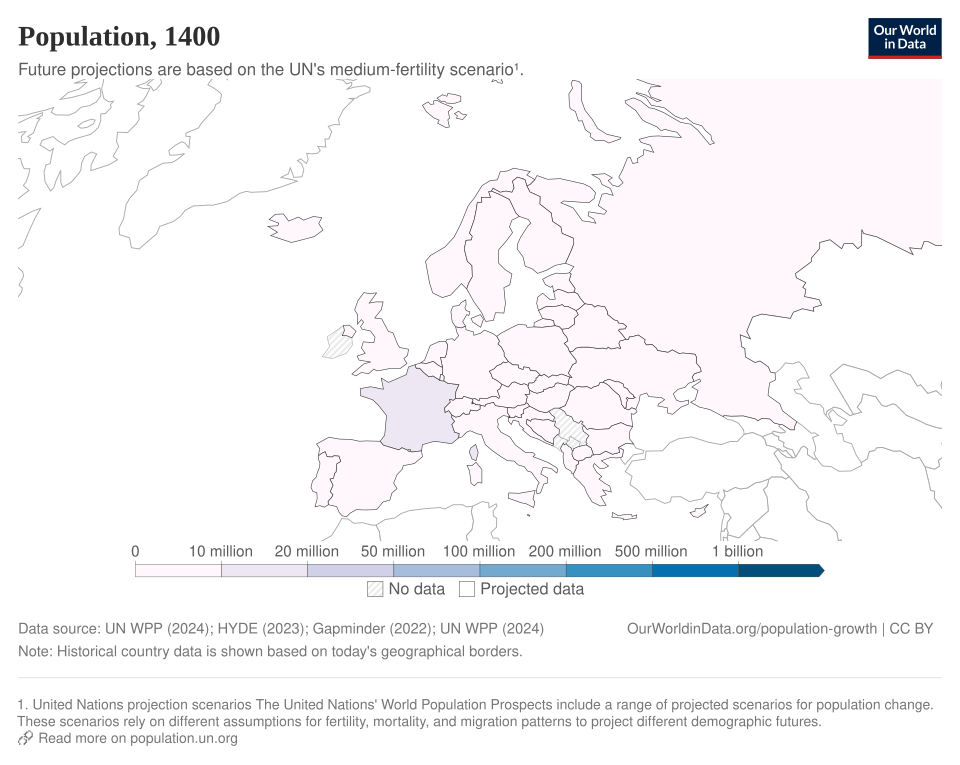
This chart shows Europe’s population trajectory over the long run, making the post–Black Death rebound visually explicit. It helps connect demographic recovery to heightened demand for land and staple goods, setting up why early modern economies experienced sustained pressure on basic resources. Source
Because most Europeans lived close to subsistence, even moderate population growth could create major economic strain. Early modern economies were still overwhelmingly agricultural, so population change affected daily life directly. A larger population did not automatically mean prosperity; it could also mean sharper competition for limited resources. This was a long-term trend rather than a sudden event, but its effects were profound.
Why More People Meant Higher Prices
Food was the clearest example. Grain was the basic staple for much of Europe, and rising population increased demand for bread and other grain products. Yet agricultural productivity did not expand quickly enough to match that demand. Land that had been abandoned after the plague could be brought back into use, but much of it was poorer land and less productive. As a result, the supply of food often grew more slowly than the number of consumers.
Population growth also increased pressure on other necessities. More households needed housing, more peasants sought access to land, and more urban residents had to buy provisions in the market. When demand rose faster than supply, prices increased. This pattern was especially damaging because necessities took up a very large share of ordinary household budgets. A rise in food prices therefore mattered far more than a rise in luxury goods.
Pressure on Resources
Land became more contested as more families depended on farming or rent.
Food supplies faced strain because harvests could not easily expand year by year.
Urban markets felt the effects quickly because townspeople depended on purchased grain and basic goods.
Why Wages Did Not Keep Up
The key problem was not simply that prices rose, but that wages often rose more slowly. After the Great Plague, labor had been relatively scarce, which could strengthen workers’ bargaining power. As population recovered, however, the labor supply increased. More workers competing for employment made it harder for laborers to demand higher pay.
Employers had less reason to raise wages rapidly when many people needed work.
This produced falling real wages.
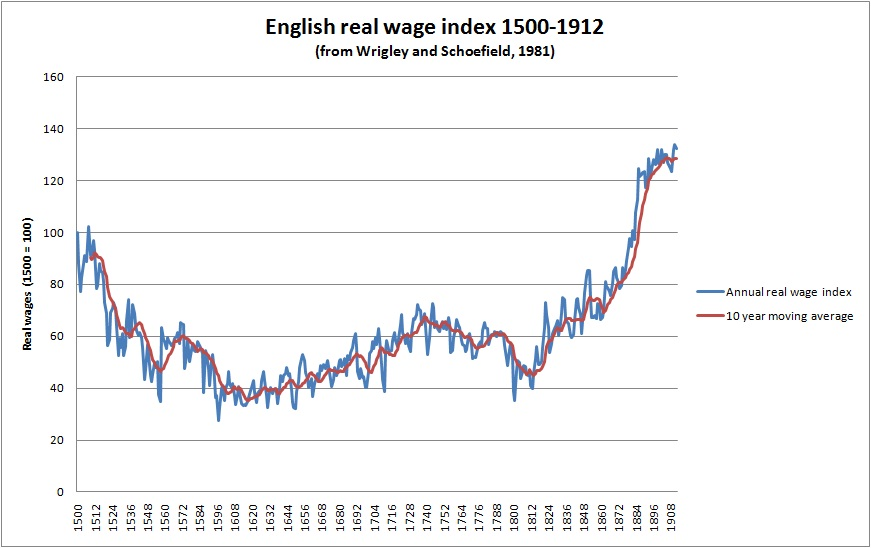
This real-wage index for England illustrates how workers’ purchasing power changed over time, including the crucial 1500s when living costs often rose faster than earnings. Reading it alongside the text reinforces the idea that “real wages” can fall even if money wages are stable, because the price level is rising faster than pay. Source
Real wages: The purchasing power of wages, measured by what income can actually buy rather than the number of coins earned.
A worker might receive roughly the same money wage, or only a small increase, while the cost of bread, rent, and fuel climbed much more quickly. In practical terms, that meant wages bought less. For many families, the issue was not total income alone but whether that income still covered essential consumption. When prices rose faster than wages, living standards declined.
Effects on Ordinary People
The burden fell most heavily on those who depended on fixed wages or small incomes. Urban artisans, laborers, servants, and many rural workers were especially vulnerable. Small tenants and poorer peasants could also suffer if they had to buy food rather than produce enough themselves. Marriage, apprenticeship, and household formation could become harder to finance. In contrast, some people who sold grain or controlled land could benefit from higher prices.
Several effects followed:
Households spent a larger share of their income on food.
Families had less money left for clothing, tools, rent, or taxes.
Bad harvests became more dangerous because there was less room in the budget to absorb sudden price spikes.
Poverty became more visible as more people struggled to maintain earlier standards of life.
Rising prices therefore did not affect society evenly. They tended to redistribute advantage away from many wage earners and toward those better positioned to profit from scarce goods. This helps explain why population growth could create hardship even during a period of overall demographic recovery.
Historical Importance
For AP European History, the central idea is a clear chain of causation: population recovery after the plague increased demand, demand placed pressure on land and food supplies, and that pressure helped drive prices upward. Because wages did not keep pace, many Europeans experienced declining purchasing power. This development reveals how vulnerable early modern society remained to demographic shifts. In an economy still dominated by agriculture and limited productivity, more people often meant greater stress rather than immediate improvement. It also helps explain why economic change did not benefit all groups equally.
Practice Questions
Briefly explain one reason population recovery after the Great Plague caused rising prices in early modern Europe. (2 marks)
1 mark for identifying that a larger population increased demand for food, land, housing, or other necessities.
1 mark for explaining that supply, especially agricultural supply, did not expand quickly enough, so prices rose.
Explain how population recovery after the Great Plague contributed to declining living standards for many Europeans. (5 marks)
1 mark for explaining that population growth increased demand for basic goods, especially grain.
1 mark for explaining that limited agricultural productivity meant supplies could not keep pace.
1 mark for explaining that prices rose faster than wages.
1 mark for explaining the idea of falling purchasing power or real wages.
1 mark for explaining one social effect on ordinary people, such as hardship for wage earners, greater poverty, vulnerability to bad harvests, or difficulty affording necessities.
FAQ
Grain mattered because it was the basis of everyday diet for much of Europe. When grain prices rose, the cost of bread and porridge rose with them, affecting nearly everyone.
For poorer households, food could consume most of the family budget. That meant even a modest increase in grain prices could quickly produce hunger, debt, or reliance on charity.
No. Recovery varied by region because war, disease, migration, climate, and local farming conditions all mattered.
Some areas regained population earlier and felt price pressure sooner. Others remained thinner in population for longer, so the effects on land, wages, and food costs could be less intense or delayed.
Historians compare surviving records such as:
town wage books
estate accounts
market price lists
poor relief records
household and monastery accounts
These sources allow them to track what workers were paid and what staple goods cost. The most useful evidence often shows not just money wages, but how much bread or grain those wages could actually buy.
Many women and servants depended on low, fixed, or seasonal earnings. Their income could be less flexible than that of landholders or merchants.
Some were partly paid in food, lodging, or clothing, which offered limited protection. But if employment became irregular, or if households cut costs, they had fewer reserves and less property to fall back on.
Authorities sometimes tried to reduce distress by:
monitoring grain stocks
restricting exports
punishing hoarding
regulating bread prices or weights
expanding poor relief
These measures could soften short-term shortages, but they rarely solved the deeper issue: more people were competing for limited supplies in an economy with slow agricultural growth.