AP Syllabus focus:
'Subsistence farming dominated, with three-field rotation in the north and two-field systems in the Mediterranean.'
Early modern European agriculture remained highly traditional. Most people depended on the land, and regional farming systems reflected local climate, soil, and custom more than innovation or large-scale commercial production.
Subsistence as the Basic Pattern
For most Europeans, agriculture was organized first around survival. Households aimed to produce enough grain and other staples to feed themselves, keep seed for the next season, and meet basic local needs. Only after those needs were met could any real surplus be sold or stored.
Subsistence farming: Farming mainly designed to feed the household or local community rather than produce a large market surplus.
This mattered because low productivity made rural communities vulnerable. A bad harvest could quickly mean hunger, reduced livestock numbers, or pressure on village resources. Since output was often limited, farming decisions were cautious and shaped by experience rather than experimentation.
Most communities also depended on cereal crops as the foundation of diet. Bread or porridge made from grain was central, so maintaining a reliable crop cycle was more important than maximizing short-term profit. Agricultural systems therefore focused on preserving soil fertility and managing risk across the year.
Regional Agricultural Systems
Although subsistence farming was widespread, Europe did not use one uniform system. Different regions adopted patterns suited to their own environmental conditions.
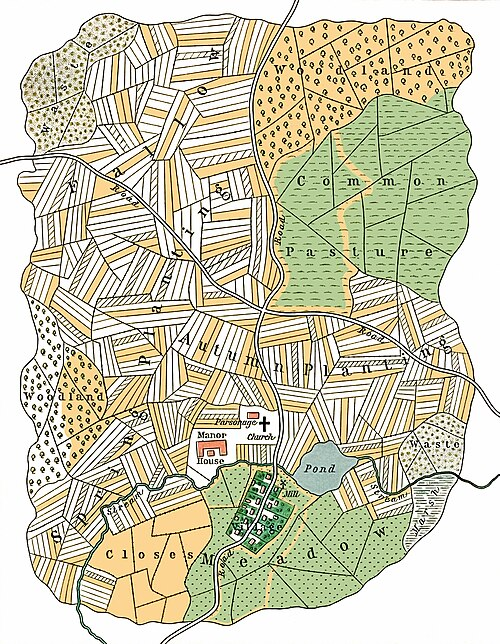
Plan-style schematic of a medieval manor illustrating the open-field system, including the nucleated settlement and surrounding agricultural land organized into large fields subdivided into strips. It provides spatial context for why crop-rotation decisions were typically communal and coordinated rather than purely individual choices. Source
Three-field rotation in northern Europe
In much of northern Europe, farmers used a three-field rotation system.
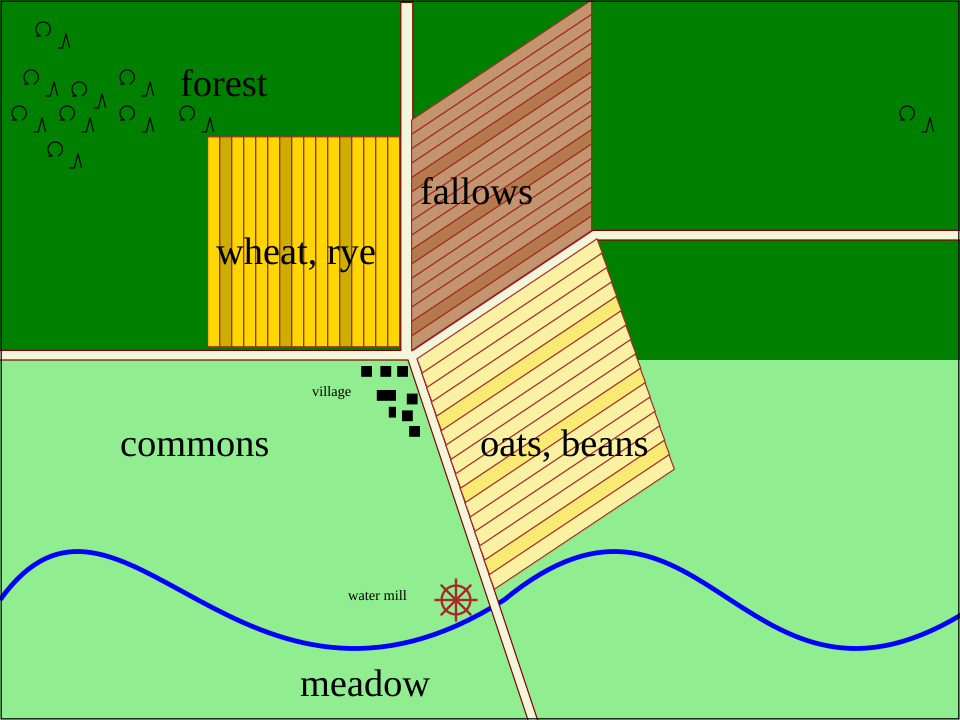
Diagram of the three-field rotation cycle, showing how land is divided into three fields and rotated among autumn-sown grain, spring-sown crops, and a fallow year. This visual reinforces why (in a typical year) roughly two-thirds of arable land could be cultivated while one-third recovered. Source
Three-field rotation: A system in which land was divided into three parts, with one planted in autumn crops, one in spring crops, and one left fallow each year.
A typical cycle divided arable land into:
one field planted with autumn grain, often wheat or rye
one field planted with spring crops, such as barley, oats, or legumes
one field left fallow, meaning uncultivated for recovery
Because only one of the three fields rested each year, about two-thirds of the land could remain under cultivation. This made the system somewhat more productive than a two-field arrangement. It also spread risk across different planting seasons and crops.
Northern conditions helped support this pattern. Cooler temperatures, somewhat higher rainfall, and heavier soils made regular cereal cultivation more feasible in many areas. The use of both winter and spring planting also helped communities balance labor demands and diversify food supplies. The inclusion of spring crops could also support work animals and reduce the danger that one failed planting season would ruin the entire year.
The system was still limited, however. Leaving land fallow meant that a significant share of farmland produced no crop in a given year, and yields remained modest by modern standards. Yet within the technological limits of the period, the three-field system was a practical method of maintaining cultivation over time.
Two-field systems in the Mediterranean
Mediterranean Europe often relied more heavily on a two-field system, which fit its drier conditions.
Two-field system: A system in which one part of the land was cultivated while the other lay fallow, with the sections switching in the next cycle.
In this arrangement, one portion of land was planted while the other rested, and the roles switched in the next cycle. As a result, only about half the land was usually under grain cultivation at one time. This reduced pressure on thin or dry soils and helped farmers cope with lower rainfall.
Hot summers and uneven moisture made intensive grain farming harder in many Mediterranean regions than in the north. Resting the land longer could therefore be necessary. Mediterranean agriculture also often combined cereal farming with olives, vines, and grazing, creating a different balance of land use from northern grain-centered farming. This did not mean Mediterranean farmers were less skilled; rather, they adapted to a more water-stressed environment.
Why These Systems Mattered
These systems reveal both the possibilities and the limits of early modern agriculture. Farmers were not ignorant or passive; they used methods based on generations of local knowledge. The main goal was stability in a world where weather, soil exhaustion, and poor harvests could threaten survival.
Three broad features stand out:
low surplus production, since much output went directly to household consumption
dependence on fallow land, because regular rest was one of the main ways to maintain fertility
strong regional variation, as climate and terrain shaped what kinds of rotation were practical
The contrast between three-field and two-field agriculture also helps explain differences in productivity across Europe. Where a larger share of land could be cultivated annually, food supply could be somewhat more secure. Where environmental conditions required more fallow, agriculture tended to remain more constrained.
Continuity and Daily Rhythms
Agricultural systems in early modern Europe were marked more by continuity than by rapid transformation. Most peasants worked within long-established rotations, seasonal labor patterns, and local custom. Farming remained tied to natural rhythms rather than major technological change.
These systems shaped the rural calendar:
plowing and sowing had to match seasonal weather
harvest time concentrated labor and determined the food supply for the coming year
fallow periods allowed grazing, manure spreading, and partial recovery of the soil
Northern communities often managed separate autumn and spring sowing seasons. Mediterranean communities more often adjusted work to dry summers and the coexistence of grain land with vineyards, olive groves, or pasture. The result was an agriculture carefully adapted to place, but still constrained by low yields and constant dependence on the land.
Practice Questions
Identify ONE characteristic of the three-field rotation system used in northern Europe and explain ONE reason it allowed more land to be cultivated than the Mediterranean two-field system. (2 marks)
1 mark for identifying one valid characteristic, such as division into three fields, use of autumn and spring crops, or one field left fallow.
1 mark for explaining that only one-third of the land rested at a time, so more land was cultivated annually than in a two-field system.
Describe how subsistence farming shaped agricultural life in early modern Europe, and explain how regional conditions contributed to the use of three-field rotation in the north and two-field systems in the Mediterranean. (5 marks)
1 mark for describing subsistence farming as agriculture aimed mainly at feeding the household or local community.
1 mark for explaining one consequence of subsistence farming, such as low surplus production, cautious decision-making, or vulnerability to bad harvests.
1 mark for identifying a feature of three-field rotation in northern Europe.
1 mark for identifying a feature of the Mediterranean two-field system.
1 mark for explaining that regional environmental conditions, such as wetter northern climates and drier Mediterranean conditions, helped shape these different systems.
FAQ
No. The three-field pattern was common in many northern regions, but it was not universal.
Some areas used two-field arrangements.
Others relied more on pasture, woodland, or mixed local practices.
Mountains, marshes, and thin soils often made neat rotational systems difficult.
Local custom, landlord authority, and village organisation could matter just as much as geography.
Fallow land was not simply ignored. It often remained economically useful.
Livestock could graze on it.
Farmers might spread manure there.
Weeds could be cut back so the field would be more productive later.
This meant fallow was part of a wider cycle linking crops, animals, and soil management.
Olives and vines suited climates with hot, dry summers better than many grain crops did.
They were valuable because they produced goods that could be stored and used over time:
olive oil
wine
related by-products for food, trade, and household use
They also helped communities diversify. If cereal yields were poor, tree crops and vines could still provide income or necessities.
Animals were central to farming, even when grain was the main focus.
Oxen or horses pulled ploughs.
Sheep and cattle grazed on fallow land and stubble.
Their manure helped maintain soil fertility.
Without livestock, many crop systems would have been much harder to sustain. Animals were therefore part of the agricultural system itself, not separate from it.
A low seed-to-harvest ratio meant that farmers had to keep back a large share of grain for the next sowing season.
If yields were poor, the problem became severe:
less grain for family consumption
less reserve for famine years
less flexibility after crop failure
That is why even small differences in productivity could matter greatly in a subsistence economy.