AP Syllabus focus:
'Demographic catastrophes among indigenous peoples increased European reliance on enslaved African labor.'European expansion into the Americas caused a massive population crisis among indigenous peoples. That collapse reshaped colonial labor systems and pushed Europeans toward much heavier dependence on enslaved Africans.
Indigenous Demographic Collapse
In the first generations after European arrival, many indigenous communities experienced a demographic catastrophe.
Europeans expected to extract labor, tribute, and agricultural production from native populations, but extreme mortality quickly weakened that plan.
Demographic catastrophe: A sudden and severe population collapse caused by exceptionally high death rates and social disruption.
Main Causes
The collapse did not result from a single event. It came from several destructive forces working together:
Disease was the most devastating factor.

This clinical photograph documents smallpox pustules on a patient’s arm and palm (1969), illustrating the characteristic skin eruptions of a major epidemic disease. In the early modern Atlantic world, the introduction of Old World pathogens such as smallpox into immunologically naïve Indigenous communities helped drive catastrophic mortality and cascading social breakdown. Source
Smallpox, measles, and other infections spread rapidly through populations with no previous exposure, killing large numbers in a short period.
Forced labor increased death rates. Indigenous workers were compelled into mines, fields, transport work, and construction under brutal conditions.
Violence and conquest disrupted communities, destroyed political leadership, and undermined social stability.
Displacement from ancestral lands reduced access to food and shelter, making famine and further disease more likely.
These pressures reinforced one another. A population already weakened by epidemic disease was less able to resist military conquest or sustain agriculture. At the same time, warfare and forced labor made communities more vulnerable to new outbreaks. The result was not simply a decline in numbers, but the breakdown of family networks, local authority, and economic life.
Why Population Loss Changed Colonial Labor Systems
European colonists in the Americas wanted a dependable workforce for mining, agriculture, transport, and construction. Early colonial regimes often attempted to exploit indigenous labor directly through tribute obligations and coercive labor systems. When indigenous populations fell sharply, however, the available workforce became smaller, less stable, and harder for colonists to control.
This mattered because European colonies were designed to extract wealth. Colonial officials and settlers needed workers to keep mines operating, grow export crops, and support expanding settlements. If indigenous populations had remained large and stable, Europeans could have continued to rely more heavily on coerced native labor. Instead, mortality, resistance, flight, and social fragmentation made that approach less effective in many regions.
Population collapse therefore created a major labor shortage from the colonial point of view. Europeans still tried to exploit surviving indigenous communities, but the scale of death meant that colonists increasingly searched for another labor force that could be controlled and transported where it was needed. The demographic crisis did not end coercion; it redirected it.
The Turn to Enslaved African Labor
As indigenous labor became less available, Europeans increasingly relied on enslaved African labor.
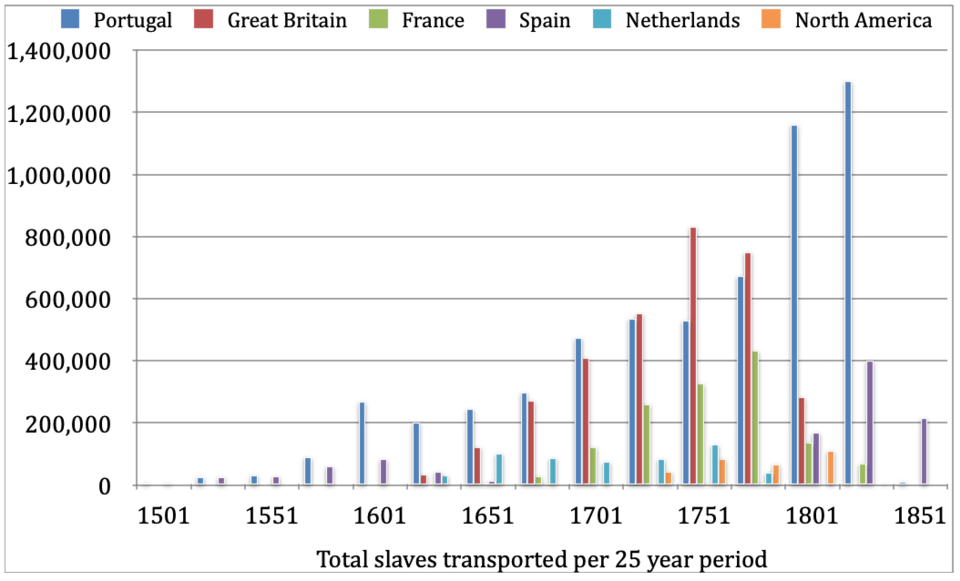
This chart summarizes the transatlantic slave trade in 25-year intervals and breaks down estimated numbers of enslaved people transported by major European carriers. It helps students see the long-run expansion of forced migration and how different imperial states became central to Atlantic slavery at different moments. Source
This was a shift in emphasis, not an immediate or total replacement. In many places, indigenous people continued to face forced labor demands. Even so, the destruction of native populations pushed Europeans toward a much larger use of enslaved Africans.
Several conditions made this shift possible. European merchants could purchase captives through expanding Atlantic trading networks. Colonists also claimed that Africans were better suited for harsh labor in tropical and subtropical environments. These ideas were deeply racist and self-serving, but they helped Europeans justify a system of mass enslavement.
The move toward African labor also reflected colonial priorities. Europeans wanted workers who could be transported in large numbers, permanently controlled, and assigned to demanding forms of production. Because indigenous societies had been devastated, colonists increasingly turned to a labor source that could be imported from outside the Americas. In this way, demographic catastrophe among indigenous peoples became a key cause of Europe’s growing dependence on African slavery.
Effects on Atlantic Societies
The rise in African slavery did more than solve a labor problem for colonists. It helped create a durable system of chattel slavery.
Chattel slavery: A system in which enslaved people are legally treated as property, and enslaved status can be inherited.
As Europeans imported more Africans, colonial societies became more rigidly organized around race and forced labor. The link between ancestry and legal status hardened over time. Indigenous decline thus contributed not only to a change in who performed labor, but also to the creation of long-lasting racial hierarchies.
For Europeans, this shift increased access to workers for profit-making colonial enterprises. For Africans, it meant forced migration, family separation, and extreme exploitation. For indigenous peoples, demographic catastrophe did not end oppression; instead, it changed the balance of colonial labor systems while preserving European domination.
Historical Nuance
A Partial, Not Total, Replacement
AP European History emphasizes a clear causal relationship: demographic collapse among indigenous peoples increased European reliance on enslaved Africans. Still, the pattern was not identical everywhere. In some areas of Spanish America, surviving indigenous communities remained an important labor source. In other regions, especially zones of intensive export production, African slavery became far more dominant.
It is also important to see that indigenous catastrophe alone did not produce this outcome automatically. Europeans still needed merchant networks, ships, and legal systems that allowed slavery to expand. Yet the central point remains: as indigenous populations were destroyed on a massive scale, Europeans became more dependent on enslaved Africans to sustain colonial production and imperial wealth.
Practice Questions
Identify ONE cause of demographic collapse among indigenous peoples in the Americas after European arrival and explain ONE way this collapse increased European reliance on enslaved African labor. (2 marks)
1 mark for identifying a valid cause such as epidemic disease, warfare, forced labor, famine, or displacement.
1 mark for explaining that heavy indigenous mortality reduced the available workforce and pushed Europeans to obtain more enslaved Africans for colonial labor.
Evaluate the extent to which demographic collapse among indigenous peoples was the main reason Europeans increasingly relied on enslaved African labor in the period c. 1500–1700. (6 marks)
1 mark for a defensible thesis that makes a clear judgment about extent.
1 mark for broader context, such as early conquest in the Americas and initial European attempts to exploit indigenous labor.
1 mark for specific evidence of indigenous demographic collapse, such as smallpox epidemics or deaths caused by forced labor.
1 mark for specific evidence of increased reliance on enslaved Africans, such as large-scale importation to colonial mines or plantations.
1 mark for explaining causation by linking indigenous population loss to colonial labor shortages.
1 mark for nuance or qualification, such as noting the importance of Atlantic trading networks, racial ideology, or regional variation.
FAQ
Recovery varied because disease exposure, geography, and colonial pressure were not the same everywhere. Remote regions sometimes had less sustained contact with Europeans, while heavily settled or mined areas faced repeated epidemics and labour drafts.
Political continuity also mattered. Communities that preserved local leadership, farming systems, and family networks were often better able to rebuild than societies shattered by war, relocation, or prolonged forced labour.
Atlantic islands such as Madeira and São Tomé acted as early laboratories for plantation production. Europeans experimented there with sugar cultivation, slave management, and maritime supply systems before similar methods expanded in the Americas.
These islands helped normalise the large-scale use of enslaved Africans. They also linked European merchants, financiers, and shipowners to a developing transatlantic labour trade.
Some European rulers claimed indigenous peoples were subjects who should be converted to Christianity and, in theory, protected from outright enslavement. That legal language was often ignored, but it still shaped imperial policy.
Africans were more commonly classified as captives who could be bought, sold, and inherited as property. This legal distinction helped colonial authorities justify expanding African slavery even while publicly debating the treatment of indigenous communities.
Enslaved Africans did not arrive as blank labour units. Many brought valuable agricultural and technical knowledge from West and Central Africa.
Examples included:
rice cultivation
cattle handling
ironworking
tropical farming techniques
That expertise made colonial production more efficient and profitable, which in turn strengthened European commitment to importing more enslaved Africans.
Population decline was not caused only by deaths. Birth rates often dropped because families were broken apart, food supplies were disrupted, and many adults of childbearing age died or were forced into labour far from home.
Stress and malnutrition also reduced fertility. When communities lost elders, healers, and local leaders, the social conditions needed for family formation became much weaker, slowing recovery even after the worst epidemics passed.