AP Syllabus focus:
'Commercial growth created new elites, deepened east-west differences in rural life, and increased urban pressures and peasant unrest.'
Commercial expansion reshaped early modern European society unevenly. It raised some families into positions of influence, sharpened regional contrasts in the countryside, and produced new tensions in towns and villages.
Commercial Change and Social Hierarchy
Early modern commercial growth meant more trade, wider markets, expanding credit, and a stronger connection between production and profit.
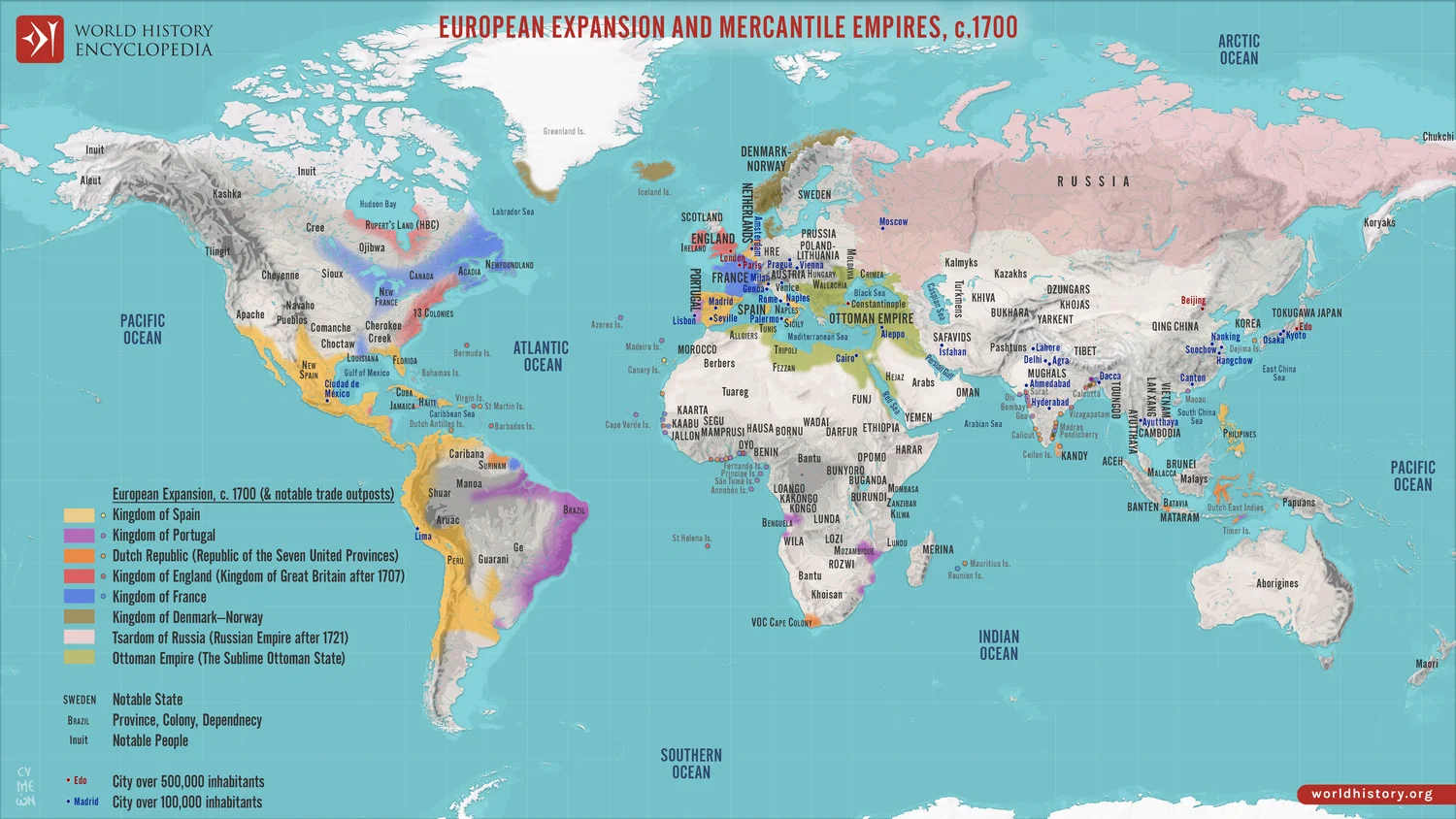
This map situates European commercial expansion within the larger framework of empire building around c. 1700. It helps connect long-distance trade networks and colonial possessions to the state-backed commercial competition that enriched merchants, financiers, and shipowners. Seeing the geographic scale of overseas empires clarifies why commercial profits could translate into social and political influence at home. Source
These changes did not simply make Europe richer; they changed who held power and who faced new risks.
When economic life became more market-oriented, historians often describe the process as commercialization.
Commercialization: The growing importance of producing, buying, and selling goods for the market rather than mainly for local subsistence.
People who could control trade, finance, and large-scale production often rose in status. Merchants, bankers, tax farmers, shipowners, and wealthy commercial landowners used profits to buy urban office, country estates, and advantageous marriages. This blurred older social boundaries. Commercial change did not eliminate the nobility, but it allowed some non-nobles to enter elite circles and pushed nobles to seek profit more aggressively.
The Rise of New Elites
The new elites were rarely poor people moving suddenly to the top. More often, they were already advantaged urban families who gained additional influence through commerce. Their power rested on:
investment in long-distance trade
lending money to governments and rulers
control of urban offices or tax collection
purchase of land, titles, or prestigious marriages
Their rise mattered because status increasingly depended not only on birth, but also on wealth, education, and access to markets. In many towns, wealthy commercial families shaped local government and patronage networks, making commercial success a route to social authority.
East-West Differences in Rural Life
Commercial change also reshaped the countryside, but not in the same way across Europe. One of its most important social effects was a growing divide between western Europe and eastern Europe.
In much of western Europe, landlords increasingly sought cash income from the land.
Some peasants became more independent tenants or commercial farmers, selling grain, wool, or other products to the market. However, others lost access to land and common resources, becoming wage laborers or poor rural dependents. Commercial opportunity therefore existed alongside social insecurity.
In parts of eastern Europe, landlords tightened control over peasants through serfdom.
Serfdom: A system in which peasants were legally bound to the land and owed labor services, dues, or restrictions on movement to a landlord.
This development is often called the second serfdom. Landlords increased labor services and restricted peasant movement so estates could produce for export. Rather than loosening old obligations, commercialization in the east often strengthened them.
Why the Divide Deepened
Commercial growth widened regional differences because markets rewarded landowners differently. In the west, commercialization could weaken older peasant obligations and create a more flexible labor system. In the east, the same growth in trade encouraged nobles to force peasants into harsher dependence. As a result, rural Europe became less socially uniform over time.
Urban Pressures in a Commercial Society
Growing commerce also put strong pressure on cities. Expanding trade attracted migrants seeking work, but urban economies could not provide stability for everyone. Many towns saw:
population growth faster than employment growth
overcrowding and higher demand for food and housing
a larger number of wage earners vulnerable to downturns
rising numbers of poor, beggars, and itinerant workers
Commercial change increased wealth, but it also made survival more dependent on fluctuating markets. Artisans, laborers, servants, and the urban poor were especially exposed when trade slowed or food prices rose. City governments therefore faced growing concerns about poverty, disorder, and social discipline.
Urban pressure was not just economic. It also had a political dimension. As wealthy families gained influence, poorer groups could feel excluded from the benefits of growth. This sharpened tensions within towns between rich and poor, masters and workers, and established residents and migrants.
Peasant Unrest and Social Tension
In the countryside, peasant unrest often emerged when commercialization threatened customary rights or increased burdens on ordinary people. Peasants commonly reacted against:
higher rents or dues
expanded labor obligations
loss of common land
seigneurial attempts to intensify control
taxes linked to stronger state and landlord demands
Protest did not always reject markets themselves. More often, peasants resisted the unequal terms on which commercial change was imposed. They wanted to defend traditional access to land, limit noble power, and protect local economic security.
Why Unrest Increased
Commercial growth redistributed benefits unevenly. Large landowners and successful urban investors were often best placed to profit, while small peasants and wage earners faced greater vulnerability. This imbalance made conflict more likely. In western Europe, unrest often reflected land hunger, enclosure, and pressure on village resources. In eastern Europe, unrest was tied more closely to the reinforcement of noble domination.
What makes this development historically important is that commercial change did not produce one simple social outcome. It promoted mobility for some groups while hardening subordination for others. The same expansion of markets that elevated merchants and commercial landlords also increased poverty, dependence, and resistance among those with fewer resources.
Practice Questions
Identify ONE group that formed part of the new elite created by commercial growth in early modern Europe, and explain ONE way that group increased its influence. (2 marks)
1 mark for identifying a valid group, such as merchants, bankers, tax farmers, shipowners, or wealthy commercial landowners.
1 mark for explaining a valid way influence increased, such as buying land, entering urban government, lending to rulers, or marrying into noble families.
Explain how commercial growth affected rural life differently in eastern and western Europe, and assess how those differences contributed to peasant unrest. (5 marks)
1 mark for explaining a western European development, such as weaker serfdom, more cash rents, tenant farming, or market-oriented agriculture.
1 mark for explaining a western social consequence, such as landlessness, pressure on common rights, or greater inequality among peasants.
1 mark for explaining an eastern European development, such as stronger noble control, increased labor services, or second serfdom.
1 mark for linking rural change to peasant unrest through higher dues, restricted movement, loss of rights, or resentment of landlord demands.
1 mark for an overall assessment that commercial growth intensified regional contrasts and produced uneven benefits rather than a single shared improvement.
FAQ
Guilds often tried to defend traditional standards, prices, and membership rules.
However, expanding trade sometimes allowed merchants and rural producers to bypass guild control. This weakened urban craft monopolies in some places, while in others guilds became more restrictive and protective of insiders.
Commercial towns drew migrants seeking work, but employment could be irregular and seasonal. That made more households vulnerable to hunger, rent arrears, and debt.
As a result, town councils, parishes, and charities expanded systems of relief. These aimed not only to help the poor but also to reduce begging, unrest, and disorder.
Wealth alone was not always enough. New elites often copied older elite habits to gain wider acceptance.
Common strategies included:
buying country estates
funding churches or civic buildings
arranging prestigious marriages
commissioning portraits
educating sons for public office
These choices turned economic success into recognised social status.
No. Many peasants used quieter methods before turning to open revolt.
They might:
submit petitions
bring legal complaints
refuse dues or taxes
hide produce
leave an estate without permission
Violence was only one form of resistance. Everyday defiance could also challenge landlord power.
Its effects were mixed. Some women found openings in textile production, market selling, domestic service, and small-scale retail.
Yet these opportunities were often insecure. Guild barriers, lower wages, and legal dependence on fathers or husbands limited women’s ability to convert work into lasting power or property.