

AP Syllabus focus:
'European states pursued exploration for commercial profit and religious motives, leading to overseas colonies.'
European expansion grew from practical state interests rather than simple curiosity. Rulers supported long-distance voyages when they promised new wealth, wider influence, and opportunities to spread Christianity beyond Europe.
State Interests and the Turn to the Sea
European overseas exploration was driven less by random curiosity than by the calculations of rulers. Voyages were expensive, dangerous, and uncertain, so monarchs supported them only when they appeared useful to the state. Exploration promised access to new sources of revenue, greater international prestige, and strategic advantages over rival powers. As states became more organized and ambitious, overseas ventures looked like a way to increase both wealth and authority.
This helps explain why exploration was often a political project. Crowns issued permissions, granted monopolies, and protected voyages because rulers expected returns. Exploration therefore grew out of the interests of states, not just individual adventurers.
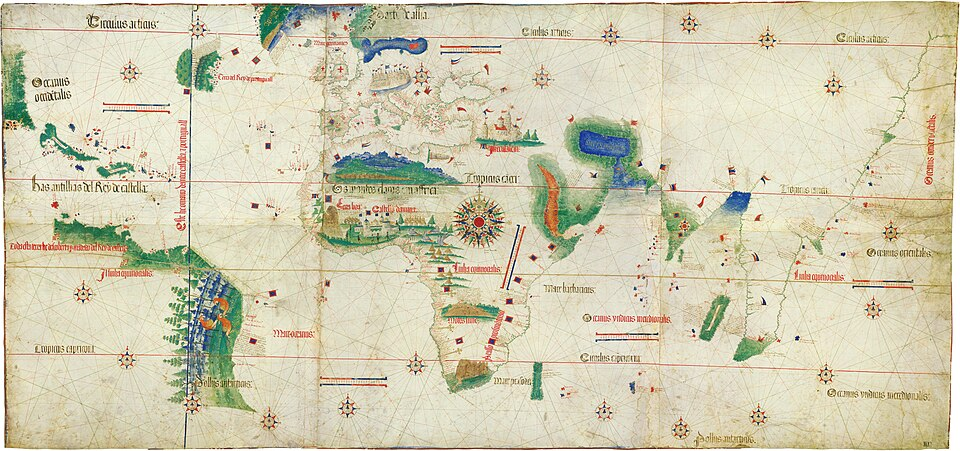
The Cantino planisphere (1502) is an early Portuguese world map that records new Atlantic routes and recently encountered coasts in Africa and the Americas. As a state-linked cartographic document, it illustrates how exploration generated strategic information that monarchies could convert into claims, prestige, and administrative control overseas. Source
A successful voyage could enrich the ruler, strengthen the treasury, and enhance the standing of the monarchy.
Commercial Profit as a Central Motive
Commercial profit was one of the strongest incentives for exploration. European rulers and merchants wanted more direct access to valuable trade. If states could reach distant markets by sea, they could reduce dependence on older trade routes and on middlemen who increased prices. Overseas exploration therefore seemed like a practical route to greater wealth.
Profit mattered at several levels:
For monarchs, successful trade meant customs revenue, taxes, and greater financial independence.
For merchants, new routes opened chances for monopoly trading rights and large returns on investment.
For states as a whole, wealth from trade could support armies, diplomacy, and administration.
Because of this, exploration was tied closely to state power. Wealth was not only desirable in itself; it was also a tool of government. A richer crown could fight wars more effectively, reward supporters, and compete more successfully against rival states. Commercial motives therefore made exploration attractive both economically and politically.
The search for profit also pushed states beyond occasional voyages. Once trade opportunities were discovered, rulers wanted to secure them. This often encouraged a more permanent overseas presence, since commerce was easier to protect when states controlled ports, sea-lanes, and settlements.
Religious Motives and the Expansion of Christianity
Religion was another major cause of overseas exploration. Many European rulers saw the spread of Christianity as a duty and a source of legitimacy. Supporting voyages could be presented as serving God as well as serving the state. This gave exploration a moral language that made it easier to defend at home.
Religious motives took several forms:
A desire to convert non-Christians to Christianity
The belief that rulers should extend the reach of the Christian faith
The idea that exploration could enhance a monarch's reputation as a defender of religion
These aims were especially important because religion and politics were deeply connected in early modern Europe. Rulers did not usually separate spiritual goals from political ones. A king or queen who sponsored missionary efforts could gain prestige, strengthen ties with the Church, and claim divine approval for expansion.
Religious motives also helped justify the risks and costs of exploration. Profit alone might seem self-interested, but conversion and missionary work gave expansion a higher purpose. As a result, religion did not simply accompany exploration after the fact; it was part of the original reasoning behind many voyages.
Profit and Faith Working Together
Commercial and religious motives were not separate forces operating in isolation. In practice, they often reinforced one another. A ruler might hope that a voyage would open trade opportunities while also spreading Christianity. Merchants, clergy, and monarchs could support the same expedition for different, but compatible, reasons.
This overlap is important because it shows that overseas exploration was not caused by one single factor. States backed long-distance travel when it could serve multiple goals at once:
economic gain
political prestige
religious expansion
strategic advantage
By combining these motives, rulers could justify large expenditures and maintain support for continued expansion. Exploration became more appealing when it promised both material wealth and spiritual purpose. That combination helps explain why states were willing to sustain overseas ventures despite high costs and uncertainty.
From Exploration to Overseas Colonies
The final part of the syllabus point is the link between exploration and overseas colonies. Once states recognized that overseas territories could provide wealth and opportunities for conversion, they often sought more lasting control.
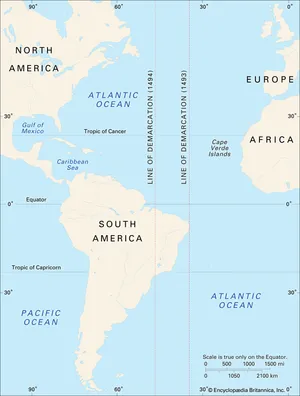
This map depicts the Iberian “lines of demarcation” used to divide claims in the Atlantic between Spain and Portugal, a vivid example of states treating exploration as a diplomatic and legal problem. It helps explain why overseas ventures quickly moved from individual voyages toward formalized imperial boundaries and colonial administration. Source
Exploration was therefore not an end in itself. It frequently led to settlement, conquest, and colonial administration.
Colonies served the same motives that had encouraged exploration in the first place. They could:
protect profitable trade
secure resources and routes for the sponsoring state
extend political authority abroad
create a framework for missionary activity
In this way, the causes of exploration also help explain the rise of European colonial empires. Commercial profit encouraged states to hold on to valuable territories, while religious motives encouraged them to reshape those territories in ways they viewed as spiritually justified. Overseas colonies were thus a logical outcome of explorations driven by wealth, power, and faith.
Practice Questions
Identify one commercial motive and one religious motive that encouraged European states to sponsor overseas exploration. (2 marks)
1 mark for identifying a valid commercial motive, such as seeking direct access to profitable trade, increasing state revenue, or gaining wealth from overseas commerce.
1 mark for identifying a valid religious motive, such as spreading Christianity, converting non-Christians, or enhancing a ruler’s image as a defender of the faith.
Evaluate the relative importance of commercial profit and religious motives in causing European overseas exploration in the early modern period. (6 marks)
1 mark for a clear thesis or argument that makes a judgment about relative importance.
1 mark for explaining how commercial profit encouraged exploration.
1 mark for supporting the commercial argument with relevant evidence, such as the search for direct trade access, customs revenue, or monopoly rights.
1 mark for explaining how religious motives encouraged exploration.
1 mark for supporting the religious argument with relevant evidence, such as conversion efforts, missionary goals, or rulers seeking religious legitimacy.
1 mark for analysis that shows how the two motives interacted or explains how they led to overseas colonies.
FAQ
Portugal and Spain had several advantages that made early expansion more likely. Both were Atlantic-facing kingdoms, so the sea was central to their outlook. Their rulers were also better placed than many others to direct resources towards long voyages.
They also benefited from:
relatively strong monarchies
experience with Atlantic islands
a political culture that rewarded expansion and royal service
These conditions made overseas ventures easier to organise and justify.
Dynastic competition mattered because rulers feared being left behind. If one monarchy gained new trade, prestige, or territory overseas, rival courts worried that the balance of power in Europe would shift against them.
Exploration therefore became a way to:
match or surpass competing rulers
claim glory for a dynasty
prevent rivals from monopolising profitable regions
In this sense, overseas ventures were tied to European power politics as much as to distant lands.
Papal support could give exploration a sense of religious legitimacy. When rulers received papal approval, they could present expansion as part of a Christian mission rather than as simple ambition.
This mattered because papal backing could:
strengthen a monarch’s claim to newly reached lands
reduce disputes within Catholic Europe
frame conquest and conversion as religiously sanctioned acts
Even so, papal approval did not remove political rivalry; rulers still competed intensely for influence and territory.
For some nobles, especially younger sons who would not inherit major estates, overseas service offered a path to status. Royal expeditions could bring offices, land grants, titles, pensions, or military honour.
This made exploration attractive as a social opportunity. Service overseas could help ambitious men gain:
advancement at court
personal wealth
fame through royal favour
So, support for exploration was not only about state policy; it also drew strength from elite ambition.
Many Europeans began with imperfect geographical knowledge. Some believed Asia could be reached more directly than it actually could, or they underestimated the size of the globe. These misunderstandings encouraged rulers to think a sea route might quickly produce great profits.
Because Asia was associated with luxury goods and commercial wealth, even inaccurate maps could make voyages seem worthwhile. In that sense, mistaken assumptions did not prevent exploration; they often made it seem more urgent and more achievable.

.jpg)