AP Syllabus focus:
'Struggles for sovereignty and secular systems of law contributed to new political institutions and greater centralization.'
Political change in early modern Europe was not sudden. It developed through conflicts over authority, law, and governance that gradually strengthened rulers, expanded state institutions, and weakened older patterns of divided power.
Struggles for Sovereignty
One major political consequence of the early modern period was the growing importance of sovereignty, or the claim that political authority should be supreme within a defined territory. In medieval Europe, power had often been fragmented.
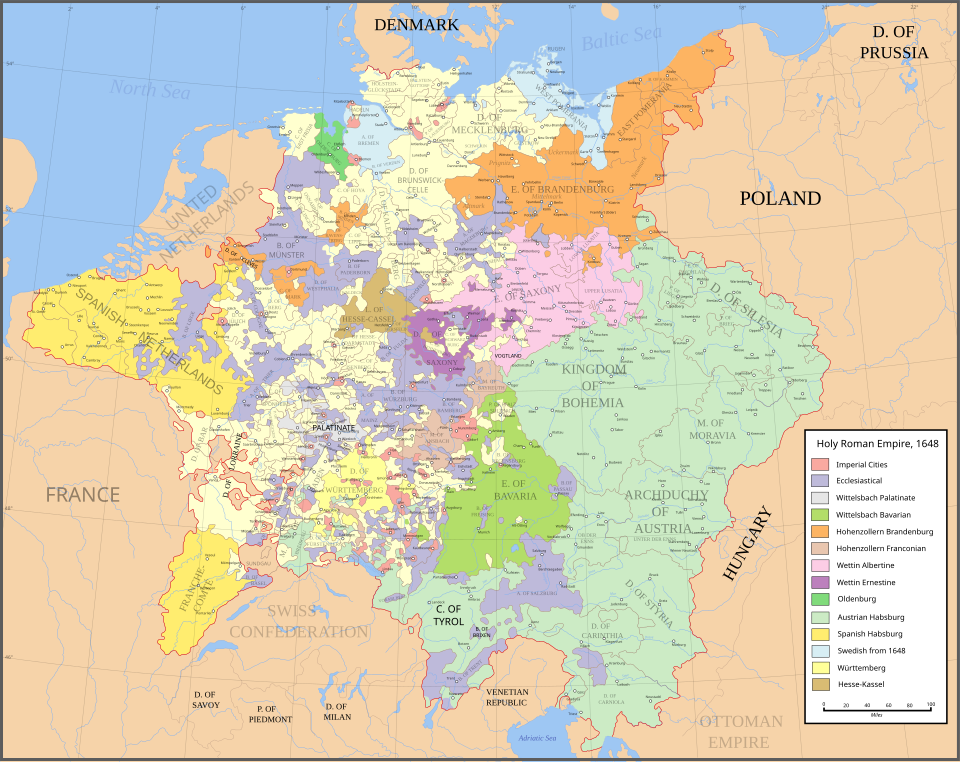
Map of the Holy Roman Empire in 1648, illustrating the dense patchwork of secular and ecclesiastical territories within a single imperial framework. The visual fragmentation helps explain why early modern rulers faced persistent obstacles when trying to make sovereignty “supreme within a defined territory.” Source
Kings, nobles, towns, church leaders, and regional bodies all exercised authority, sometimes at the same time. This made rule negotiated and overlapping rather than fully centralized.
Before rulers could build stronger states, they had to challenge these competing claims to power.
Sovereignty: The principle that the highest political authority within a territory belongs to a ruler or state rather than to multiple rival powers.
Struggles for sovereignty therefore involved more than military conflict. They also involved defining who had the right to make laws, collect taxes, administer justice, and command obedience. Rulers increasingly argued that these powers should belong to the crown or central government instead of being shared broadly among local and religious authorities.
From Shared Authority to Concentrated Rule
As rulers asserted sovereignty, they tried to reduce the independence of groups that had traditionally limited royal power. These included:
regional nobles with private political influence
towns and provinces with local privileges
representative bodies that expected consultation
church courts and clerical authorities with separate jurisdiction
This process did not eliminate all local power. In many places, rulers still had to bargain. However, the direction of change was important: authority became increasingly territorial, hierarchical, and centered on the state. The political order moved away from medieval patterns of personal obligation and layered loyalties toward more direct claims of rule over subjects.
Secular Systems of Law
A second major development was the growing role of secular systems of law. Political authority became stronger when rulers could govern through legal rules created and enforced by lay institutions rather than relying primarily on custom, feudal privilege, or ecclesiastical judgment.
Secular law: Law administered by civil or political authorities rather than by religious institutions.
Secular law mattered because it gave rulers a practical instrument for centralization. A claim to sovereignty was more persuasive when it could be expressed through courts, decrees, records, and trained officials. Instead of power resting mainly on personal relationships, it increasingly rested on administrative procedure and legal jurisdiction.
This shift also encouraged a more impersonal style of government. Subjects were governed less as members of a local feudal network and more as people living under the authority of a territorial state. In that sense, secular law helped transform power from a collection of customary rights into a system of public governance.
Law and Administration
Secular legal development supported centralization in several ways:
It expanded the authority of royal courts over local courts.
It encouraged the use of written law, which was easier to standardize and enforce.
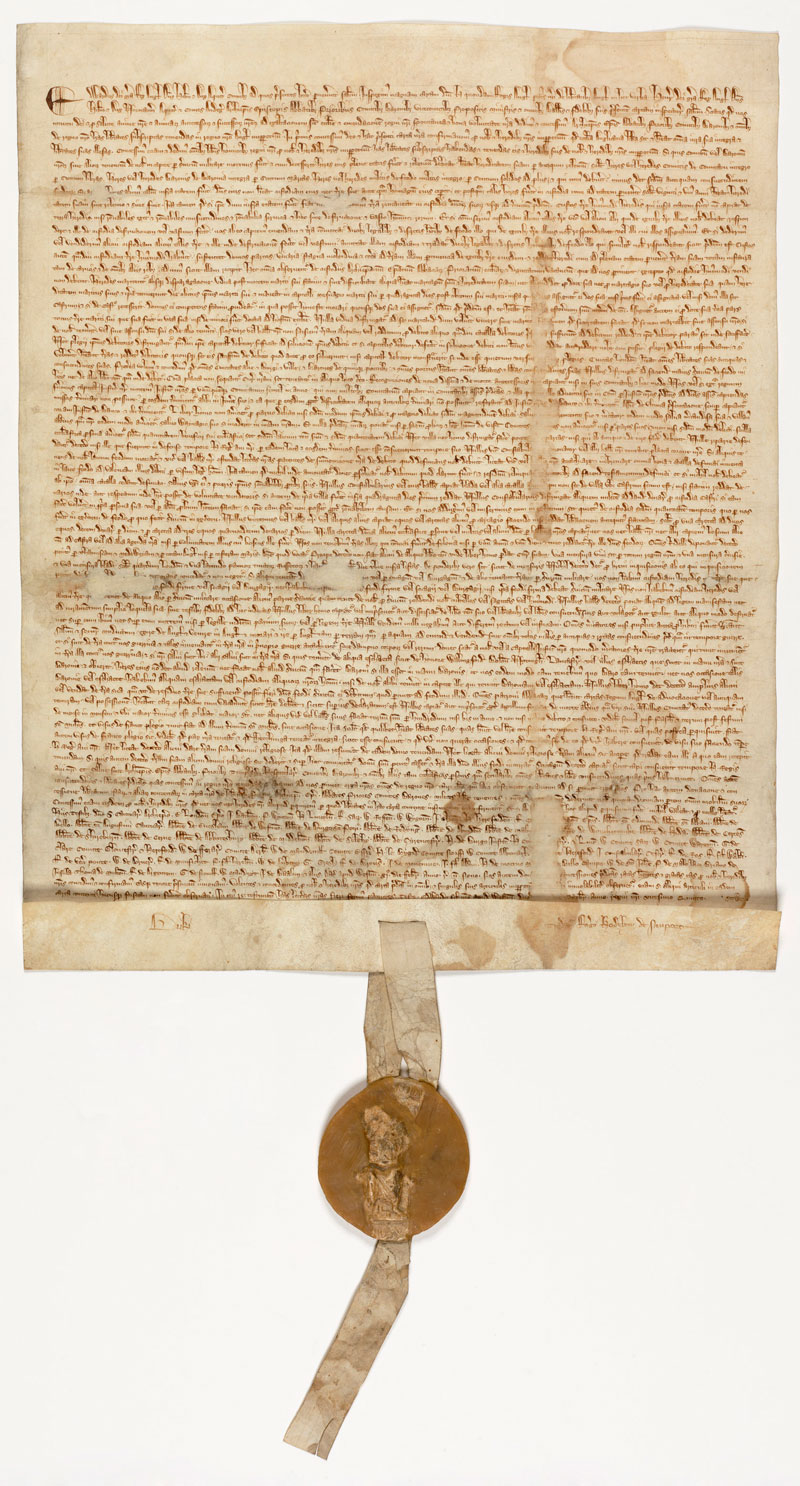
Photograph of Magna Carta (a 1297 reissue of the 1215 charter), a foundational example of rights and obligations being set down in a durable written legal form. For AP Euro themes, it illustrates how written documents could be used to define limits, procedures, and jurisdictions—ideas that later states expanded through courts, records, and professional legal administration. Source
It increased the importance of trained jurists and administrators, whose expertise served rulers.
It linked justice more closely to the state, making obedience to law part of obedience to political authority.
Because law could be recorded, interpreted, and applied across wider territories, it helped rulers govern more consistently. This did not create complete uniformity, but it did strengthen the reach of central institutions.
New Political Institutions
Claims of sovereignty and the expansion of secular law led to the creation or strengthening of new political institutions. These institutions allowed rulers to turn ideas about authority into everyday governance.
Important institutions included:
royal councils, which advised rulers and helped coordinate policy
central courts, which extended legal authority over larger areas
tax offices and treasuries, which made revenue collection more regular
chanceries and record-keeping offices, which organized administration through documents
professional bureaucracies, which tied service to the state rather than to local lordship
These developments mattered because stronger institutions made political power more durable. A ruler could not centralize effectively through force alone. Centralization required offices, procedures, and officials able to carry out commands across a kingdom or state. As these institutions developed, government became less dependent on personal presence and more dependent on organized administration.
Greater Centralization
Centralization did not mean that all parts of Europe became equally unified. It meant that political authority increasingly flowed from the center outward. Rulers expanded their ability to supervise taxation, justice, and policy, and they did so through secular institutions that claimed authority over territory.
Centralization had several important consequences:
it reduced the autonomy of many local powers
it strengthened the connection between rulers and subjects
it made administration more regular and systematic
it increased the political importance of the state as an institution
Even where resistance remained strong, the long-term trend was clear. Political life became more closely associated with centralized rule, territorial sovereignty, and legal systems controlled by secular authorities.
Historical Significance
The broader significance of these changes lies in the emergence of more recognizable state structures. Early modern Europe did not yet have fully modern governments, but the foundations were being laid. Struggles over sovereignty clarified where supreme authority should reside, while secular law provided tools for enforcing that authority. Together, they encouraged the development of political institutions that could govern more effectively, claim broader obedience, and concentrate power in ways that reshaped European politics.
Practice Questions
Identify ONE way that struggles for sovereignty contributed to greater political centralization in early modern Europe. (2 marks)
1 mark for identifying a valid way, such as reducing the political independence of nobles, towns, or church authorities.
1 mark for explaining how this increased the power of the ruler or central government over a defined territory.
Evaluate the extent to which secular systems of law contributed to new political institutions and greater centralization in early modern Europe. (6 marks)
1 mark for a defensible thesis that directly addresses the role of secular law in centralization.
1 mark for explaining how secular law shifted authority from religious or customary jurisdictions to civil government.
1 mark for explaining how secular law strengthened institutions such as royal courts, councils, or bureaucracies.
1 mark for linking legal change to broader state-building, such as more regular taxation, record keeping, or administration.
1 mark for showing complexity by noting limits, such as continued local privileges or resistance from traditional powers.
1 mark for using historically accurate evidence and reasoning throughout the response.
FAQ
Legal pluralism meant that several kinds of law operated at once, often in the same region. A ruler might face customary law, feudal privilege, urban charters, and church courts all at once.
This made government slower and less predictable because no single authority could easily settle every dispute.
Centralisation became easier only when rulers could bring more of these jurisdictions under civil supervision or make appeals flow towards central courts.
Jurists helped turn political claims into enforceable authority. They could draft decrees, interpret precedents, and organise courts in a more systematic way.
Their importance also reflected a shift in power:
from local custom to written procedure
from personal lordship to office-holding
from informal rule to administrative government
In that sense, jurists were essential servants of central authority.
No. In many places, assemblies remained important, especially for taxation and negotiation.
However, their role often changed. Rulers increasingly tried to:
limit when assemblies met
shape who influenced them
use them to approve policies already designed at the centre
So centralisation did not always abolish assemblies; it often reduced their independence.
Borderlands exposed the weakness of uncertain authority. If multiple rulers, nobles, or jurisdictions claimed power in the same area, sovereignty was harder to enforce.
For that reason, frontiers often pushed governments to strengthen:
military administration
tax collection
legal oversight
diplomatic definition of territorial control
Border regions therefore encouraged clearer, more territorial forms of rule.
Force alone rarely produced lasting authority. Rulers needed local elites, judges, officeholders, and taxpayers to accept at least part of the new system.
Cooperation mattered because local knowledge and social influence remained powerful.
In practice, centralisation usually advanced through a mix of:
pressure from the centre
negotiation with regional elites
rewards for service
gradual acceptance of state institutions
This is why centralisation was often uneven rather than absolute.