AP Syllabus focus:
'Commercial and agricultural capitalism reshaped daily life and social patterns while older structures remained.'
Economic change in early modern Europe did not simply create new wealth; it altered work, land use, household choices, and social rank, even as many people still lived within older local and hierarchical systems.
Commercial Capitalism and Daily Life
Commercial capitalism expanded as more economic activity was organized around profit, markets, and investment rather than only local subsistence or customary exchange.
Commercial capitalism: An economic system in which merchants, investors, and producers seek profit through trade, credit, and market exchange.
As trade grew, many Europeans became more connected to regional and international markets. Towns and port cities gained importance because they linked producers, shippers, financiers, and consumers.
This changed daily life in several ways:
More people depended on cash wages and money payments.
Households increasingly produced goods for sale, not just for their own use.
Consumption widened as imported and manufactured goods became more available to some groups.
Urban employment became more varied, especially in trade, transport, retail, and craft production.
Commercial change also encouraged the rise of people whose status came less from birth and more from wealth, expertise, or business success. Merchants, financiers, and professionals could gain influence in towns and sometimes buy land or offices to increase their social standing. This did not erase nobility, but it did create new forms of competition within elite society.
Uneven Effects of Commercial Growth
The benefits of commercialization were not shared equally. People who controlled capital, trade networks, or market access usually gained the most. Those with fewer resources often faced instability.
Wage earners were vulnerable to fluctuations in employment and prices.
Small producers could be squeezed by stronger merchants or landowners.
Urban migrants often found opportunity, but also overcrowding and poverty.
Traditional community protections weakened when market pressures became stronger than local custom.
Because of this, commercial capitalism reshaped social patterns by widening the gap between prosperous groups and more precarious laboring people. Economic growth therefore brought both opportunity and insecurity.
Agricultural Capitalism and the Countryside
Agricultural capitalism developed when land was managed increasingly for profit, efficiency, and market production rather than mainly for local subsistence or customary obligation.
Agricultural capitalism: A system in which landowners and farmers organize agriculture to increase output and profit for the market.
This was a major shift because most Europeans still lived in the countryside. When landowners focused more heavily on market production, they often tried to increase rents, improve yields, reorganize holdings, or direct labor more closely. The countryside therefore changed not only economically but socially.
How Rural Life Was Reshaped
Commercial agriculture could encourage specialization and a stronger link between villages and markets. Some farmers produced more saleable crops or livestock, while larger landholders strengthened their control over land. This affected daily life in several ways:
Peasants and tenants had to think more in terms of market demand.
Access to land became even more important to survival and status.
Rural laborers without secure holdings became more dependent on wages.
Wealthier farmers could expand, while poorer villagers risked decline.
These changes helped create sharper distinctions within the rural population. A village was less likely to be made up of people living at roughly the same level. Instead, there could be substantial differences between large landowners, prosperous tenants, smallholders, and landless workers.
Continuity in the Countryside
Even as agriculture became more commercial, older structures remained powerful.
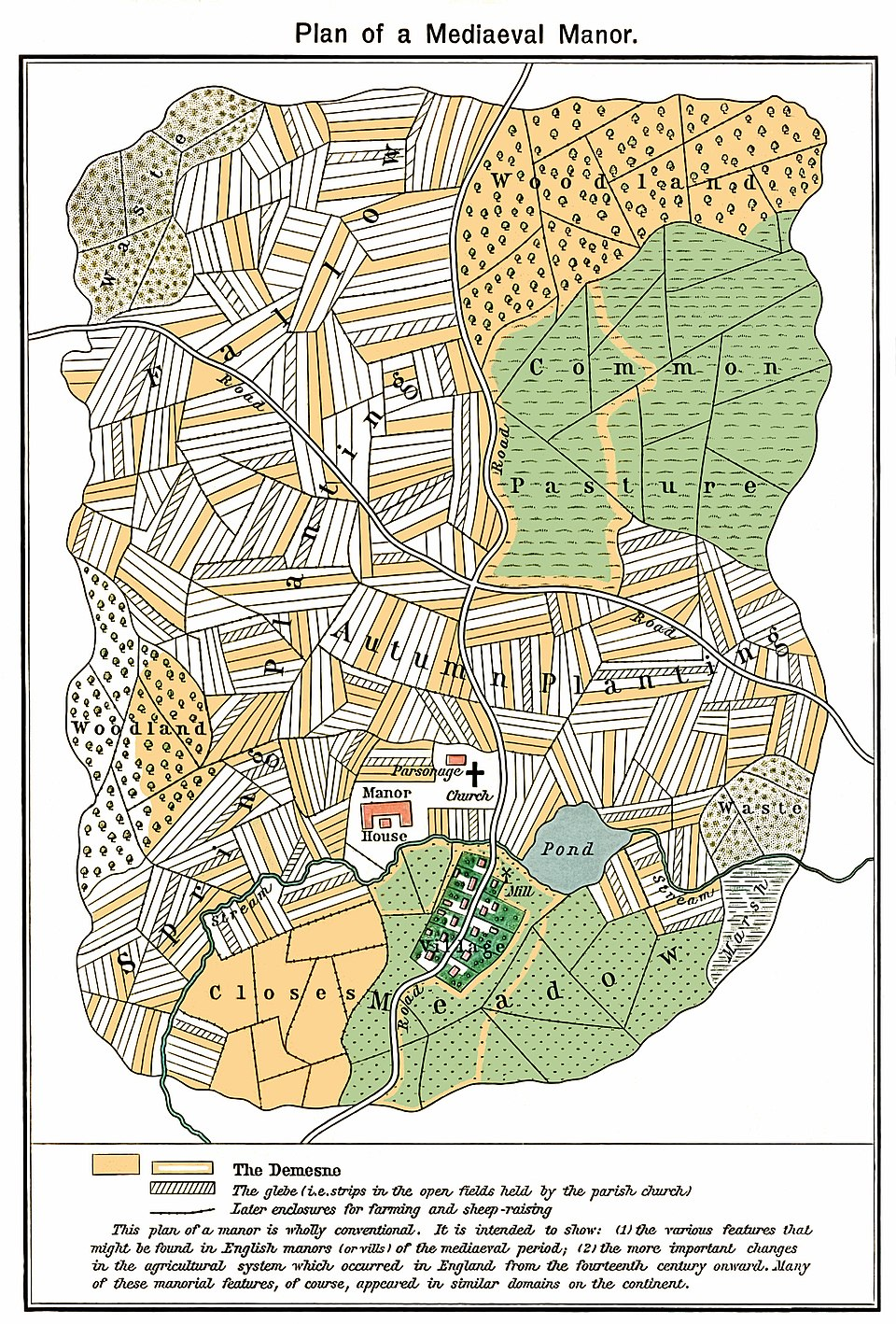
Plan of a medieval manor showing the open-field system: peasant strip holdings scattered across large unfenced fields alongside the lord’s demesne and shared common lands. The layout illustrates how land use and social authority were embedded in customary arrangements, making rapid “modernization” difficult even when commercialization increased. Source
Many Europeans still depended on customary rights, inherited social rank, and local obligations. Land was not suddenly transformed everywhere into a modern capitalist system.
In many places:
Traditional rents, dues, or labor obligations continued.
Social authority remained tied to nobles, landlords, or village elites.
Most farming was still vulnerable to harvest failure and local conditions.
Families continued to organize work through household labor rather than fully free labor markets.
This continuity matters because AP European History emphasizes both change and persistence. Early modern Europe did not simply replace the medieval world overnight. New economic practices spread into societies that were still shaped by old legal, social, and customary frameworks.
Social Patterns in Transition
The spread of commercial and agricultural capitalism changed how people understood status, work, and security. Wealth became a more visible source of power, especially in towns and in commercially active rural areas. Social mobility was possible for some, but many others experienced pressure rather than advancement.
New Divisions and New Aspirations
Economic change produced:
New elites whose influence rested on money, office, or enterprise.
Greater separation between employers and wage-dependent workers.
More pressure on households to adapt to markets and changing opportunities.
Aspirations for upward mobility through trade, landholding, or education.
At the same time, family background, legal privilege, and inherited rank still shaped opportunity. Nobles often retained social prestige and political influence, even when merchants accumulated significant wealth. Likewise, many peasants remained tied to older rural structures despite expanding markets.
Why Older Structures Remained
Older structures endured because they were built into law, landholding, and social expectations. Economic change could be powerful without being complete. A market-oriented economy could grow inside a society that still respected hierarchy, corporate privilege, and customary relationships.
This meant early modern Europeans often lived in two worlds at once:
a changing world of profit, exchange, and social competition
a persistent world of rank, obligation, and inherited authority
Because these systems overlapped, market behavior expanded without eliminating hierarchy. Europeans increasingly bought, sold, invested, and sought profit, but they still did so inside societies shaped by privilege, custom, and unequal access to land.
Practice Questions
Answer all parts briefly.
a) Identify one way commercial capitalism changed daily life in early modern Europe.
b) Identify one way agricultural capitalism changed rural society.
c) Identify one older structure that remained despite these economic changes.
(3 marks)
1 mark for a valid answer to part (a), such as increased wage dependence, greater market production, or wider consumer access.
1 mark for a valid answer to part (b), such as sharper rural inequality, stronger landlord control, or more wage labor.
1 mark for a valid answer to part (c), such as inherited privilege, customary obligations, noble authority, or local hierarchy.
Evaluate the extent to which commercial and agricultural capitalism transformed European social patterns while older structures remained. (6 marks)
1 mark for a clear thesis addressing both transformation and continuity.
1 mark for explaining one effect of commercial capitalism on daily life.
1 mark for explaining one effect of agricultural capitalism on rural society.
1 mark for explaining the persistence of an older structure such as hierarchy, privilege, or customary obligation.
1 mark for using specific relevant historical evidence.
1 mark for demonstrating complexity by showing that economic change was significant but incomplete.
FAQ
Common lands gave poorer villagers access to grazing, fuel, wood, and gleaning. These rights could make the difference between survival and hardship.
When land became more profit-oriented, pressure on common rights often increased. If access narrowed, poorer households became more dependent on wages or poor relief, even if they technically still lived in the same village.
Commercial growth did not always improve women’s position. In some places, work that women had long done informally became more regulated or more closely tied to guilds and contracts dominated by men.
Women still laboured in households, markets, and fields, but their work was often less visible in formal records. As a result, expanding market activity could coincide with weaker recognised economic authority for many women.
Historians often rely on indirect evidence to reconstruct daily life. Useful sources include:
probate inventories
parish registers
tax rolls
wage data
court cases
household accounts
These records help reveal changing consumption, wealth gaps, family strategies, and vulnerability to debt or bad harvests. They do not give a perfect picture, but together they show how economic change affected different social groups.
Many households lived with irregular income. Rent, seed, tools, food shortages, and taxes could all create short-term crises.
Local credit helped families bridge these gaps. People borrowed from neighbours, shopkeepers, landlords, or kin. Debt was therefore not always a sign of collapse; it was often a normal part of managing an economy that had become more cash-based and market-dependent.
Marriage was closely tied to resources. In many communities, couples delayed marriage until they had enough savings, tools, land access, or employment to form a household.
This meant economic change could shape family formation. Service before marriage, dowry arrangements, and inheritance expectations all mattered. Marriage patterns therefore provide historians with a useful way to see how broader commercial pressures affected private life.