AP Syllabus focus:
'The revival of classical learning and observation of the natural world transformed European thought and scholarship.'
The Renaissance began when Europeans changed how they pursued knowledge, looking both to the ancient past and to the visible world for guidance instead of relying only on inherited authority.
The Revival of Classical Learning
Why ancient texts mattered
One major cause of the Renaissance was the renewed study of the civilizations of ancient Greece and Rome. Educated Europeans increasingly saw classical authors as models of clear writing, moral reflection, political thought, and historical understanding. This mattered because it broadened the range of subjects that seemed worthy of serious study. Learning was no longer defined only by theological questions or by repeating accepted authorities. Ancient works suggested that human beings could examine ethics, government, language, and history through disciplined reading and reason.
Ancient texts also offered examples of complex societies that had achieved distinction in law, literature, and philosophy. That example encouraged educated Europeans to believe that wisdom could be recovered from the past and used in the present. The past was no longer simply old; it became a source of standards, methods, and intellectual inspiration.
Classical learning: The study of the literature, history, philosophy, and languages of ancient Greece and Rome.
How classical learning changed scholarship
The revival of classical learning did more than revive admiration for old books. It changed how scholars worked. They searched for better manuscripts, compared different copies, noticed errors, and tried to restore original meanings. Instead of accepting later interpretations without question, they returned to earlier sources. This encouraged a more critical and historical approach to scholarship.
As a result, scholars became more aware that ideas belonged to particular times, places, and languages. Careful reading, comparison, and correction became marks of serious learning. Scholarship therefore became less passive. It involved recovery, judgment, and investigation rather than simple repetition.
Observation of the Natural World
Experience as a source of knowledge
A second major cause of the Renaissance was growing confidence in observation of the natural world. Thinkers increasingly believed that nature itself could teach. Careful attention to bodies, plants, landscapes, movement, and physical proportion encouraged Europeans to test inherited claims against visible evidence.
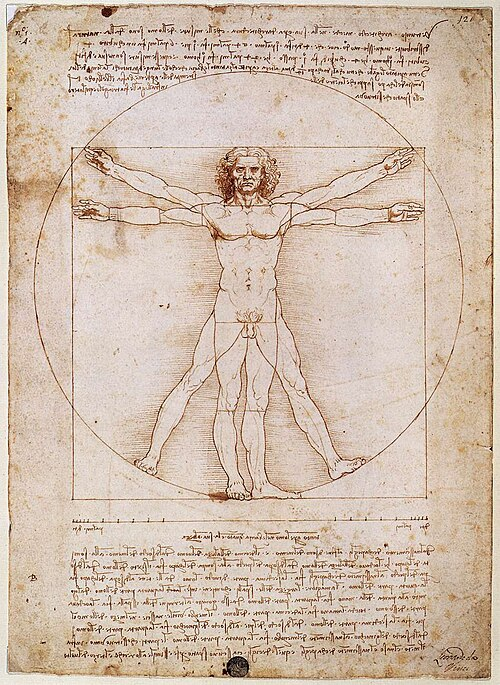
Leonardo da Vinci’s Vitruvian Man (c. 1490) presents the human body as a measurable, proportional system that can be studied through direct observation. The drawing links classical ideas (Vitruvius on ideal proportions) with Renaissance empiricism by treating anatomy as something that can be inspected, compared, and expressed with mathematical precision. Source
Knowledge became less dependent on authority alone and more connected to what could actually be seen, described, and compared.
Observation also changed the tone of intellectual life. It rewarded patience, accuracy, and curiosity. Rather than beginning with a fixed conclusion, scholars were more likely to begin with what they could inspect directly. That habit helped create a culture in which evidence gained greater importance.
Why observation mattered
Observation encouraged scholars to trust the disciplined use of the senses. If the natural world was orderly, then close study could reveal patterns and truths that older commentaries had missed. This did not mean Europeans rejected all traditional learning. Instead, they increasingly balanced respect for older authorities with attention to direct experience.
That balance was transformative. When scholars could compare a written claim with what they observed, authority no longer seemed complete by itself. Nature became another source of knowledge. This shift helped reshape European thought by making inquiry more active and less dependent on unquestioned tradition.
Breaking with Older Patterns
Beyond medieval scholasticism
These two causes mattered because together they weakened the dominance of older methods of learning.
Scholasticism: A medieval method of study that emphasized logical analysis of authoritative texts, especially in theology and philosophy.
Scholasticism trained students to reconcile authorities through formal argument. Renaissance learning did not erase that method, but it changed what many scholars valued most. Classical learning pushed them to recover original texts and contexts. Observation pushed them to examine the world directly. As a result, authority had to be checked, not merely cited. A text had to be read critically, and a claim about nature could be tested against experience.
A broader view of knowledge
The revival of classical learning expanded the subjects that educated Europeans thought important. Ancient writings treated history, rhetoric, ethics, and politics as serious fields of inquiry.
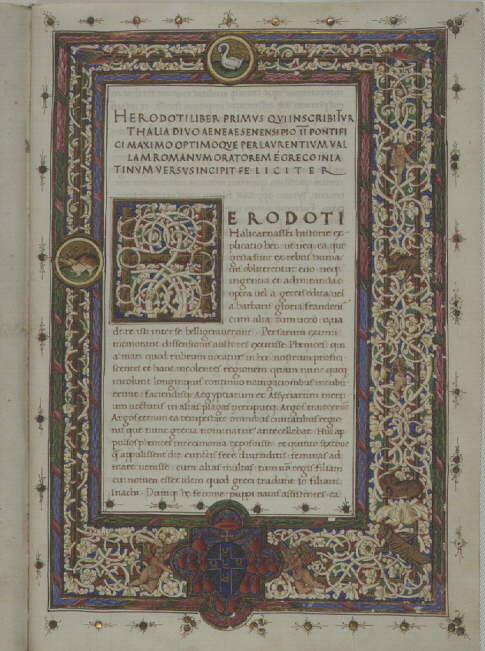
This decorated frontispiece introduces a fifteenth-century Latin translation of Herodotus, illustrating the Renaissance recovery of Greek historical writing through translation and manuscript culture. It reinforces how classical texts—especially history—were treated as authoritative models and carefully transmitted, curated, and studied by humanists. Source
Observation of the natural world expanded interest in physical reality and practical investigation. Together, these developments widened the intellectual agenda of Europe.
This broader outlook transformed European thought because it made learning more human-centered and more evidence-based. People increasingly believed that the human mind could investigate language, history, and nature with skill and discipline. Knowledge was not limited to preserving inherited doctrine; it could also be recovered, corrected, and extended.
New Standards of Scholarship
Evidence, context, and inquiry
Renaissance scholarship increasingly valued:
accurate texts rather than unquestioned copies
historical context rather than timeless interpretation
language study for precise meaning
direct observation alongside book learning
critical comparison as a way to judge evidence
These habits transformed scholarship. Scholars aimed to discover what ancient authors had actually written and what the natural world actually revealed. The revival of classical learning taught Europeans to recover the past carefully, while observation of nature taught them to examine the present closely. Together, these causes made evidence, context, and inquiry central to European intellectual life.
Practice Questions
Identify one way the revival of classical learning transformed European scholarship during the Renaissance. (2 marks)
1 mark for identifying a valid transformation, such as increased study of Greek and Roman texts, greater interest in history and rhetoric, or more critical reading of sources.
1 mark for explaining how that transformation changed scholarship, such as by reducing reliance on unquestioned authority or encouraging comparison of manuscripts.
Evaluate the relative importance of the revival of classical learning and the observation of the natural world in changing European thought during the Renaissance. (5 marks)
1 mark for a clear argument or thesis addressing both factors.
1 mark for explaining the importance of the revival of classical learning.
1 mark for explaining the importance of observation of the natural world.
1 mark for making a comparative judgment about which factor was more important or how they worked together.
1 mark for using specific relevant evidence, such as recovery of ancient texts, textual criticism, direct study of nature, or increased emphasis on evidence.
FAQ
No. Medieval scholars preserved many important texts and built universities that later Renaissance thinkers used.
What changed was emphasis:
Renaissance scholars were less satisfied with relying only on established commentary.
They wanted older sources, better wording, and closer attention to context.
So the Renaissance was partly a break, but also partly a development from medieval foundations.
Many western Europeans had long depended more heavily on Latin texts, including translations and summaries.
The return of Greek study mattered because it allowed scholars to:
read some ancient works more directly
compare translations with originals
notice distortions or omissions
widen the range of classical authors available
That deepened the revival of classical learning and made scholarship more exacting.
Before print became widespread, texts survived in handwritten copies. Collecting manuscripts therefore shaped what scholars could read.
When scholars and patrons searched for neglected works, they:
expanded access to classical literature
encouraged copying and circulation
raised the prestige of ancient learning
created libraries that supported further study
Manuscript collecting was not just a hobby; it helped build the intellectual raw material of Renaissance scholarship.
Not necessarily. Many people believed that studying nature was a way of understanding creation more fully.
For some scholars, close observation complemented faith rather than challenged it. Tension arose only when observed evidence seemed to conflict with accepted interpretations.
In this sense, observation could be both devotional and intellectually disruptive, depending on what it revealed.
The Renaissance did not start everywhere at once, and its causes developed gradually.
Historians debate timing because:
classical learning revived unevenly
local institutions changed at different rates
observation and critical scholarship spread slowly
older medieval methods continued alongside new ones
So the Renaissance is often better understood as a process than as a single starting date.