AP Syllabus focus:
'Monarchs such as Henry VIII and Elizabeth I promoted religious reform from above to control religious life and morality.'
In sixteenth-century England, religion became a matter of royal policy. Reform imposed by rulers reshaped church authority, worship, and moral discipline, showing how monarchs used religion to strengthen obedience and order.
What Top-Down Religious Reform Meant
Top-down religious reform did not begin as a popular movement among ordinary believers. Instead, it was directed by the monarch, supported through government institutions, and enforced on subjects through law, clergy, and local officials.
Top-down religious reform: Religious change imposed by rulers and governments rather than initiated mainly by popular religious movements.
In this model, the crown decided what subjects were expected to believe, how they were expected to worship, and which behaviors were treated as morally acceptable. Religious reform therefore became a political tool as well as a spiritual one. Monarchs could use it to define loyalty, limit resistance, and shape everyday life.
Henry VIII: Reform Directed by the Crown
Henry VIII is the clearest early example of reform imposed from above. His break with the papacy was driven first by dynastic and political concerns, especially his desire to secure an annulment and control decisions affecting the English crown. The result was a major institutional shift: the English monarch, not the pope, would command the national church.
The key turning point was the Act of Supremacy of 1534, which declared the king supreme head of the Church of England. This established royal supremacy in the English church and made obedience to royal religious policy a test of political loyalty.
Royal supremacy: The principle that the monarch held ultimate authority over the national church within the realm.
Henry used this authority to reorganize religious life. The dissolution of the monasteries placed vast church wealth and land under royal control and weakened an important independent religious institution.

An interactive map plotting monastic houses affected by the Dissolution, showing how widespread the crown’s intervention was across the realm. The spatial distribution helps explain why the policy reshaped local communities as well as national finances: monasteries were embedded throughout England’s religious and economic landscape. Mapping the closures makes the “institutional shift” of top-down reform visible at a national scale. Source
Royal injunctions shaped preaching, worship, and the circulation of approved religious texts. Yet Henry’s reform was not fully Protestant in doctrine. He changed authority more than belief, showing that top-down reform could be selective and practical rather than ideologically consistent.
Elizabeth I and the Religious Settlement
Elizabeth I also promoted reform from above, but her approach was more carefully balanced. When she came to the throne, England had already experienced sharp religious swings. Elizabeth therefore aimed to create stability through a settlement controlled by the state rather than by rival religious factions.
The Religious Settlement of 1559 restored royal control over the church and required outward uniformity in worship.
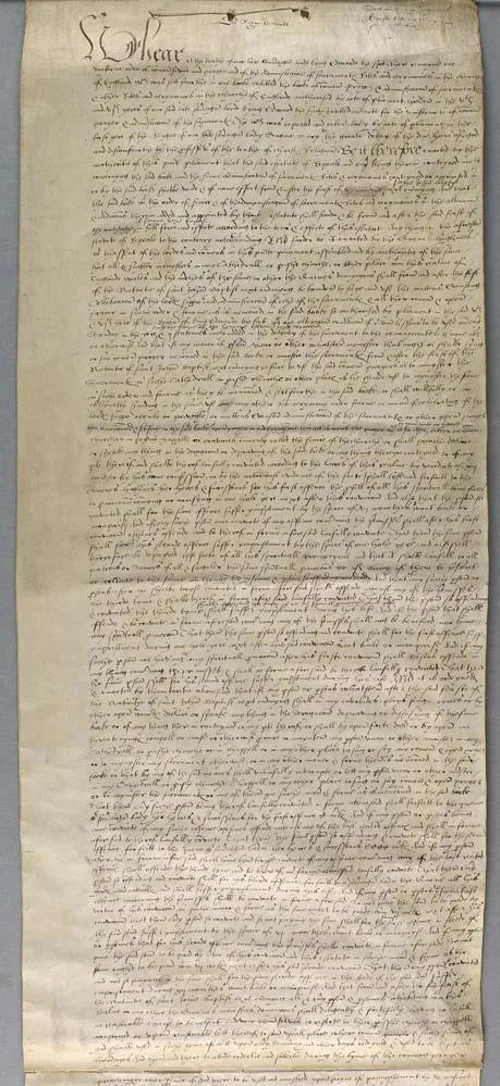
A scanned image of the 1559 Act of Uniformity, the statute that legally enforced a standardized form of public worship in Elizabethan England. Seeing the original document emphasizes how religious practice was regulated through parliamentary law, not simply through preaching or popular enthusiasm. It illustrates the administrative and legal backbone of the Elizabethan Religious Settlement. Source
The Act of Supremacy made Elizabeth the Supreme Governor of the Church of England, while the Act of Uniformity required use of an approved prayer book and attendance at church services. This did not eliminate disagreement, but it made the crown the final authority in religious policy.
Elizabeth’s reform showed the political logic of top-down change. She did not simply encourage belief; she regulated practice. By requiring common worship, licensing clergy, and supervising bishops, the monarchy tried to reduce open conflict and create a religious order compatible with political obedience. Her policy was less about satisfying all consciences than about preventing religious division from threatening the realm.
Controlling Religious Life and Morality
Top-down reform extended beyond church leadership into everyday conduct. Early modern rulers believed that a well-ordered society depended on religious discipline. As a result, reform touched both religious life and morality.
This control worked through several mechanisms:
Uniform worship: Subjects were expected to attend approved services and follow official liturgy.
Clerical supervision: The state influenced who could preach, teach, and hold church office.
Moral discipline: Authorities monitored behavior considered sinful or disorderly, linking religion to social stability.
Legal enforcement: Refusal to conform could bring fines, loss of office, imprisonment, or suspicion of disloyalty.
Under this system, religion helped define acceptable behavior in the community. Church attendance, public worship, and respect for approved doctrine became visible signs of obedience. Moral regulation also had a broader purpose: it supported a disciplined society in which authority flowed from the crown downward.
Religion as an Instrument of Rule
Henry VIII and Elizabeth I demonstrate that religious reform in the sixteenth century was not always driven by theologians or grassroots protest. In England, it often came through statutes, proclamations, and official enforcement. Monarchs reshaped religion to govern more effectively.
This reveals a major feature of early modern rule: religion and politics were deeply intertwined. By directing reform from above, rulers claimed the right to organize worship, discipline conduct, and define the relationship between conscience and obedience. The key historical point is that these monarchs used reform not only to alter church structures but also to control the moral and religious life of their subjects.
Practice Questions
Identify ONE action taken by Henry VIII to promote religious reform from above in England, and briefly explain how it increased royal control over religion. (2 marks)
1 mark for identifying a valid action, such as the Act of Supremacy, the dissolution of the monasteries, royal injunctions, or requiring obedience to the king as head of the church.
1 mark for explaining how that action increased royal control, such as reducing papal authority, placing church wealth under the crown, or making loyalty to religious policy a test of obedience.
Evaluate the extent to which Elizabeth I’s religious policies were designed to control religious life and morality in England. (6 marks)
1 mark for a defensible thesis that directly answers the question.
1 mark for relevant contextualization, such as religious instability before Elizabeth’s reign or the need for political order.
2 marks for specific evidence related to Elizabeth’s policies, such as the Religious Settlement of 1559, the Act of Supremacy, the Act of Uniformity, required church attendance, or supervision of clergy.
1 mark for explaining how the evidence shows control of religious life through uniform worship and state authority.
1 mark for explaining how the evidence shows control of morality or social discipline, or for offering a qualified judgment about the extent of Elizabeth’s success.
FAQ
The title was politically safer than “Supreme Head.” Some subjects objected to the idea that a woman could be head of the church, while others thought only Christ could hold that position in a spiritual sense.
“Supreme Governor” preserved royal authority without forcing the same level of theological resistance. It was a practical wording choice that helped Elizabeth win broader acceptance for her settlement.
Royal visitations sent officials into dioceses and parishes to inspect clergy, church buildings, books, and religious objects. They checked whether local communities were following official policy.
These inspections mattered because they turned royal commands into local enforcement. Visitations gathered information, exposed non-compliance, and reminded communities that religious policy came from the crown, not merely from local custom.
Many people chose outward conformity because the risks of open resistance were high. Missing services, rejecting official worship, or challenging royal policy could bring fines, suspicion, or loss of office.
This created a gap between public behaviour and private belief. In practice, the monarchy often cared most about visible obedience, because outward conformity helped maintain order even when inward conviction remained uncertain.
Changes in policy often altered church interiors. Depending on the ruler, parishes might remove images, cover wall paintings, replace altars with communion tables, or display authorised English Bibles and royal instructions.
These physical changes mattered because they made reform visible. Subjects could see that religion was being reorganised by authority from above, not simply debated in books or sermons.
The monarch did not act alone. Enforcement depended on bishops, churchwardens, justices of the peace, and other local officeholders who translated national policy into parish practice.
This network was essential because the crown could not monitor every community directly. Local officials reported disobedience, enforced attendance, and helped make religious reform part of everyday governance.