AP Syllabus focus:
'Continued political fragmentation in Renaissance Italy encouraged new ideas about the secular state.'
Renaissance Italy remained divided among competing powers, and that instability reshaped political thought. In this environment, rulers and writers increasingly valued practical rule, diplomacy, and survival over universal medieval ideals.
Italy's Political Landscape
Renaissance Italy was not a unified kingdom. It was a patchwork of competing city-states, republics, princely territories, and the Papal States.
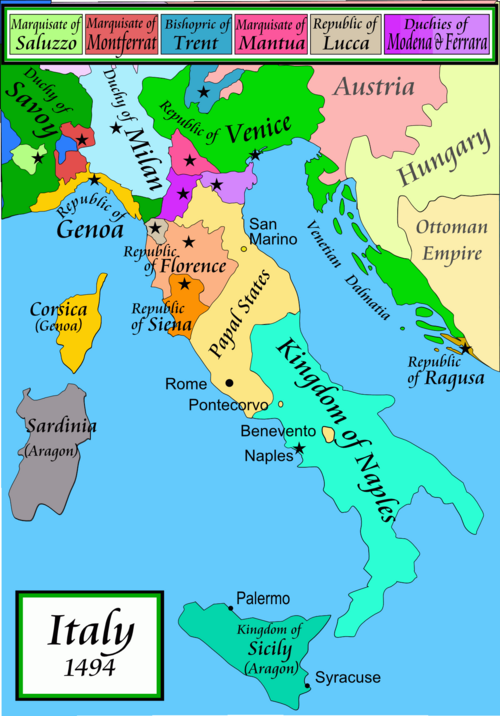
Political map of the Italian peninsula in 1494, showing the major territorial states (e.g., Venice, Milan, Florence, the Papal States, and Naples) alongside smaller entities. The dense mosaic of borders illustrates why Renaissance Italy faced constant rivalry and why diplomacy and military readiness mattered so much to state survival. Source
Major powers included Florence, Venice, Milan, Naples, and Rome under papal rule. Their wealth, strong local traditions, and long histories of self-government made political unity difficult.
Unlike more centralized monarchies in western Europe, Italy had no single ruler able to impose lasting control over the peninsula. Instead, governments guarded their independence, feared neighboring expansion, and relied on shifting alliances. This political fragmentation created a competitive environment in which survival often depended on calculation rather than inherited custom or universal Christian ideals.
Why Fragmentation Encouraged New Thinking
Because Italian states lived beside powerful rivals, politics became immediate and practical. Rulers had to raise money, secure borders, control elites, negotiate with neighbors, and respond quickly to danger. In this setting, good government was increasingly judged by whether it kept the state stable and secure.
The weakness of divided Italy became even clearer when foreign powers, especially France and Spain, intervened in Italian affairs.
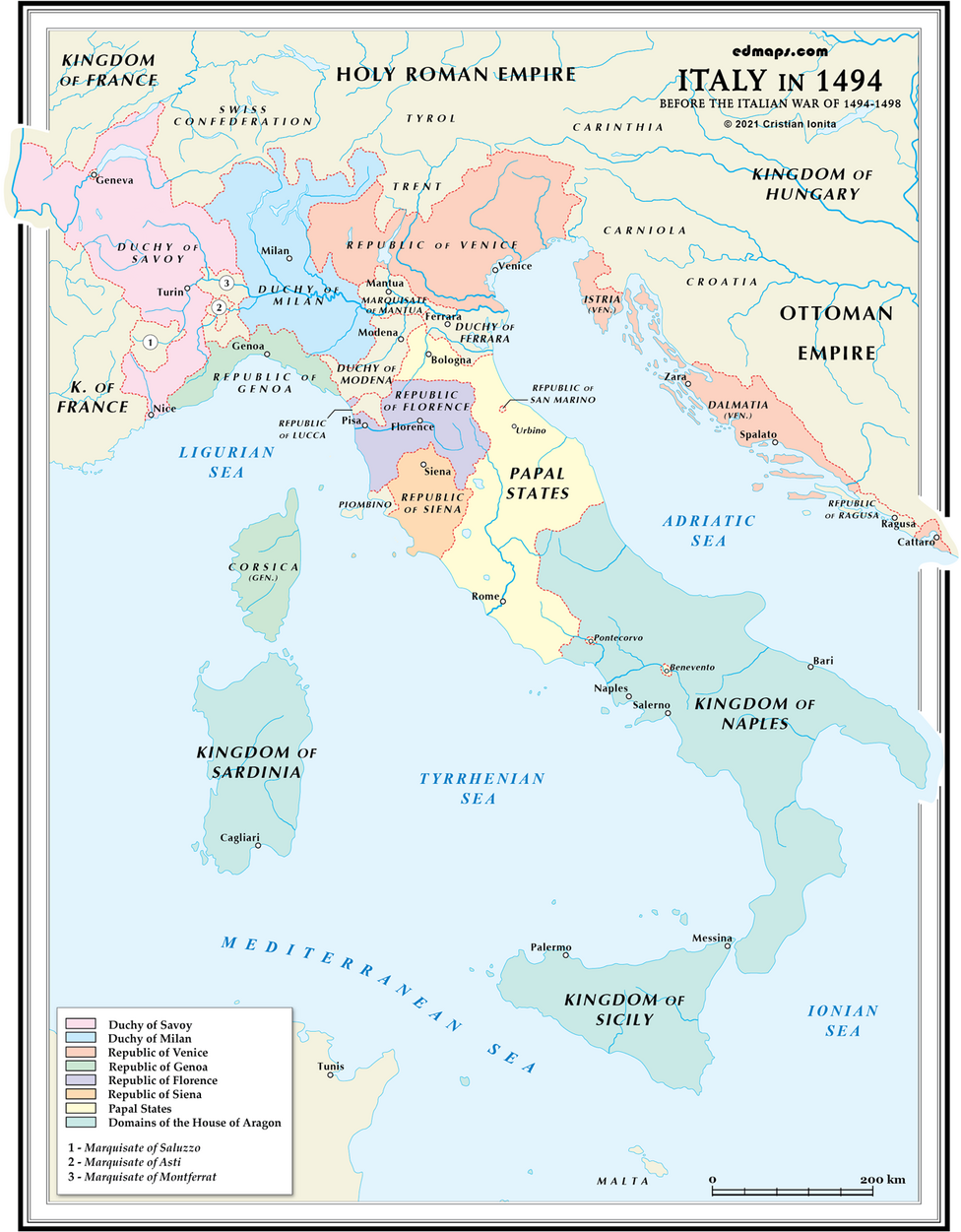
An educational map page centered on Italy in 1494, a key moment just before sustained foreign intervention escalated into the Italian Wars. Used alongside your notes, it helps students connect the geographic reality of divided states to the strategic problem of defending Italy against major outside powers. Source
These invasions showed that wealth and culture alone did not guarantee safety. Italian leaders therefore paid closer attention to military organization, diplomacy, intelligence gathering, and administrative efficiency. The result was a more realistic view of politics, one less centered on medieval ideas of a single Christian commonwealth.
Secular Statecraft
Out of this environment grew secular statecraft, a way of thinking about politics as a distinct sphere of human action.
Secular statecraft: An approach to politics that treats governing as a practical human activity focused on power, security, and administration rather than primarily on religious authority or church doctrine.
This did not mean that religion disappeared from politics. Italian rulers still sought legitimacy, used religious language, and operated in a society shaped by Christianity. The change was that political decisions were increasingly defended in terms of state interest, necessity, and effectiveness. A ruler who preserved order, protected territory, and strengthened the government could be praised even if his methods were morally troubling.
This was a major departure from older expectations that political conduct should closely reflect Christian virtue. In fragmented Italy, leaders often believed that strict moral idealism could leave a state exposed to stronger, less scrupulous rivals. Political success therefore seemed to require flexibility, caution, and sometimes deception.
Diplomacy and Political Calculation
Italian fragmentation also encouraged new diplomatic habits. Since no major state was strong enough to dominate permanently, rulers watched one another constantly and tried to prevent any single power from becoming too powerful. This logic helped shape the balance of power.
Balance of power: A diplomatic principle in which states prevent any one rival from becoming overwhelmingly dominant by shifting alliances and combining against the strongest power.
Italian governments increasingly used permanent envoys, careful reporting, and regular negotiation to manage rivalries. Diplomacy became less a temporary response to crisis and more a permanent tool of government. The state was treated as an enduring political actor whose interests had to be monitored and defended at all times. This development reflected a secular understanding of politics: rulers needed information, strategy, and foresight, not just moral claims, to survive.
Machiavelli and the New Politics
Niccolò Machiavelli became the most famous writer to emerge from this world of instability.
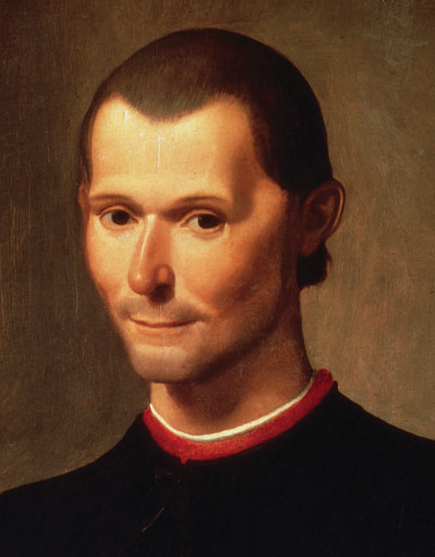
Posthumous painted portrait of Niccolò Machiavelli, the Florentine official whose writings helped define secular statecraft. Placing Machiavelli in a concrete historical and cultural setting reinforces why his arguments about power, necessity, and effective rule resonated in a competitive Italy. Source
A Florentine official and observer of war, alliance, and foreign invasion, he argued that rulers must understand politics as it actually worked, not as moralists wished it to work.
In The Prince, Machiavelli presented government as a matter of power, necessity, and effective action. A ruler's first duty was to maintain the state. If harsh measures, manipulation, or force were required to preserve political order, he suggested that they might be justified. This analysis made the security of the state more important than abstract moral perfection.
Machiavelli's thought was also broader than support for princes alone. In the Discourses, he praised republican energy and citizen participation, showing that secular statecraft could apply to different forms of government. What united his writings was the assumption that politics followed its own rules and should be studied through history, experience, and human behavior rather than theology.
Significance and Limits
The Italian example mattered because it helped separate politics from the universal claims of church and empire. Fragmentation encouraged rulers and thinkers to treat the state as something that had its own interests, its own problems, and its own methods.
At the same time, this shift had limits. Renaissance Italy did not become irreligious, and rulers did not stop using religion to strengthen authority. Yet the pressures of competition pushed political thought in a more secular direction. In divided Italy, survival itself became a central political principle.
Practice Questions
Identify ONE reason continued political fragmentation in Renaissance Italy encouraged secular ideas about politics. (2 marks)
1 mark for identifying a relevant condition such as rivalry among Italian states, the absence of a unified monarchy, frequent warfare, or foreign intervention.
1 mark for explaining that this pushed rulers to prioritize practical state survival, diplomacy, or military strength over universal religious ideals.
Explain how political fragmentation in Renaissance Italy contributed to the development of secular statecraft in the fifteenth and early sixteenth centuries. (6 marks)
1 mark for a clear argument that fragmentation encouraged practical, power-centered governance.
Up to 4 marks for specific supporting points, such as:
competition among Florence, Venice, Milan, Naples, and the Papal States
shifting alliances and diplomacy used to preserve independence
greater emphasis on effective rule, military preparedness, and administration
foreign invasions exposing the weakness of divided Italy
Machiavelli arguing that rulers should act according to political necessity
1 mark for qualification or nuance, such as noting that religion still mattered even as politics became more secular.
FAQ
The Peace of Lodi of 1454 mattered because it reduced open warfare among major Italian powers, especially Milan, Venice, and Florence.
It also encouraged a more deliberate system of alliance politics. Rather than trying to conquer the whole peninsula, rulers often aimed to preserve equilibrium. That helped make political balance, not unity, a realistic goal.
Condottieri were leaders of mercenary companies hired by Italian states under military contracts.
Italian governments often used them because many city-states lacked large standing armies. Mercenaries offered flexibility, but they could be expensive, self-interested, and unreliable. Their importance shows how politics in Italy often depended on money, negotiation, and short-term calculation.
The Medici often governed through influence rather than open monarchy. They built power through banking wealth, patronage, family alliances, and control over officeholding.
This mattered because Florence formally preserved republican institutions while one family exercised enormous informal authority. It was a classic example of how Renaissance Italian politics could be highly personal even when constitutional forms remained in place.
Guicciardini, another Florentine political thinker, shared Machiavelli’s interest in realism but was generally more cautious.
He placed greater stress on circumstance, experience, and the limits of broad political rules. Where Machiavelli often searched for recurring patterns in history, Guicciardini was more sceptical and believed that each political situation had to be judged on its own conditions.
Marriage ties, kinship groups, and patron-client relationships often shaped alliances as much as formal institutions did.
In a fragmented political world, family connections could secure loyalty, reduce risk, and open access to offices or military support. This made Italian politics highly personal. Power often depended not only on law or territory, but also on who was connected to whom.