AP Syllabus focus:
'The Portuguese built a commercial network along the African coast, in Asia, and in South America during the late fifteenth and sixteenth centuries.'
In the late fifteenth and sixteenth centuries, Portugal created a wide maritime trading system that connected African coastal markets, Indian Ocean commerce, and Brazilian production through ships, ports, and strategic control of sea routes.
Foundations of Portuguese expansion
Portugal was a small European kingdom, so its rulers could not easily build a vast land empire. Instead, they pursued a maritime commercial strategy. Portuguese captains gradually explored the Atlantic and the western coast of Africa, looking for profitable exchange and secure navigational routes.
Important voyages marked the growth of this network:
Bartolomeu Dias rounded the Cape of Good Hope in 1488
Vasco da Gama reached India by sea in 1498
Pedro Álvares Cabral reached Brazil in 1500
These voyages allowed Portugal to connect the Atlantic Ocean to the Indian Ocean and then to extend commercial activity into South America.
The Portuguese model depended less on conquering large inland territories and more on controlling ports, coastal bases, and key sea lanes.
Trade along the African coast
The first major stage of Portuguese expansion developed along the African coast. Portuguese sailors established regular contact with coastal rulers and merchants, creating exchange networks for valuable goods.
Feitoria: A fortified trading post or factory established by the Portuguese to store goods, conduct trade, and protect commercial interests at an important port.
Portuguese feitorias helped them maintain a permanent presence without conquering extensive inland areas. A major example was Elmina, founded in 1482 on the Gold Coast.
From such posts, Portuguese merchants obtained:
gold
ivory
pepper
other regional products
This system relied heavily on negotiation with African elites. Portuguese power was strongest on the coast, while inland rulers often remained politically independent. The result was not a continuous territorial empire, but a chain of commercial footholds linked by sea.
African expansion also gave Portugal practical experience in:
long-distance ocean travel
coastal fortification
naval supply systems
commercial administration overseas
These experiences later shaped Portuguese activity in both Asia and Brazil.
Expansion into Asia
After da Gama’s voyage, Portugal entered the already active trade system of the Indian Ocean. Portuguese merchants and officials did not invent Asian commerce; instead, they tried to insert themselves into existing routes and redirect profits toward Portugal.
Their approach centered on controlling strategic choke points and heavily trafficked ports.
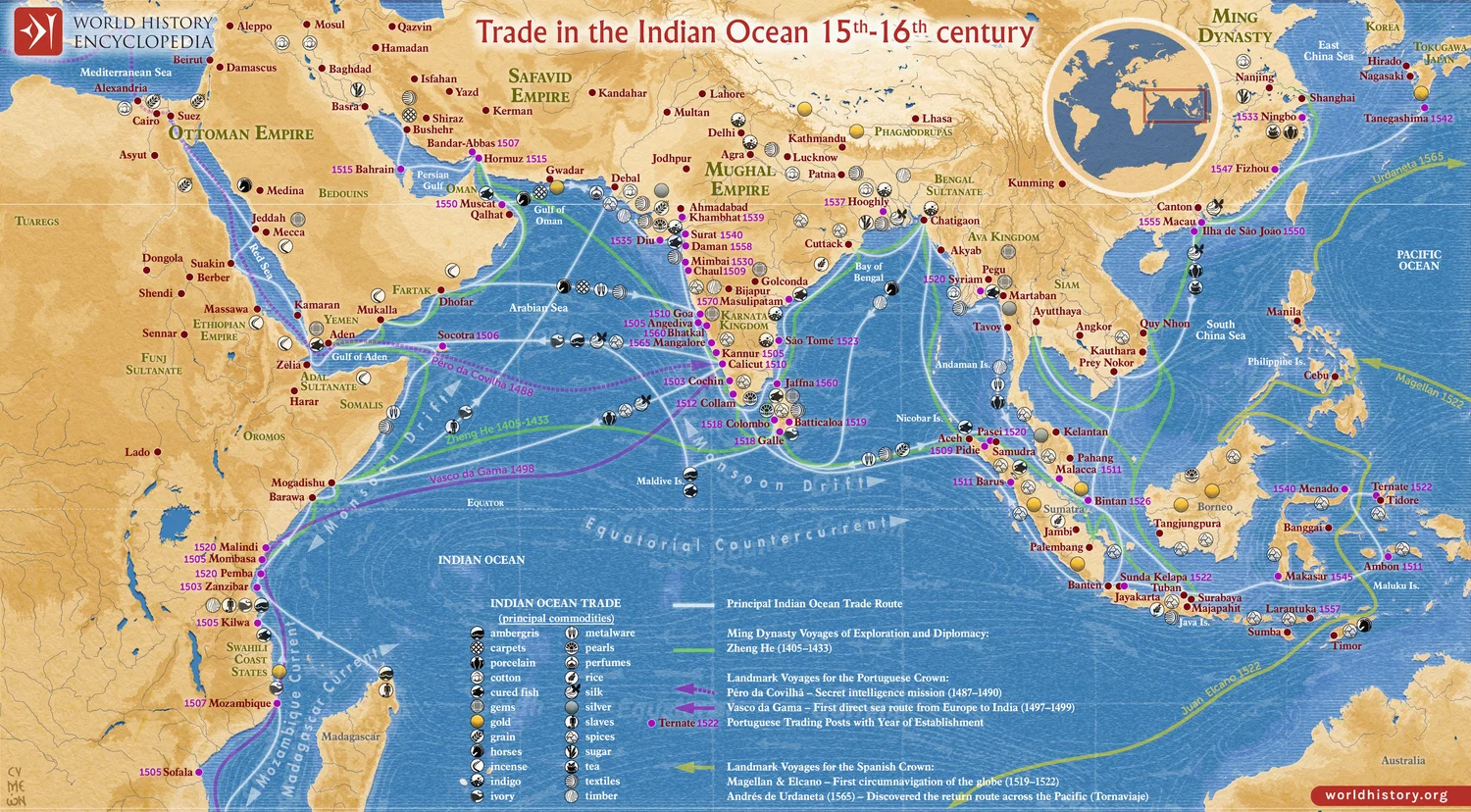
This map visualizes the Indian Ocean trading system in which the Portuguese inserted themselves, highlighting the dense web of maritime connections between East Africa, the Middle East, South Asia, and Southeast Asia. It supports the notes’ emphasis on strategic ports and choke points by situating places like Calicut, Hormuz, and Malacca within wider routes of exchange. The result is a geographic explanation for why controlling a few fortified nodes could influence commerce across an entire ocean basin. Source
Important locations included:
Goa in India, captured in 1510
Malacca in Southeast Asia, captured in 1511
Hormuz at the entrance to the Persian Gulf, taken in 1515
Estado da Índia: The Portuguese crown’s administrative and commercial system in the Indian Ocean, centered on fortified ports and governed mainly from Goa.
Through the Estado da Índia, Portugal aimed to dominate the movement of high-value goods such as:
spices
silks
cotton textiles
precious stones
luxury items from Asian markets
Portuguese influence in Asia depended on warships, fortresses, and selective alliances. Rather than seeking to rule all of India or Southeast Asia, they tried to command the most profitable points in the trade network. This was a commercial empire at sea, not a large continental empire.
Because Portugal had limited manpower, this strategy made practical sense. A small number of heavily defended ports could influence trade over a much larger area than Portugal could directly govern on land.
South America and Brazil
Portuguese expansion also reached South America, especially Brazil. After Cabral’s landing, Portugal claimed the territory and began to exploit its coastal resources. In the early phase, one important export was brazilwood, valued as a dye source.
Over time, Brazil became more significant because of sugar production along the Atlantic coast. This gave Portugal an important commercial base in the western Atlantic and tied South America into a wider Portuguese system linking:
Brazilian plantations
Atlantic shipping
African coastal trade
Brazil differed from many Portuguese outposts in Africa and Asia because settlement became more extensive there. Even so, the Portuguese presence first developed around the coast, ports, and export activity rather than immediate inland domination.
Brazil therefore became both a colony of settlement and a commercial zone, strengthening Portugal’s position in transoceanic trade during the sixteenth century.
Key characteristics of the Portuguese network
The Portuguese overseas system had several distinctive features:
it was maritime, not mainly territorial
it relied on fortified coastal posts
it focused on high-value trade
it connected Africa, Asia, and South America
it depended on royal direction but also on merchants, sailors, and local intermediaries
This network was impressive in scale, but it also had weaknesses:
routes were very long and expensive to maintain
Portugal had a relatively small population
overseas officials were widely scattered
control often depended on a limited number of ships and strongpoints
Portuguese early expansion is important because it showed how a European state could build a far-reaching overseas presence through commerce, naval strength, and strategic ports, creating one of the earliest durable global trade networks of the early modern period.
Practice Questions
Identify TWO features of the Portuguese overseas commercial network in the late fifteenth and sixteenth centuries. (2 marks)
1 mark for identifying reliance on fortified coastal trading posts or ports
1 mark for identifying focus on maritime trade rather than large inland conquest
1 mark for identifying the network’s spread across the African coast, Asia, and Brazil
1 mark for identifying control of strategic sea routes through naval power
Award any two valid points for a maximum of 2 marks.
Explain how Portugal built and maintained a commercial network along the African coast, in Asia, and in South America during the late fifteenth and sixteenth centuries. (6 marks)
Up to 2 marks for explaining African expansion, such as voyages down the coast, establishment of feitorias, or trade through ports like Elmina
Up to 2 marks for explaining Asian expansion, such as da Gama’s route to India, seizure of Goa, Malacca, or Hormuz, or control of Indian Ocean trade routes
Up to 2 marks for explaining South American expansion, such as Cabral’s claim to Brazil, export of brazilwood, or growth of coastal sugar production
To earn full marks, the response should address all three regions and explain methods of network-building, not just list places.
FAQ
The Casa da Índia was a royal institution in Lisbon that helped manage Portugal’s overseas trade, especially with Asia.
It supervised shipping, cargoes, customs duties, and commercial information. In practice, it was a key tool for turning overseas expansion into crown revenue. It also helped the monarchy keep tighter control over valuable imports such as spices.
The cartaz was a naval pass issued by the Portuguese in the Indian Ocean.
Ships were often expected to carry one to trade legally in waters patrolled by Portugal. This allowed Portuguese authorities to inspect commerce, collect fees, and try to weaken rivals. It was a way of projecting influence at sea even when Portugal lacked direct rule on land.
Macau, on the southern coast of China, became valuable because it connected Portuguese merchants to East Asian trade.
It served as an important base for exchange involving Chinese silk, Japanese silver, and other luxury goods. Its value came less from large territorial control and more from its position inside profitable regional trade circuits.
Portuguese expansion depended on many groups beyond crown officers.
These included:
private merchants
ship captains
financiers
interpreters
local pilots
Asian, African, and Brazilian intermediaries
Without these people, long-distance trade would have been much harder to organise. The network was therefore not run by the state alone, even when the crown claimed authority over it.
Portuguese settlements were often small and far from Europe, so daily life depended on local relationships.
Marriage, partnership, trade, and language exchange produced Luso-African and Luso-Asian communities in several regions. These groups could act as brokers between Portuguese newcomers and local societies. Their existence shows that Portuguese expansion was not simply one-way domination; it also involved adaptation and cultural blending.