AP Syllabus focus:
'Responses to Luther and Calvin included religious radicals such as the Anabaptists and social groups like German peasants.'
The Reformation did not stop with Luther or Calvin. It also inspired more disruptive movements that challenged church membership, social hierarchy, and political obedience in ways many rulers found dangerous.
Why radical responses emerged
The first wave of Protestant reform weakened the belief that a single church and clergy should govern all Christians. Once traditional authority was questioned, some believers asked why reform should remain limited. They wanted a church made up of committed believers, not an entire population automatically enrolled at birth.
Others connected religious change to demands for justice in everyday life. This pushed the Reformation beyond doctrine and into conflicts over authority, social order, and political obedience. In this sense, radical responses differed from more moderate reformers, who usually worked with princes or city governments and aimed to preserve stability.
The Anabaptists
Beliefs and practices
One of the most important radical groups was the Anabaptists.
Anabaptists: Radical reformers who rejected infant baptism and argued that only believing adults should be baptized and admitted to the church.
Unlike Luther, most Anabaptists did not accept a broad territorial church supported by rulers. They argued that a true Christian church should be voluntary, disciplined, and separate from the automatic religious identity of the larger population. Many gathered in homes or small fellowships and expected clear moral commitment from members.
Important Anabaptist beliefs included:
Adult baptism, because faith had to be a conscious personal decision
A gathered church made up of true believers rather than everyone in a territory
Strong emphasis on the Bible as the guide to Christian life
In many communities, pacifism, refusal to swear oaths, and simple living
Not all Anabaptists were alike. Some groups were peaceful and communal, while a few adopted more apocalyptic and militant ideas. Still, the movement as a whole challenged the assumption that religious unity should be enforced by the state.
Why rulers feared them
Anabaptism alarmed both Catholic and Protestant authorities because early modern governments tied religion closely to public order. Infant baptism was not just a sacrament; it marked a person’s place within the Christian community and, indirectly, within the political community as well.
Rulers feared Anabaptists because they seemed to undermine:
State-supported churches, by rejecting automatic membership
Civic authority, especially when they refused oaths or military service
Social unity, because separate religious meetings could appear secretive or rebellious
A dramatic militant episode at Münster in the 1530s intensified these fears.
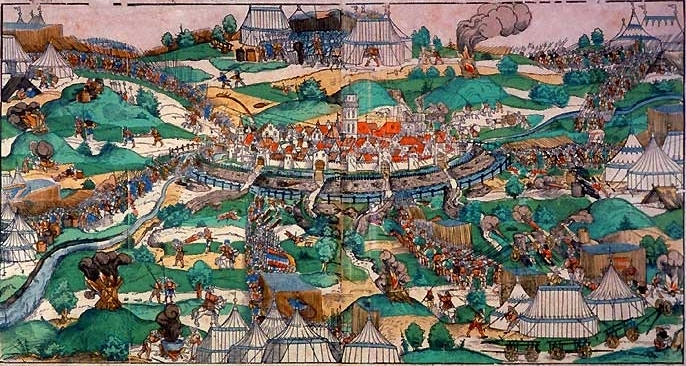
This period image depicts the city of Münster under siege during the Anabaptist takeover, capturing the episode that became a cautionary tale for early modern authorities. The scene underscores why rulers associated certain radical religious movements with civic instability and even open warfare. Source
There, radical leaders took control of the city and tried to build a godly community by force. Although most Anabaptists were not violent, Münster convinced many rulers that radical religion could produce political disorder. As a result, Anabaptists were often persecuted, imprisoned, or executed.
German peasants and social protest
Causes of unrest
Radical response also appeared among German peasants, who combined religious language with long-standing economic and social complaints. Many resented rising dues, labor obligations, restrictions on hunting and wood gathering, and pressure from lords over land and village customs.
Reformation preaching gave some peasants a new language of Christian freedom with which to criticize lordly power. They did not simply call for chaos. Instead, they argued that social relations should better reflect justice and the will of God.
Their demands included:
Relief from excessive feudal dues
Greater control over the selection of pastors
Restoration of traditional village rights
Objections to forms of serfdom and arbitrary lordly power
These ideas appeared clearly in the Twelve Articles of 1525, a famous statement of peasant grievances. The document used scripture to support social and economic demands, showing how closely religious reform and popular protest could become linked.
The Peasants' War
The German Peasants' War of 1524-1525 spread through parts of southwestern and central Germany.
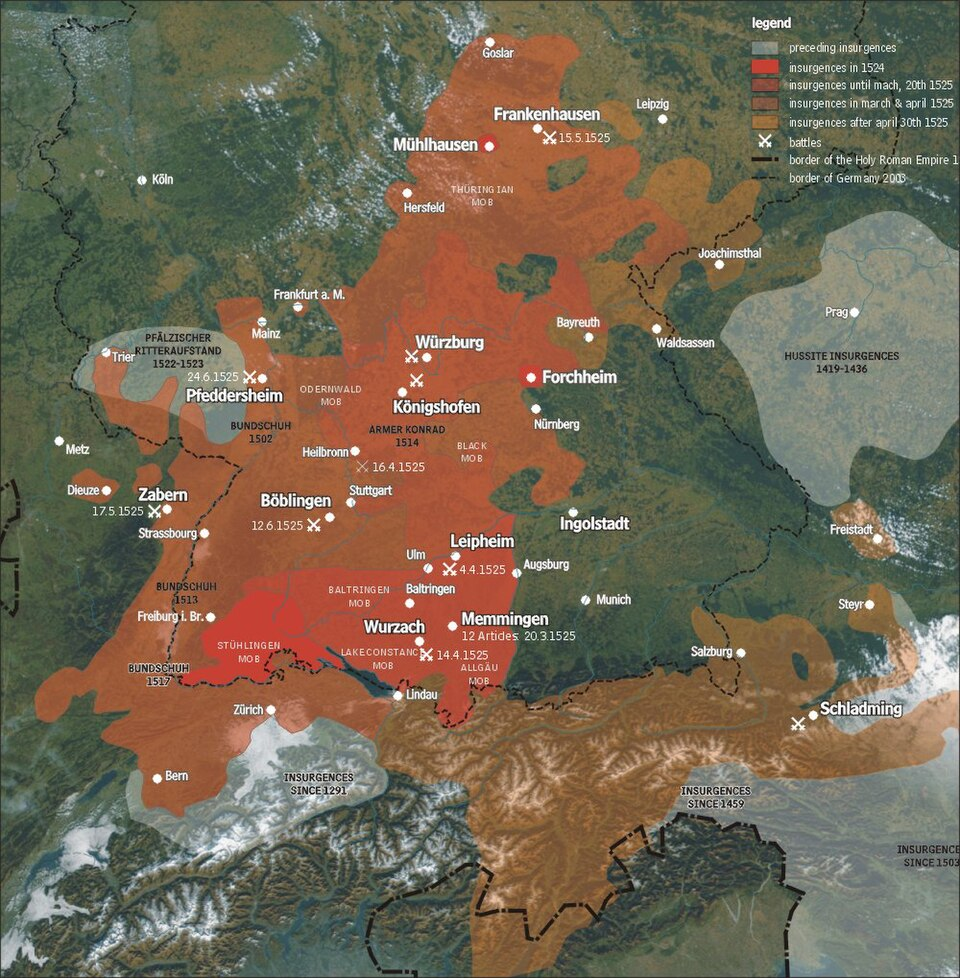
This map plots major centers and flashpoints of the German Peasants’ War (1523–1525), visually emphasizing how peasant bands mobilized across a wide swath of the German lands. Seeing the clustered sites of revolt helps explain why territorial rulers treated the uprising as a systemic threat to political order, not merely a set of isolated disturbances. Source
Peasant bands attacked monasteries, castles, and legal records that symbolized seigneurial control.
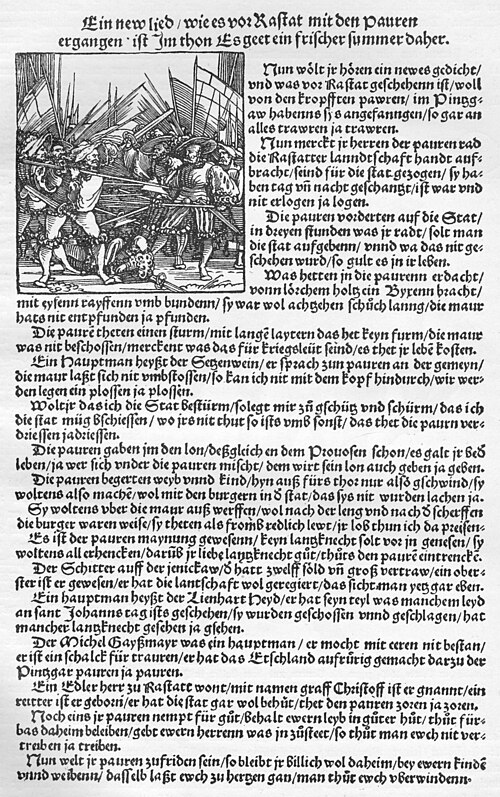
This contemporary-style leaflet from the time of the German Peasants’ War illustrates how print culture helped circulate messages, symbols, and polemics during the uprising. As a visual source, it highlights that the conflict was not only fought with weapons but also with propaganda and public persuasion aimed at shaping legitimacy and obedience. Source
The uprising drew strength from local grievances, but it was also energized by the belief that reform should transform society, not just church teaching.
Some radicals, especially Thomas Müntzer, encouraged a more confrontational response and portrayed struggle as part of God’s judgment against injustice. This gave the revolt a sharper religious intensity, though not all peasants followed such extreme ideas.
Luther at first urged rulers to address peasant complaints, but when the revolt turned violent he condemned it harshly and supported the restoration of order. His response showed the limits of mainstream Protestant reform: he accepted religious change, but not social revolution. Princes and armies crushed the uprising, killing tens of thousands of peasants.
Why these responses mattered
Radical responses to the Reformation were important because they revealed how deeply religion shaped social life.
They showed that reform could inspire ordinary people, not just theologians and rulers.
They exposed the difference between religious reform and social revolution.
They demonstrated that questions about baptism, church membership, and scripture could also become questions about property, justice, and obedience.
They helped define the boundaries of acceptable Protestantism, since both Protestant and Catholic rulers moved against groups they considered too radical.
They also left a lasting legacy, because some Anabaptist traditions survived persecution and continued outside official churches.
Practice Questions
Identify ONE belief of the Anabaptists and briefly explain why it worried early modern rulers. (2 marks)
1 mark for correctly identifying a belief such as adult baptism, voluntary church membership, pacifism, refusal of oaths, or rejection of infant baptism.
1 mark for explaining why that belief alarmed rulers, such as weakening state churches, challenging civic authority, or undermining social unity.
Evaluate the extent to which the German Peasants' War was driven by religious ideas rather than social and economic grievances. (6 marks)
1 mark for a clear thesis that makes a defensible argument about the relative importance of religious versus social and economic causes.
1 mark for evidence of religious influence, such as Christian freedom, use of scripture, or the Twelve Articles.
1 mark for additional religious evidence, such as the influence of reform preaching or Thomas Müntzer.
1 mark for evidence of social or economic grievances, such as feudal dues, labor services, serfdom, or loss of common rights.
1 mark for additional social or economic evidence, such as resentment of lordly control or village tensions.
1 mark for analysis that explains how these causes interacted or that shows the revolt was a mix of both religious and material demands.
FAQ
Persecution pushed many Anabaptists into small, mobile congregations rather than large public churches. They often met in houses, barns, or remote rural spaces and relied on trusted local networks.
This pressure also encouraged strict discipline. Leaders had to be careful, members were expected to show strong commitment, and migration became common as communities sought safer regions.
Menno Simons was a former Catholic priest who became one of the most influential leaders of Dutch and north German Anabaptists. He helped give scattered groups a clearer identity after severe repression.
He emphasised adult baptism, non-violence, moral discipline, and separation from worldly corruption. Because of his influence, many followers later became known as Mennonites.
Münster became famous because radicals there seized control of a city and tried to impose a dramatic religious transformation. Their rule included communal experiments, authoritarian leadership, and extreme social policies.
Its violent collapse gave enemies of radical reform a powerful warning story. For years afterwards, rulers used Münster as proof that religious radicalism could lead to political chaos, even though most Anabaptists rejected violence.
Yes. Women often hosted meetings, spread beliefs within households, and joined adult baptism as a public declaration of faith. In persecuted groups, their commitment could be highly visible.
Some women also gained attention as prophets, witnesses, or martyrs. Even so, most radical groups still limited formal authority, so women’s influence was often strongest in informal religious life rather than official leadership.
Ideas survived through oral teaching, family memory, letters, hymns, and secret gatherings. Travelling preachers and refugees connected isolated communities across regions.
Over time, suffering itself became part of group identity. Stories of imprisonment and execution were remembered as signs of true faith, helping later generations preserve beliefs even without legal protection.