AP Syllabus focus:
'Some Protestant groups, especially Calvinists, taught that wealth could be viewed as a sign of God’s favor and diligent labor.'
This topic explains how some Protestant believers linked religious faith to everyday labor, thrift, and prosperity, reshaping attitudes toward work without teaching that salvation could be bought, earned, or guaranteed by material success.
Work as a Religious Duty
For many Protestant reformers, ordinary daily labor gained new spiritual dignity. Work was not merely a practical necessity; it could be a way to serve God. This idea was especially important in communities influenced by Calvinism, where believers were urged to live disciplined, morally serious lives.

This lithographic portrait of John Calvin (Jean Calvin) provides a visual reference for the leading Reformed theologian whose ideas shaped Calvinist religious culture. Including Calvin’s image helps connect the discussion of discipline, calling, and moral seriousness to a specific historical actor and movement. Source
When Protestants argued that all believers should honor God directly, they also challenged the older assumption that monasteries and convents represented a higher spiritual path than ordinary occupations. Farming, trade, craftsmanship, and household management could all become forms of religious obedience when performed faithfully.
The key idea was the calling.
Calling: The belief that each person has a God-given vocation or duty in ordinary life, and that serving faithfully in that role is a way to glorify God.
This teaching elevated everyday occupations. A merchant or artisan could view careful work, honesty, and persistence as signs of obedience to God rather than as merely worldly activity.
Wealth as a Sign, Not a Cause
The most important distinction is that wealth did not create salvation. Protestants, especially Calvinists, did not teach that money could purchase God’s favor. Instead, some believers came to see prosperity from disciplined labor as a possible outward sign that God had blessed their efforts.
This idea was connected to Calvinist beliefs about God’s power and human dependence on divine grace. Since salvation was understood to come from God rather than human merit, believers often searched for evidence of spiritual seriousness in their lives. Steady labor, self-control, and material success achieved through lawful means could offer reassurance, even though they never guaranteed salvation.
Because of this, wealth had to be interpreted carefully:
Riches were not automatic proof of holiness
Poverty was not automatic proof of damnation
The moral character of how wealth was gained and used mattered greatly
Labor, Discipline, and Moral Character
Diligence and Self-Control
In Calvinist-influenced settings, diligent labor became closely linked to moral worth. Idleness was condemned because it suggested disorder, waste, and vulnerability to sin. By contrast, hard work showed seriousness, responsibility, and willingness to fulfill one’s calling.
This outlook encouraged habits such as:

This sixteenth-century painting of moneychangers emphasizes meticulous weighing, counting, and documentation of value—concrete behaviors that parallel the notes’ themes of thrift, careful record-keeping, and disciplined economic life. The scene is also morally suggestive (wealth under scrutiny), matching the idea that prosperity had to be interpreted carefully rather than celebrated uncritically. Source
punctuality
reliability
thrift
sobriety
careful record-keeping
regular attention to one’s occupation
These behaviors had both religious and practical value. A disciplined worker or merchant could build a reputation for honesty and trustworthiness, qualities that mattered in an increasingly commercial society. Economic success, when combined with modest living and visible piety, could therefore appear as a sign of God’s favor.
Thrift Rather than Luxury
Protestant approval of labor did not mean approval of unlimited pleasure or conspicuous spending. Many Calvinists praised thrift and restraint, not extravagance. Wealth was supposed to be managed responsibly, not wasted on display.
This created an important balance. On the one hand, prosperity from honest work could be seen positively. On the other hand, luxury, vanity, and self-indulgence remained morally suspect. The ideal believer was not simply rich, but disciplined. Money should support the household, assist the community, or be put back into productive use rather than spent carelessly.
Why This Appealed to Some Protestants
These ideas spoke strongly to many people living in towns and commercial centers. Merchants, shopkeepers, artisans, and professionals could see their daily efforts reflected in Protestant teaching. Their occupations no longer needed to be spiritually inferior to cloistered religious life. Instead, useful labor in the world could honor God.
This outlook also fit a broader emphasis on personal accountability. Believers were expected to examine their conduct closely. Success achieved through patience, honesty, and endurance could strengthen a sense that one was living in a godly way. As a result, work became more than economic activity; it became part of a believer’s religious identity.
Limits of the Idea
It is important not to oversimplify this teaching. Not all Protestants interpreted wealth in the same way, and even among Calvinists there was deep anxiety about confusing outward prosperity with true spiritual status. Ministers repeatedly warned against greed, pride, and false confidence.
The central message was therefore narrower than a celebration of wealth:
labor should be constant and useful
prosperity should be approached with humility
money should be treated as a responsibility
visible success could suggest blessing, but it could never replace faith and moral discipline
Historical Significance
For AP European History, this subtopic matters because it shows that the Reformation changed more than church doctrine.
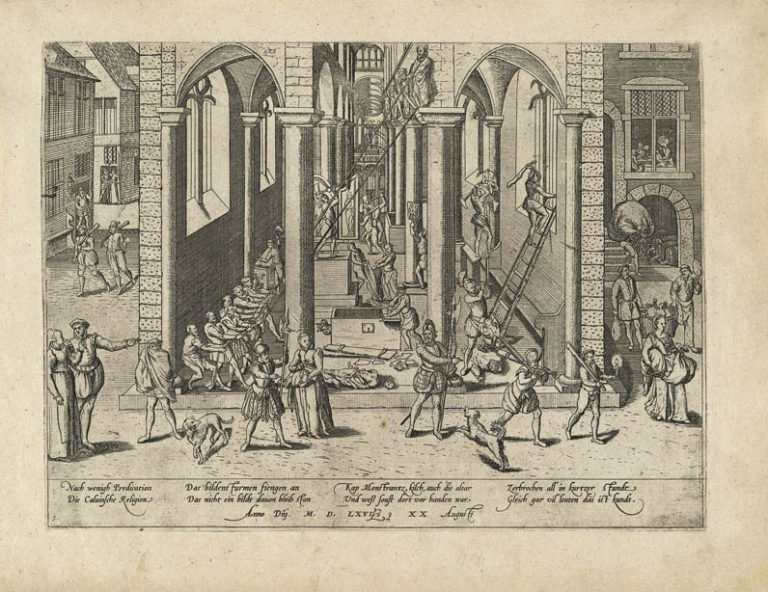
This labeled etching of Calvinist iconoclasm in the Netherlands (ca. 1566) depicts crowds removing and destroying religious images inside a church. It visually reinforces how Reformed Christianity often redirected devotion away from sacred objects and toward disciplined belief and practice, reshaping the public religious environment. Source
It also reshaped attitudes toward:
the dignity of everyday work
the relationship between morality and economic behavior
the social meaning of prosperity
the expectation that believers should live disciplined, orderly lives
In this sense, some Protestant groups, especially Calvinists, helped create a culture in which labor, thrift, and responsible prosperity carried religious value. Wealth was not holy by itself, but when joined to discipline and lawful effort, it could be interpreted as evidence of God’s favor.
Practice Questions
Identify ONE way some Calvinists linked material success to religious belief in the sixteenth century. [2 marks]
1 mark for identifying that prosperity from honest, disciplined labor could be seen as a sign of God’s favor.
1 mark for explaining that wealth did not earn salvation but could be interpreted as evidence of godly conduct or blessing.
Explain how Protestant ideas about work and wealth changed attitudes toward economic behavior in early modern Europe. [6 marks]
1 mark for a clear claim that some Protestant groups, especially Calvinists, gave everyday labor greater religious value.
1 mark for explaining the idea of a calling or God-given vocation.
1 mark for explaining the emphasis on diligence, thrift, or opposition to idleness.
1 mark for explaining that wealth was viewed as a possible sign of God’s favor, not a way to purchase salvation.
1 mark for connecting these beliefs to changing attitudes toward commerce, saving, reinvestment, or trustworthy business behavior.
1 mark for using a specific piece of historical evidence, such as Calvinists, Reformed communities, or merchants and artisans.
FAQ
Weber argued that certain Protestant beliefs, especially Calvinist ones, encouraged disciplined labour, saving, and reinvestment rather than lavish spending.
He suggested that this mindset helped modern capitalism develop. Many historians now think his argument was influential but too simple, because commercial capitalism also grew in non-Protestant areas and had older roots.
No. Early Calvinist teaching did not promise that true believers would become rich. It stressed God’s sovereignty, human uncertainty, and moral restraint.
Modern prosperity preaching usually presents wealth as an expected reward of faith. Calvinist thinking was much stricter and more anxious, and it remained suspicious of luxury and display.
Yes, but usually within a strongly patriarchal framework. A woman’s calling was often understood through household management, child-rearing, textile work, market activity, or helping with a family business.
This gave domestic labour religious worth, but it did not usually produce equal authority in church leadership or public office.
Calvinist communities still viewed charity as a Christian duty. However, they often drew sharper distinctions between the ‘deserving’ poor and those seen as idle.
This could encourage more organised systems of relief, including supervised charity, work expectations, and tighter control over begging.
Plain dress symbolised humility, self-command, and rejection of vanity. It allowed prosperous people to show that they were not ruled by pride or wasteful consumption.
Clothing therefore became a visible sign of moral discipline. In that sense, appearance could reinforce the wider belief that material success should be controlled, modest, and socially responsible.