AP Syllabus focus:
'Martin Luther criticized abuses in the Catholic Church and proposed new interpretations of Christian doctrine and practice.'
Luther’s protest began as an attack on corruption and misleading religious practices, but it quickly developed into a deeper challenge to church authority, salvation, and the proper shape of Christian life.
Setting of Luther’s Protest
At the start of the sixteenth century, most Europeans remained loyal Catholics, but criticism of the church was widespread. Reform-minded Christians complained about the wealth of high officials, the poor education or absenteeism of some clergy, and the use of church offices as sources of income and status. Luther, an Augustinian monk and professor in the Holy Roman Empire, shared these concerns. What made his attack more dangerous was that he connected visible corruption to deeper errors in religious teaching. In his view, church leaders were not simply behaving badly; they were encouraging people to trust external acts and payments rather than God’s grace.
One practice especially alarmed him: indulgence sales, promoted in the Holy Roman Empire by preachers such as Johann Tetzel.
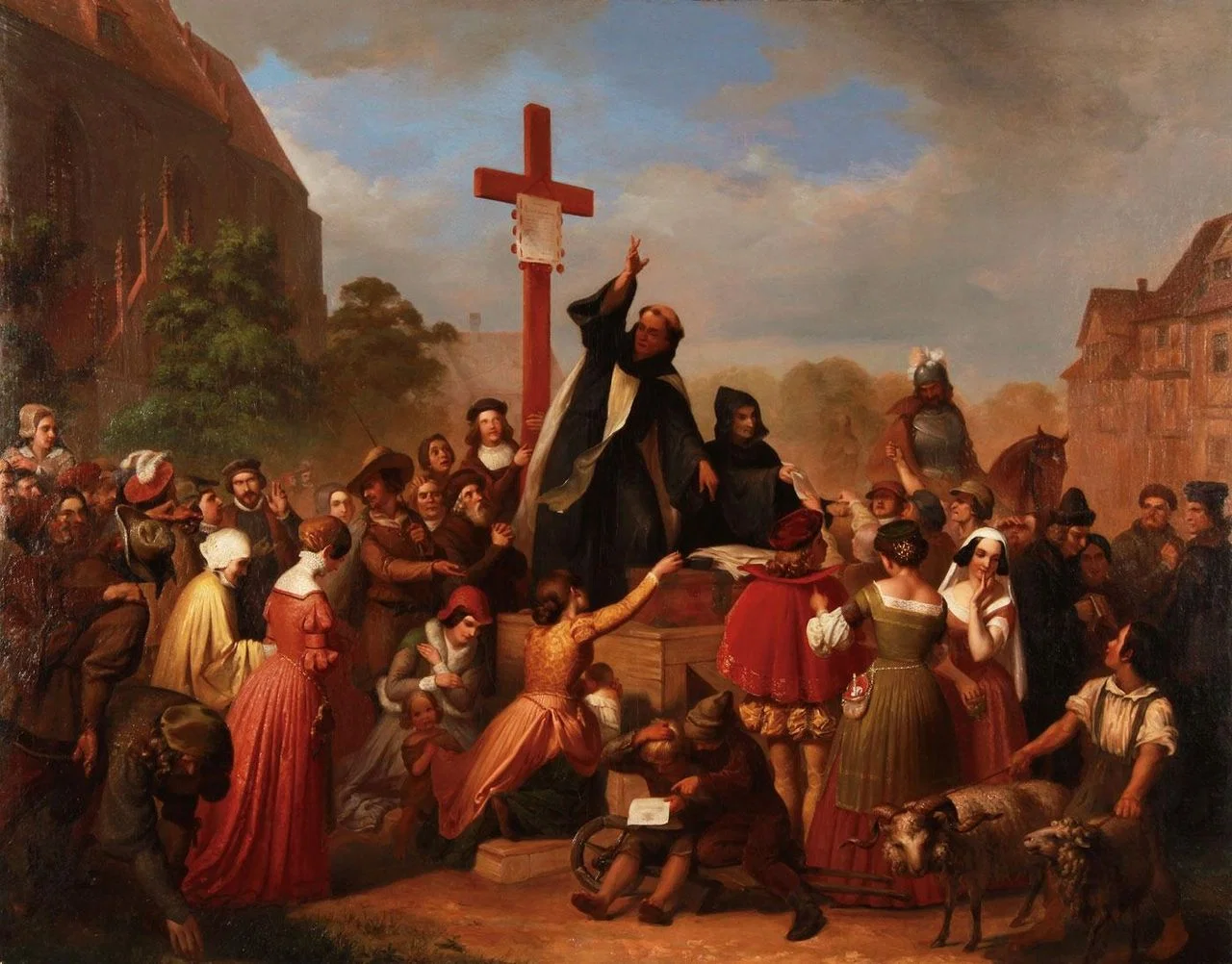
This nineteenth-century historical painting portrays Johann Tetzel preaching and selling indulgences to a crowd, emphasizing the public, transactional character of the practice. It helps visualize why Luther saw indulgence campaigns as both financial exploitation and a pastoral danger that redirected trust from repentance and grace to church-issued documents. Source
Indulgence: A remission of temporal punishment for sin granted by the Church; in Luther’s time, the preaching and sale of indulgences became a major source of controversy.
His own experience as a monk and confessor shaped this reaction. Luther was deeply concerned with the question of how a sinner could stand before a just God. Because of that concern, he saw indulgence preaching as spiritually dangerous, not merely financially corrupt. It taught people to seek reassurance in a document issued by the church rather than in repentance and divine mercy.
Luther did not deny the need for repentance. He objected to the idea that spiritual penalties could be reduced through a financial transaction. To him, indulgence preaching exploited fear of sin, death, and purgatory while giving ordinary Christians false confidence.
The Abuses Luther Criticized
Luther’s criticism focused on several related abuses:
Commercialization of salvation: Church agents acted as if divine forgiveness could be attached to money.
Misuse of papal power: The pope was presented as controlling punishments in ways Luther believed scripture did not support.
Clerical corruption: Wealth, luxury, and office-holding weakened the moral authority of church leaders.
Pastoral deception: Believers were steered toward purchased remedies instead of heartfelt repentance.
These complaints were practical, but they also raised a more serious question: who had the right to define how salvation worked?
The Ninety-Five Theses
In 1517 Luther wrote the Ninety-Five Theses, probably as an invitation to academic debate.
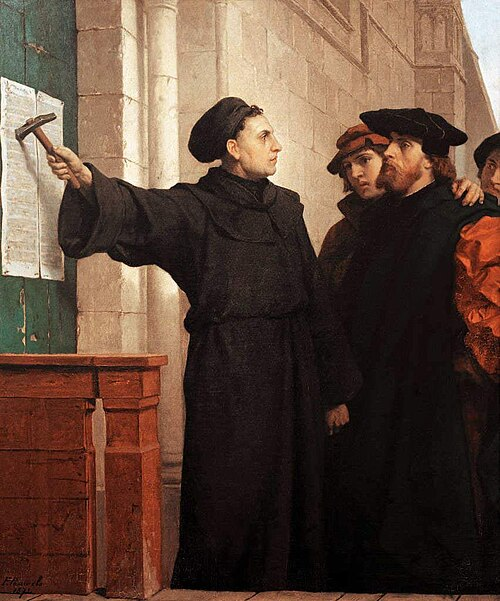
This later historical painting (by Ferdinand Pauwels) depicts Luther affixing the theses to the church door, a scene often used to symbolize the shift from critique of abuses to a broader challenge to ecclesiastical authority. As a teaching image, it helps students connect the academic genre of ‘theses’ to the public rupture that contemporaries and later generations associated with 1517. Source
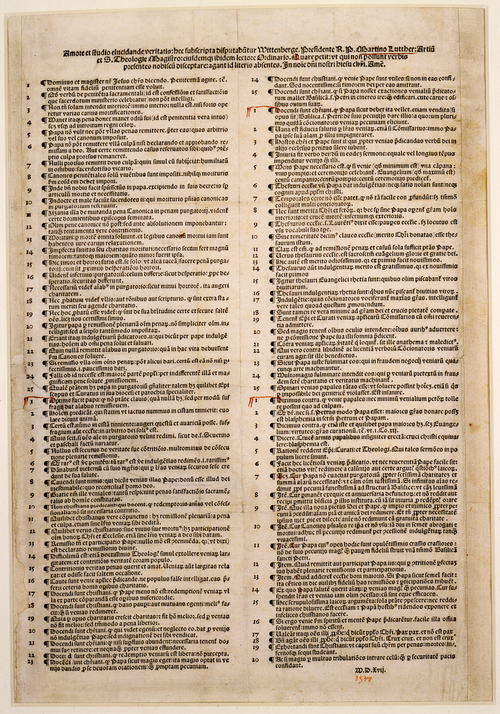
This primary-source image shows an early printed text of Luther’s Ninety-Five Theses (Latin), illustrating how Reformation ideas circulated through print rather than only through oral preaching. Seeing the dense, formal layout reinforces that the theses were framed as propositions for disputation and theological argument, not merely a simple protest slogan. Source
The theses attacked the theology and marketing of indulgences rather than calling immediately for a new church. Luther argued that genuine repentance was a lifelong inner turning toward God, not a one-time purchase confirmed by a certificate. He insisted that if the pope truly had the power to remit punishments, he should do so freely out of charity, not in exchange for money. The theses also challenged the claim that indulgence sellers could guarantee spiritual benefits for the living or the dead.
By questioning indulgences, Luther exposed tensions between sincere religious care and institutional fundraising. What looked like a dispute over one practice quickly became a dispute about authority, truth, and the limits of papal claims. The controversy mattered because indulgences were not a minor custom; they reflected a much larger system in which the church presented itself as the manager of grace.
From Moral Reform to Doctrinal Change
As the controversy deepened, Luther concluded that the problem was larger than corrupt individuals. He increasingly argued that church tradition and papal rulings had been allowed to outweigh the Bible. This shifted his protest from moral reform to doctrinal change. If salvation came from God, then no purchased act, pilgrimage, or carefully performed ritual could earn it. If church teaching conflicted with scripture, then Christians had to question inherited practices. Luther therefore moved beyond attacking abuses and began proposing a new understanding of Christian belief and practice.
In later writings, he went further by treating the papacy as a human institution rather than an unquestionable source of truth. He also argued that church councils could make mistakes. This was revolutionary because it denied that long-established authority automatically guaranteed correct teaching.
New Interpretations Luther Proposed
Scripture had higher authority than church traditions when defining essential teaching.
Salvation was God’s gift, not something dispensed through a system of financial or ritual exchange.
Church practices had to have biblical support, which led Luther to question parts of the sacramental system.
Preaching and teaching should direct believers toward repentance and trust, not toward fear-driven transactions.
Changes in Religious Practice
Luther’s protest also altered what everyday religion should look like. He wanted Christian life centered more clearly on preaching, scripture, prayer, and inward faith. He criticized practices that seemed to turn religion into a marketplace or a mechanical process. He also challenged the idea that monastic or specially religious vocations were automatically superior to ordinary lay callings. In this sense, his attack on abuse opened a wider rethinking of piety, worship, and the role of church institutions.
Why Luther’s Critique Was a Turning Point
Luther’s importance lies in the fact that he did more than condemn immoral behavior. Many before him had criticized corrupt clergy without breaking the structure of medieval Catholic authority. Luther went further by questioning whether the church could control access to grace in the way it claimed. Once indulgences were rejected, the authority behind them was also drawn into doubt. That is why church leaders treated his criticism as a serious threat. His protest challenged the religious, institutional, and intellectual foundations of the late medieval church and became a crucial starting point of the Protestant Reformation.
Practice Questions
Identify ONE abuse in the Catholic Church that Martin Luther criticized in 1517. [2 marks]
1 mark for identifying a specific abuse, such as the sale of indulgences, clerical corruption, misuse of papal authority, or treating church offices as sources of wealth.
1 mark for explaining that Luther believed the abuse misled Christians or distorted true repentance and salvation.
Explain how Luther’s critique of Catholic abuses developed into a broader challenge to Catholic doctrine and practice. [6 marks]
1 mark for explaining that Luther first attacked indulgences and other church abuses.
1 mark for explaining that he argued repentance could not be bought with money.
1 mark for explaining that he questioned papal authority to control or distribute spiritual benefits in the way indulgence preaching claimed.
1 mark for explaining that he elevated scripture above church tradition or papal rulings.
1 mark for explaining that he reinterpreted salvation as dependent on God’s grace rather than church-mediated transactions or works.
1 mark for linking these ideas to changes in practice, such as greater emphasis on preaching, scripture, or rejection of practices lacking biblical support.
FAQ
Probably not at first.
The Ninety-Five Theses were framed as points for debate, and Luther initially seems to have hoped that abuses could be corrected within the existing Church. He still saw himself as a Catholic reformer rather than the founder of a new confession.
The split widened only after public controversy, official condemnation, and Luther’s refusal to withdraw positions he believed were supported by scripture.
Albert’s role helps explain why the issue became so explosive.
He had borrowed heavily to secure multiple church offices, and indulgence revenue was tied to repaying those debts while also raising funds for St Peter’s Basilica in Rome. That meant the indulgence campaign had both spiritual claims and major financial interests behind it.
Luther’s objections therefore threatened not just a religious practice but a wider system of ecclesiastical finance.
Latin was the normal language of university debate and educated clergy.
By writing in Latin, Luther was initially addressing scholars and churchmen, not the general public. This suggests he expected an academic dispute about theology and pastoral practice.
The wider public impact came later, when the text was translated and circulated more broadly than Luther may have first anticipated.
Luther was not simply reacting emotionally to corruption; he was trained to argue from texts.
His lectures on books of the Bible, especially Psalms, Romans, and Galatians, pushed him towards a more direct reading of scripture. That habit made him suspicious of practices that seemed to rely more on custom or papal authority than on the Bible itself.
His academic background also explains why his early challenge took the form of formal theses.
Purgatory touched family feeling as well as religious fear.
Many people worried not only about their own souls but about dead relatives. If indulgences seemed to shorten suffering after death, they offered comfort, hope, and a sense that something practical could be done for loved ones.
That emotional power helps explain why Luther thought indulgence preaching was so dangerous: it operated where grief, anxiety, and trust in the Church were strongest.