

AP Syllabus focus:
'Habsburg rulers faced Ottoman expansion while unsuccessfully trying to restore Catholic unity across Europe.'
In the sixteenth century, the Habsburgs confronted two major threats at once: Ottoman military expansion and Protestant religious division. Their inability to master both revealed the limits of dynastic power.
The Habsburg Position in Europe
Charles V and a Composite Monarchy
In the early sixteenth century, Charles V inherited Spain, the Spanish Netherlands, Austrian family lands, overseas possessions, and the title of Holy Roman Emperor. He imagined himself as the leading defender of Catholic Christendom, but his lands were scattered and governed through local privileges rather than a single centralized state.
Different territories had separate laws, assemblies, and financial systems.
Habsburg rulers therefore needed negotiation as much as command.
This made rapid, coordinated action difficult when crises erupted in different regions at once.
Ottoman Expansion and the Eastern Threat
Pressure in Central Europe
Under Suleiman the Magnificent, the Ottoman Empire pushed deeper into southeastern and central Europe. The turning point came at the Battle of Mohács in 1526, where the Hungarian monarchy collapsed. This opened Hungary to Ottoman occupation and brought the Ottomans into direct conflict with the Habsburg dynasty, which also claimed the Hungarian crown.
In 1529 the Siege of Vienna demonstrated how serious the threat had become.
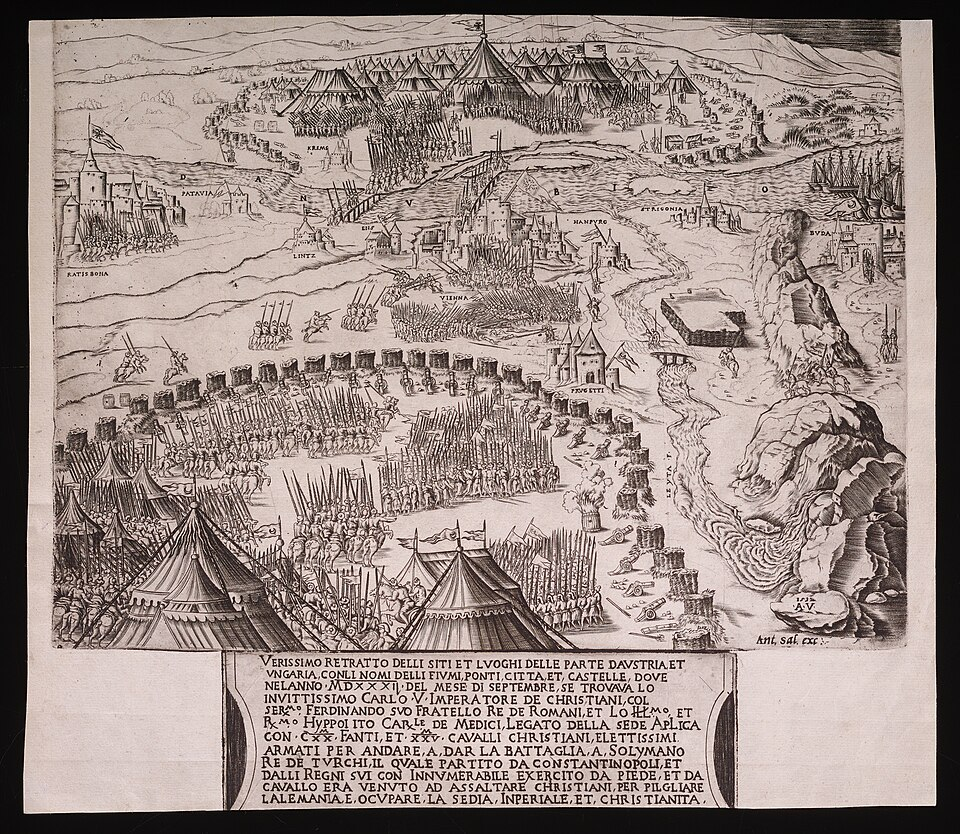
This period map depicts the Ottoman army outside Vienna during the 1529 siege and situates the event within a broader Central European geographic frame (with multiple towns labeled). It helps explain why Vienna’s defense was not just a single battle but part of a wider Habsburg frontier problem that demanded sustained resources and attention. Source
Vienna was not taken, but the siege showed that Ottoman armies could strike at the Habsburg heartland. Defending Austria and the Hungarian frontier demanded men, fortifications, diplomacy, and enormous financial resources.
A Wider Strategic Burden
The Ottoman challenge was not limited to land war. In the Mediterranean, Ottoman fleets and allied corsairs threatened Habsburg shipping and coastal regions. As a result, Habsburg rulers could not concentrate fully on problems in Germany, because eastern and southern defense remained urgent and continuous.
Protestants and Religious Division in the Empire
The Spread of Protestantism
While the Ottomans advanced from the east, the Protestant Reformation spread within the Holy Roman Empire.
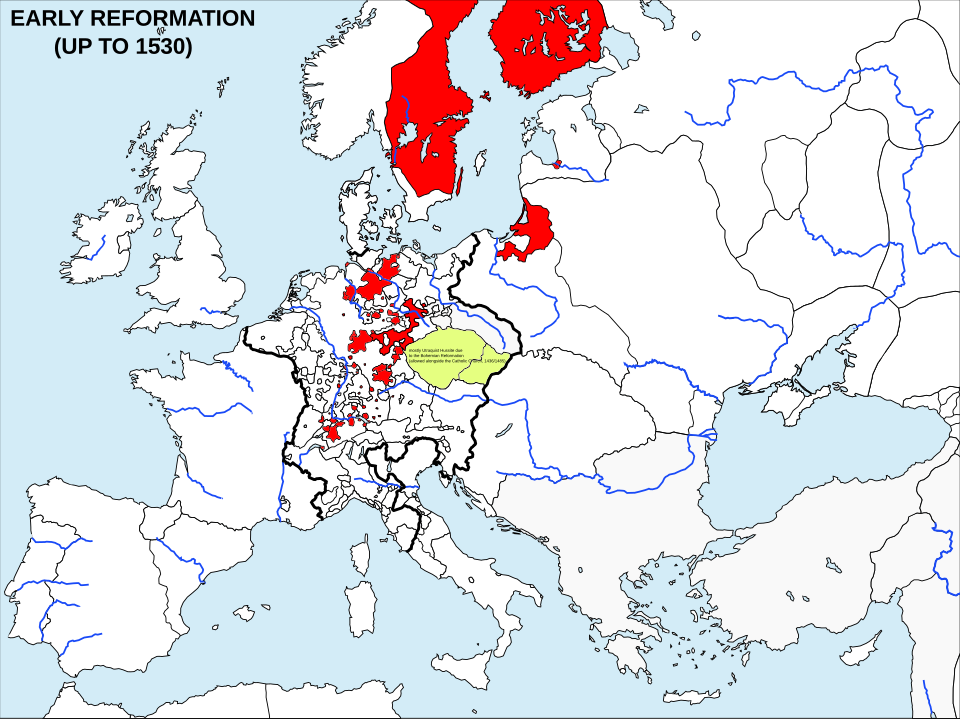
This color-coded map highlights territories that officially introduced the Reformation in the late 1520s, illustrating how rapidly Protestant alignment became geographically widespread. It reinforces the political dimension of confessional change by showing that reform took hold unevenly across many semi-independent states rather than through a single imperial decision. Source
Luther’s teachings won support among German princes, urban elites, and some ordinary believers. For some rulers, religious reform was also politically attractive because it reduced papal influence and increased princely control over church property and local religious life.
Charles V opposed Protestantism on religious and political grounds. He believed Christian unity was necessary for European stability, and he feared that confessional division would weaken imperial authority. Yet he depended on German princes for taxes, soldiers, and cooperation, which limited how forcefully he could act.
Conflict with Protestant Princes
Attempts at reconciliation repeatedly failed. Protestant rulers organized the Schmalkaldic League for mutual defense. Charles eventually defeated this alliance at the Battle of Mühlberg in 1547, but military victory did not produce lasting religious unity.
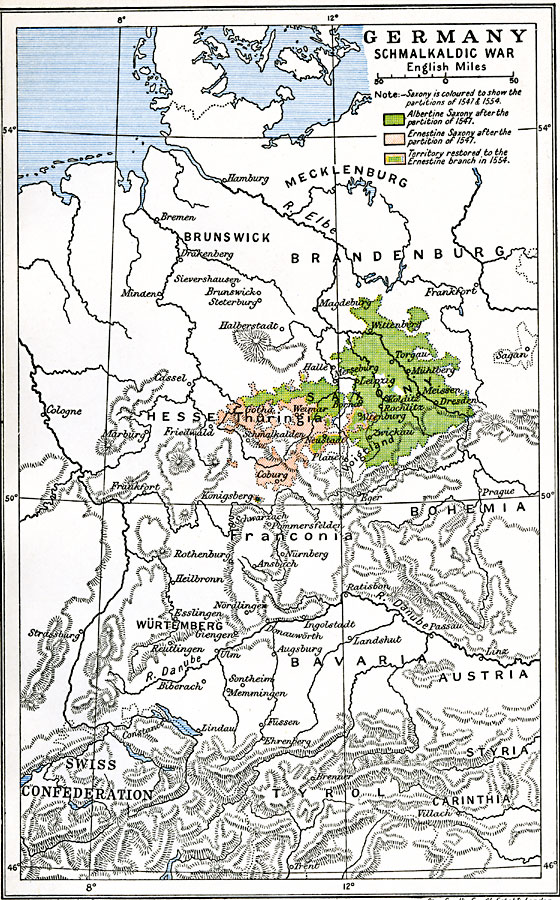
This historical atlas map shows key areas of central Germany affected by the Schmalkaldic conflict, with territory color-coded to reflect partitions and restorations after 1547. It underscores how the empire’s political geography—multiple jurisdictions and shifting control—made it difficult for Charles V to turn battlefield success into durable confessional unity. Source
Protestant belief had become too entrenched, and many local rulers resisted outside interference in their territories.
Why the Habsburgs Could Not Restore Catholic Unity
Too Many Fronts at Once
The Habsburg failure was not simply a matter of weak religious commitment. It reflected the structural limits of their power.
Ottoman pressure absorbed troops, money, and attention.
Protestant resistance was backed by regional political interests, not just theological disagreement.
The empire’s decentralized constitution prevented the emperor from ruling German states like a national monarch ruled a kingdom.
Even when Charles won battles, he lacked the administrative reach to impose a permanent settlement across hundreds of semi-independent territories. Catholic rulers elsewhere in Europe did not automatically support him if Habsburg success threatened their own interests.
Settlement Instead of Unity
By 1555, the Peace of Augsburg recognized the practical impossibility of restoring one faith in the empire. Its principle of cuius regio, eius religio allowed each ruler to choose Catholicism or Lutheranism for his territory. This agreement was a major Habsburg retreat. It accepted legal division instead of universal Catholic unity and showed that imperial authority had to compromise with territorial rulers. The settlement also excluded other groups, so religious tension remained, but the Habsburg goal of reversing Protestantism in Germany had clearly failed.
Habsburg Rule After Charles V
Division of Responsibilities
The Habsburg struggle continued after Charles. His brother Ferdinand I had long managed Austrian affairs and bore much of the responsibility for defending against the Ottomans in central Europe. After Charles abdicated, the dynasty’s Spanish and Austrian branches became more distinct, which reflected the difficulty of governing such a vast inheritance as a unified political project.
This division mattered because the Habsburg challenge was never only religious. Rulers had to balance imperial prestige, frontier defense, finance, and local politics. The Ottoman threat helped ensure that religious policy could never be pursued in isolation.
Historical Importance
The Habsburg experience revealed a major change in sixteenth-century Europe: rulers could still claim to defend universal Christianity, but they increasingly operated within a world of competing states, entrenched local privileges, and permanent confessional division. Ottoman expansion and Protestant survival together weakened the medieval ideal of a single Catholic Europe.
Practice Questions
Identify ONE reason Ottoman expansion made it harder for Habsburg rulers to suppress Protestantism in the Holy Roman Empire. Short-answer question (2 marks)
1 mark for identifying a valid reason, such as the diversion of troops, money, or attention to defend Austria, Hungary, or the Mediterranean.
1 mark for explaining how this diversion reduced the emperor’s ability to pressure Protestant princes or enforce Catholic unity.
Evaluate the extent to which political and military limitations, rather than religious ideas alone, explain the Habsburg failure to restore Catholic unity in Europe during the sixteenth century. Extended response question (6 marks)
1 mark for a defensible thesis that addresses the extent of the claim.
Up to 2 marks for specific evidence, such as Charles V’s scattered territories, Ottoman expansion into Hungary, the Siege of Vienna, the Schmalkaldic League, the Battle of Mühlberg, or the Peace of Augsburg.
Up to 2 marks for analysis explaining how military pressure, decentralized imperial government, and princely interests limited Habsburg power.
1 mark for complexity, such as showing that religious belief mattered but was inseparable from dynastic, constitutional, or geopolitical constraints.
FAQ
After Mohács, Hungary did not simply pass cleanly to one side. It was contested by Habsburg claimants, Ottoman forces, and local elites.
By the mid-sixteenth century, the region was effectively divided into:
Royal Hungary under Habsburg rule in the west and north
Ottoman Hungary in the centre
Transylvania, an Ottoman tributary with considerable autonomy
This fragmentation made defence expensive, politics unstable, and any clear Habsburg victory unlikely.
Though France was Catholic, Francis I often treated the Habsburgs as the greater threat. French diplomacy and occasional co-operation with the Ottomans forced the Habsburgs to think in geopolitical rather than purely religious terms.
This meant:
Catholic solidarity could not be assumed
Habsburg resources had to cover more fronts
Charles V’s vision of united Christendom was weakened by European power politics
Neither side could permanently dominate every part of the borderlands, so fortified towns became the backbone of defence. A fortress network slowed invasions, protected supply routes, and gave rulers bases for counter-attacks.
But fortresses were costly. They required:
permanent garrisons
artillery and repairs
reliable taxation and supply systems
For the Habsburgs, this turned border defence into a long financial burden, not just a series of dramatic campaigns.
Charles’s abdication did not end Habsburg power, but it split responsibilities more clearly. The Spanish branch under Philip II concentrated on Spain, the Netherlands, and Mediterranean concerns, while the Austrian branch under Ferdinand focused more directly on the empire and the Ottoman frontier.
This mattered because it made the dynasty more manageable, yet it also reduced the idea of one ruler directing a universal Christian mission across Europe.
The Ottoman challenge was also maritime. Ottoman fleets and North African corsairs threatened trade, raided coasts, and disrupted communication across the western Mediterranean.
This especially affected:
Naples and Sicily
the Spanish coastline
sea lanes linking Habsburg territories
As a result, Habsburg rulers had to invest in ships, coastal defence, and naval alliances, stretching their finances well beyond the central European frontier.


.svg)