AP Syllabus focus:
'Religious reform intensified conflict between monarchy and nobility, especially in the French wars of religion.'
In sixteenth-century France, religious division did not simply create theological disagreement; it destabilized the monarchy, empowered rival noble factions, and turned political competition into a long cycle of civil war.
Religious Division in France
By the mid-1500s, France remained officially Catholic, but Calvinist ideas spread rapidly through parts of the kingdom. Reform attracted some urban artisans and professionals, yet its political importance came especially from support among members of the nobility. When nobles adopted Protestant beliefs, they could protect congregations, organize military followers, and challenge royal policy in their own provinces. Religious change therefore became tied to power, patronage, and regional influence.
The French Protestant minority became known as Huguenots.
Huguenots: French Protestants, many of whom followed Calvinist teachings during the sixteenth-century wars of religion.
Because noble households often shaped the religion of dependents, conversion was never just personal. It could affect clients, towns, and local officeholders. This made confessional division especially dangerous in a kingdom where the crown depended on cooperation from powerful aristocratic families.
Monarchy and Noble Rivalry
The crisis deepened after the death of Henry II in 1559. A series of weak Valois rulers followed, and real influence often fell to competing court factions and to Catherine de' Medici, who tried to preserve the monarchy by balancing hostile groups. Instead of ending conflict, royal efforts at compromise often convinced both sides that the crown could be pressured.
Two noble houses became especially important:
The Guise family led militant Catholic interests.
The Bourbon family included leading Protestant nobles, especially Henry of Navarre.
Religion gave these rival families a powerful public cause, but their struggles were also about access to office, royal favor, and control over the state. As a result, the French Wars of Religion were never only doctrinal disputes. They were also civil wars over who would influence, restrain, or direct the monarchy.
Outbreak of War
Open warfare began in 1562 after the Massacre of Vassy, when forces connected to the Duke of Guise killed Protestant worshippers.
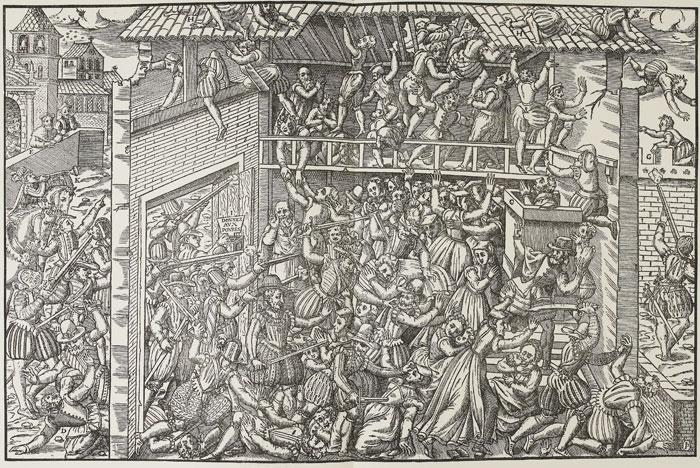
This sixteenth-century engraving depicts the Massacre of Vassy (1562), when troops associated with the Guise faction attacked a Huguenot congregation. The image highlights how noble military followings and confessional hostility could turn a provincial clash into the opening act of prolonged civil war. Source
The incident helped transform tension into sustained conflict. Over the following decades, France experienced repeated wars, temporary peace settlements, and renewed violence.
These wars revealed a serious weakness in royal authority:
Great nobles could raise armies through patronage networks.
Towns and provinces could align with confessional factions.
The crown struggled to enforce peace across the kingdom.
Military violence became tied to factional politics.
The monarchy was supposed to stand above private feuds and protect order. Instead, it often appeared indecisive, partisan, or unable to control its own subjects. Religious reform thus intensified an older problem: the difficulty of subordinating the nobility to central authority.
The St. Bartholomew’s Day Massacre
One of the most shocking turning points came in 1572. A fragile peace had led to the marriage of the Protestant Henry of Navarre to the Catholic Margaret of Valois, an attempt to reduce tensions. But after failed efforts to stabilize the kingdom, royal leaders and militant Catholics became increasingly fearful of Protestant influence at court.
In August 1572, killings of Huguenot leaders in Paris escalated into the St. Bartholomew’s Day Massacre, and violence spread to other cities.
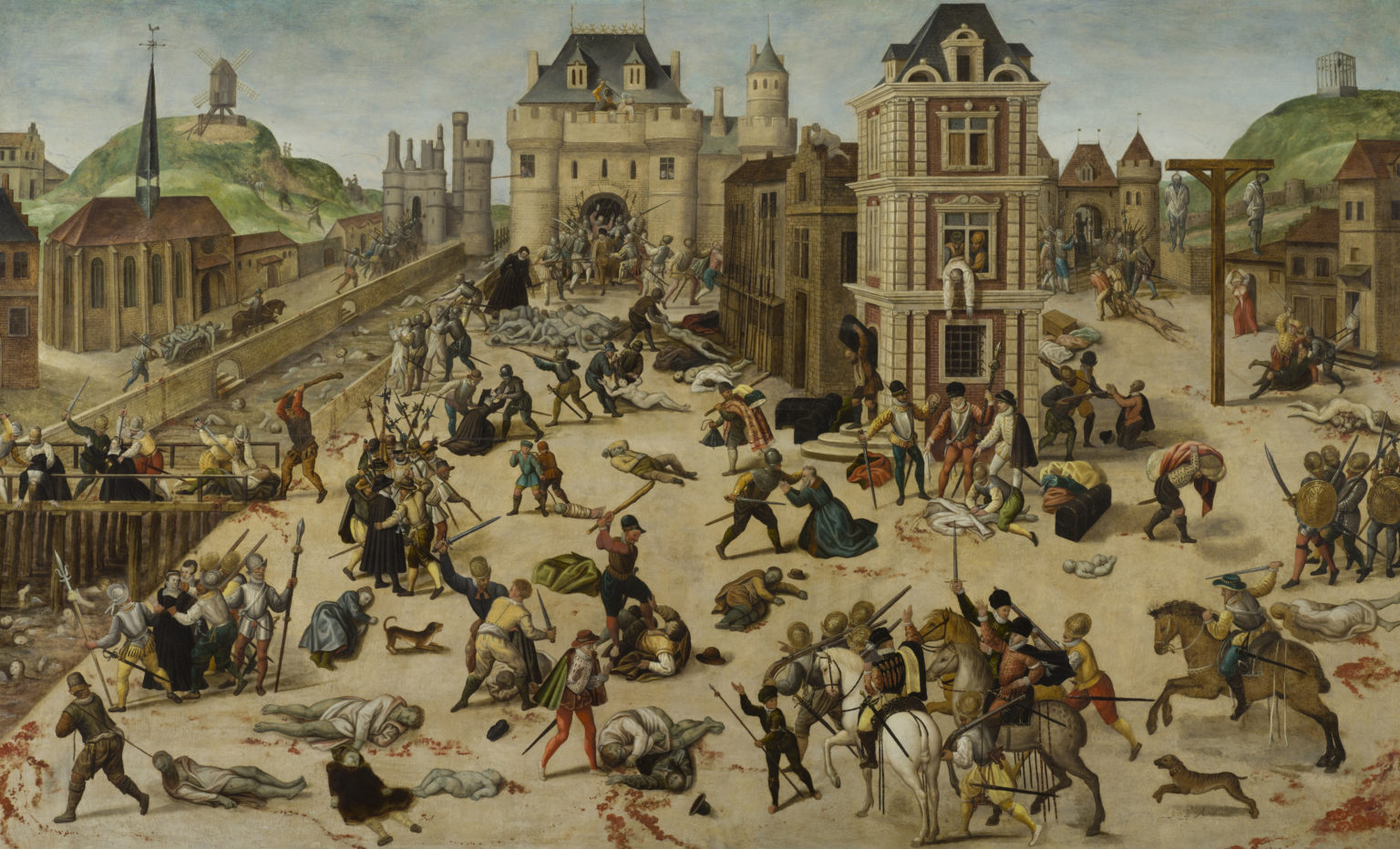
François Dubois’s painting reconstructs the St. Bartholomew’s Day Massacre by placing multiple episodes of violence within a single, staged view of Paris. Its crowded scenes emphasize how targeted political assassinations could cascade into broader urban bloodshed, shattering the monarchy’s claim to act as an impartial guardian of order. Source
The massacre had major political consequences. It destroyed trust between confessions, weakened the image of the monarchy as a neutral guardian of the realm, and convinced many Protestants that self-defense against royal violence was necessary.
The event also showed how quickly court politics, noble rivalry, and urban militancy could combine to produce mass bloodshed.
The Catholic League and the Crisis of Succession
As the wars continued, militant Catholics organized the Catholic League, which pressed for a more aggressive defense of Catholic unity and resisted any settlement that might tolerate Protestant power. The issue became even more dangerous when dynastic succession was involved. If Henry of Navarre, a Protestant, were next in line to the throne, then religion and legitimacy could no longer be separated.
This crisis produced the War of the Three Henrys:
Henry III of France
Henry of Guise
Henry of Navarre
Here the political meaning of the wars became unmistakable. Noble leaders were not merely advising the crown; they were competing to control the future of the kingdom. Henry III tried to defend royal independence by having Guise killed in 1588, but he was himself assassinated the next year. The monarchy had become the center of the conflict and also one of its casualties.
Henry IV and the Reassertion of Royal Power
When Henry of Navarre became Henry IV, he faced the challenge of ruling a largely Catholic kingdom as a Protestant claimant. His conversion to Catholicism in 1593 was a pragmatic political act that helped him gain wider recognition. It demonstrated that the survival of the monarchy required flexibility more than confessional purity.
The wars ended in 1598, when Henry IV issued the Edict of Nantes, granting limited toleration and security rights to Huguenots while preserving the Catholic identity of the kingdom.
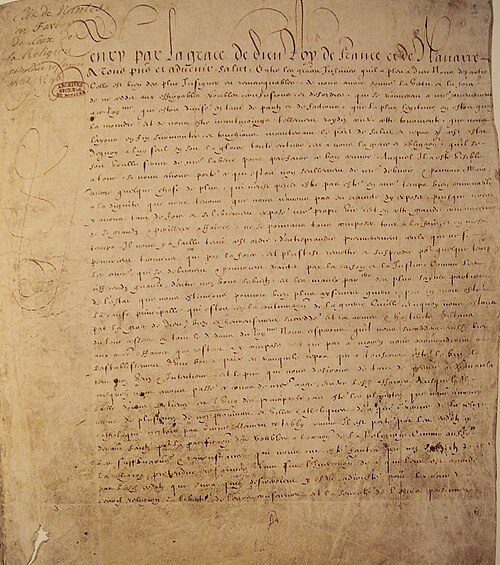
This document image shows a page from the Edict of Nantes (1598), the royal decree associated with ending the French Wars of Religion through limited toleration. Using a facsimile helps emphasize that the ‘solution’ to confessional conflict was framed in legal language—rights, protections, and enforcement—rather than doctrinal reconciliation. Source
This settlement did not erase hostility, but it reduced the ability of noble factions to use religion as a justification for endless civil war.
Key Historical Patterns
The French Wars of Religion show several major patterns in early modern France:
Religious identity became a tool in noble competition.
Weak monarchy encouraged aristocratic resistance.
Civil war emerged from the overlap of theology, faction, and dynastic politics.
Royal authority survived through political compromise rather than restored religious unity.
Practice Questions
Identify one way religious reform intensified conflict between the French monarchy and the nobility during the French Wars of Religion. (2 marks)
1 mark for identifying a valid development, such as noble conversion to Protestantism, militant Catholic noble leadership, or factional mobilization around religion.
1 mark for explaining how that development increased conflict with the monarchy, such as by allowing nobles to raise armies, influence provinces, or pressure the crown.
Evaluate the extent to which noble rivalry, rather than religious belief alone, drove the French Wars of Religion in the period 1562-1598. (6 marks)
1 mark for a defensible thesis that addresses both religion and noble rivalry.
1 mark for relevant contextualization, such as the spread of Calvinism in France or the weakness of the Valois monarchy after 1559.
2 marks for specific evidence, up to 2 marks:
Guise-Bourbon rivalry
Massacre of Vassy
St. Bartholomew’s Day Massacre
Catholic League
War of the Three Henrys
Henry IV’s conversion
Edict of Nantes
2 marks for analysis, up to 2 marks:
explains how religion gave legitimacy and intensity to aristocratic competition
explains why political ambition, dynastic succession, and control of the monarchy mattered alongside sincere belief
FAQ
Paris was the kingdom’s largest city and the symbolic heart of royal politics. It was also strongly Catholic, which made it a powerful base for militant opinion.
Because sermons, processions, and crowd action could influence events quickly, control of Paris mattered far beyond the city itself. A faction that dominated Paris could claim national legitimacy and put heavy pressure on the crown.
Printed pamphlets, rumours, songs, and sermons turned political disputes into moral emergencies. They portrayed opponents not simply as rivals, but as traitors or enemies of God.
This mattered because even people who could not read often heard texts read aloud. Propaganda helped spread fear, justify violence, and make compromise look like betrayal.
Religious conviction mattered, but it was not the only force at work. Family alliances, inheritance concerns, local feuds, military setbacks, and court favour all influenced noble decisions.
That flexibility shows why the wars were so unstable. Some nobles treated confessional identity as a fixed commitment, while others adapted when survival or advantage required it.
Elite women could shape politics through marriage alliances, household patronage, estate management, and mediation between rival families. Their influence was often indirect, but it could be substantial.
In wartime, some also defended family interests, supervised strongholds, or maintained communication networks. In a society where power was rooted in dynastic households, their political role could affect diplomacy as well as conflict.
Long civil war was expensive. The crown faced rising military costs while disorder disrupted taxation, trade, and ordinary administration.
To cope, rulers borrowed more heavily and relied on extraordinary financial measures. This increased pressure on government institutions and made political instability even harder to control, since weak finances limited the monarchy’s ability to enforce peace.