AP Syllabus focus:
'States exploited religious conflicts to advance their political and economic interests within and beyond their borders.'
In the wars of religion, states rarely acted from belief alone. Rulers used confessional conflict to strengthen authority, weaken rivals, secure resources, and reshape diplomacy across early modern Europe.
Religion as a Tool of State Policy
During the sixteenth and seventeenth centuries, religion was not only a matter of belief. For many governments, confessional division became a practical political resource. Rulers could use religious identity to rally subjects, justify taxation, and portray opponents as both heretics and enemies of public order. As a result, wars that appeared purely religious often also served state-building, dynastic rivalry, and commercial competition.
Faith and political authority
States benefited when religion reinforced obedience. An official confession could help define loyalty to the ruler, while dissent could be treated as political disobedience rather than merely private belief. This gave governments stronger grounds to police speech, worship, and assembly. In this sense, religious conflict offered rulers a language of legitimacy: defending the “true faith” could also mean defending the authority of the state.
Domestic Political Gain
Using confessional conflict at home
Inside their own borders, governments often used religion to weaken rivals and tighten control. Monarchs and princes could identify noble opposition with heresy, rebellion, or disorder, making resistance easier to suppress. Confessional policies also helped states reach more deeply into local life through oaths, parish supervision, censorship, and legal penalties.
In some territories, rulers took advantage of religious upheaval to gain material benefits. Supporting reform could allow a prince to seize church lands, redirect clerical income, or expand authority over appointments and education. Even where belief mattered sincerely, these changes increased state resources and reduced the independence of traditional religious institutions.
Religious conflict also helped governments shape political communities. By linking national or dynastic identity to a particular confession, rulers encouraged subjects to see external enemies and internal minorities as connected threats. That political use of religion mattered as much as theology itself.
Foreign Policy and Interstate Rivalry
Alliances beyond confessional lines
Religious labels also functioned in international politics. States frequently backed coreligionists abroad, but they did not do so consistently. When strategic advantage required it, rulers could cooperate across confessional boundaries. This showed that state interest often outweighed religious solidarity.
This increasingly reflected raison d'état, or reason of state.
Raison d'état: The principle that rulers may place the security and interests of the state above religious or moral consistency.
Under this logic, the survival and strength of the state could justify policies that seemed religiously inconsistent.
The clearest example was France. Although the French monarchy was Catholic, it often supported Protestant forces opposing the Habsburgs, because weakening Habsburg Spain and Austria served French security. Religion shaped the language of conflict, but balance-of-power calculations shaped decisions.
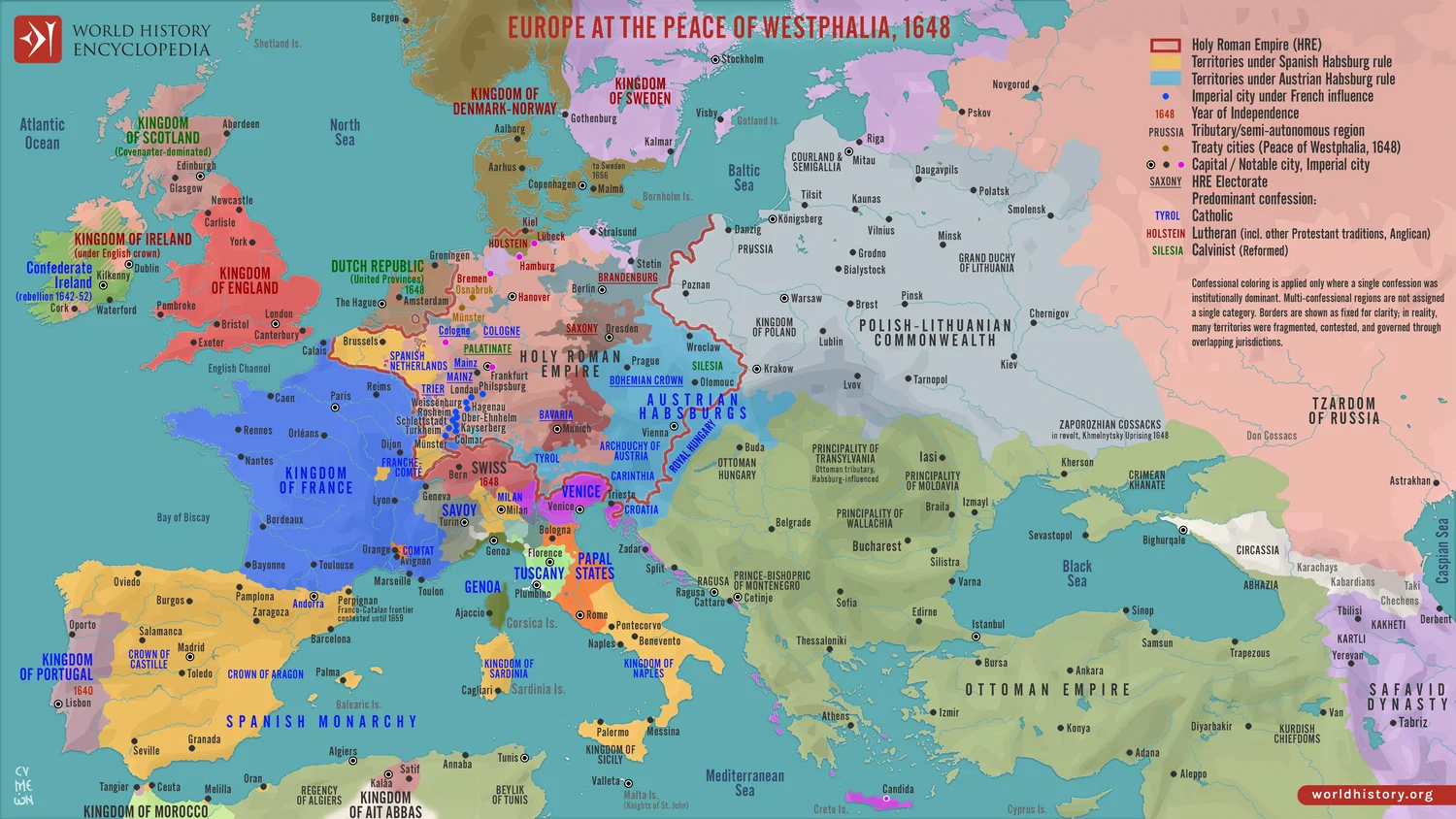
Map of Europe at the Peace of Westphalia (1648) with explanatory text emphasizing how the settlement reshaped power relations among major states. It provides a visual anchor for the idea that war aims and peace terms often followed strategic interests (territory, influence, and security) more than consistent confessional loyalty. This is particularly effective for illustrating how diplomacy translated religious-era conflicts into a new balance-of-power order. Source
Likewise, Spain presented itself as the defender of Catholicism, yet its interventions were also tied to dynastic prestige, military position, and control over valuable territories. In both cases, religion provided legitimacy, while political rivalry helped determine action.
Economic Interests in Religious Conflict
Commerce, taxation, and strategic territory
Economic motives were deeply woven into religious struggle. States fought to keep or gain provinces that produced taxes, supported armies, and linked trade networks. A government might defend a confession abroad not only to protect believers but also to protect ports, river routes, customs revenue, or access to markets.
The Spanish monarchy, for example, had major economic reasons to retain the Netherlands.
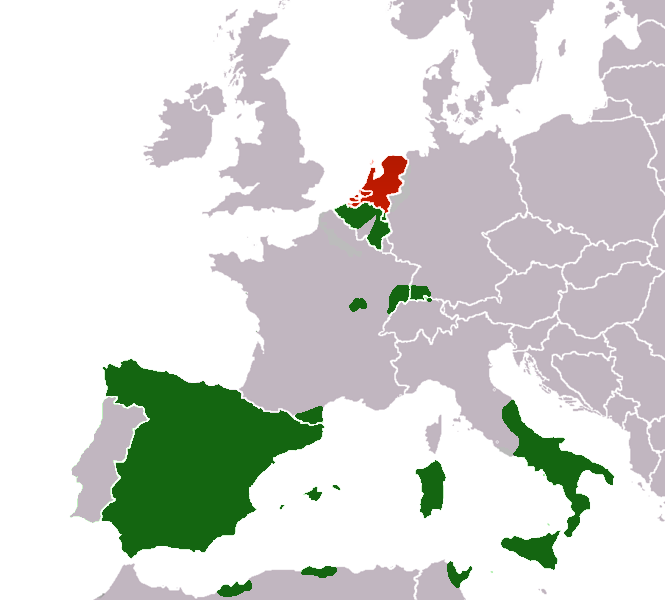
Locator-style map showing Spain’s imperial holdings alongside the Dutch Republic’s position in 1648. By placing the Low Countries within a wider imperial framework, it clarifies why the Netherlands mattered to Spanish finances and strategy beyond confessional politics. This helps students connect “religious war” narratives to the geography of empire, ports, and revenue-producing territories. Source
The region was wealthy, urbanized, and commercially important. Resistance there threatened not only Catholic authority but also Habsburg revenue and strategic access to northern Europe. England likewise had economic incentives to oppose Spanish influence: weakening Spain could assist English shipping, privateering, and overseas ambitions. Support for Protestant causes therefore could overlap with maritime and commercial goals.
Religious war could even help rulers raise money. Appeals to defend the faith encouraged elites and commoners to accept extraordinary taxation, military levies, and wartime sacrifices. Confessional fear made fiscal demands more acceptable because governments framed them as necessary for collective survival.
Interpreting State Action
How historians identify political gain
Historians look beyond official religious language to see what states were actually trying to achieve. Several patterns often reveal political gain:
alliances that crossed confessional lines
campaigns aimed at strategic provinces or trade centers
use of religious uniformity to weaken nobles or local privileges
wartime taxation justified as defense of the faith
These patterns do not prove that belief was unimportant. Instead, they show that early modern states treated religion as a usable instrument of power. In many conflicts, the same policy could defend a creed, expand authority, and improve a ruler’s diplomatic or economic position at the same time.
Practice Questions
Identify ONE way a European state used religious conflict to advance political or economic interests in the sixteenth or seventeenth century. (2 marks)
1 mark for identifying one valid method, such as using an official confession to strengthen royal authority, seizing church property, backing foreign coreligionists to weaken a rival, or using religion to justify taxation.
1 mark for giving a specific historically accurate explanation or example.
Explain the extent to which political and economic interests shaped state involvement in religious conflicts in Europe from roughly 1550 to 1650. (6 marks)
1 mark for a defensible thesis making a clear claim about the importance of political and economic interests.
1 mark for one specific piece of relevant historical evidence.
1 mark for a second specific piece of relevant historical evidence.
1 mark for explaining how one piece of evidence supports the argument.
1 mark for explaining how the second piece of evidence supports the argument.
1 mark for demonstrating nuance, such as showing that sincere religious belief and state interest often operated together.
FAQ
Early modern political thought increasingly allowed rulers to argue that preserving the state outweighed confessional consistency. Advisers could present such choices as necessary acts of prudence rather than betrayal.
Common justifications included:
preventing encirclement by a rival dynasty
protecting trade or frontier security
treating the alliance as temporary and defensive
This did not remove controversy, but it made cross-confessional diplomacy easier to defend.
Religious conflict often followed the geography of movement. Armies needed roads, river crossings, fortresses, and ports more than abstract declarations of doctrine.
Control of a corridor mattered because it affected:
troop movement
customs income
naval access
communication between separate possessions
A state might intervene in a religiously divided region because losing that route would weaken its wider military position.
Governments at war depended heavily on credit. Bankers, tax farmers, and merchant groups could influence whether a conflict was financially sustainable and which policies looked attractive.
Their interests often centred on:
secure sea lanes
predictable taxation
access to foreign markets
protection from blockade or piracy
They did not set policy alone, but rulers who ignored commercial and financial pressures risked military weakness and fiscal crisis.
Openly admitting self-interest could weaken obedience. Religious language gave war a moral purpose that subjects were more likely to accept.
Propaganda was useful because it:
simplified complex diplomacy
turned taxes and military service into sacred duty
portrayed opponents as both sinful and dangerous
reduced sympathy for domestic critics
This made religion an especially effective public language for policies driven by mixed motives.
Smaller powers could exploit it as well, though with less freedom. They often used confessional positioning to bargain for allies, subsidies, or autonomy.
Some could:
shift alliances to avoid domination by a great power
use religious identity to strengthen local cohesion
attract foreign protection without full dependence
Their room for manoeuvre was narrower, but they were not simply passive victims of larger states.