AP Syllabus focus:
'The Peace of Westphalia weakened the ideal of universal Christendom and expanded local rulers’ control over religion.'
Signed in 1648, the Peace of Westphalia marked a turning point in European politics by reducing dreams of a single Christian order and strengthening the authority of territorial rulers over religious affairs.
The settlement in context
The Peace of Westphalia was not a single document but a group of treaties that ended major conflicts in central Europe after decades of destructive warfare. Its importance for AP European History lies less in battlefield outcomes than in the political principles it confirmed. Instead of restoring one religiously unified Europe, the settlement accepted that division among Christians would continue.
This settlement mattered because it weakened the older ideal of universal Christendom.
Universal Christendom: The belief that European Christians belonged to one religious community under shared spiritual and political authority, especially the pope and emperor.
For centuries, many Europeans had assumed that political life should fit within a broader Christian order led spiritually by the papacy and, in theory, protected politically by the Holy Roman Emperor. By 1648, however, the Protestant Reformation and repeated wars had made that vision increasingly unrealistic. Westphalia did not create religious division, but it formally recognized that Europe could no longer be governed as a single Christian commonwealth.
The decline of universal Christendom
Limits on papal and imperial authority
One of Westphalia’s most important consequences was the decline of claims to universal authority. The pope could no longer expect European rulers to accept papal judgment as the final word in political settlement. Even when papal officials objected to the treaties, their protests had little practical effect. That loss of influence symbolized a larger change: political agreements among states now carried more weight than the old dream of a religiously united Europe.
The settlement also limited the power of the Holy Roman Emperor.
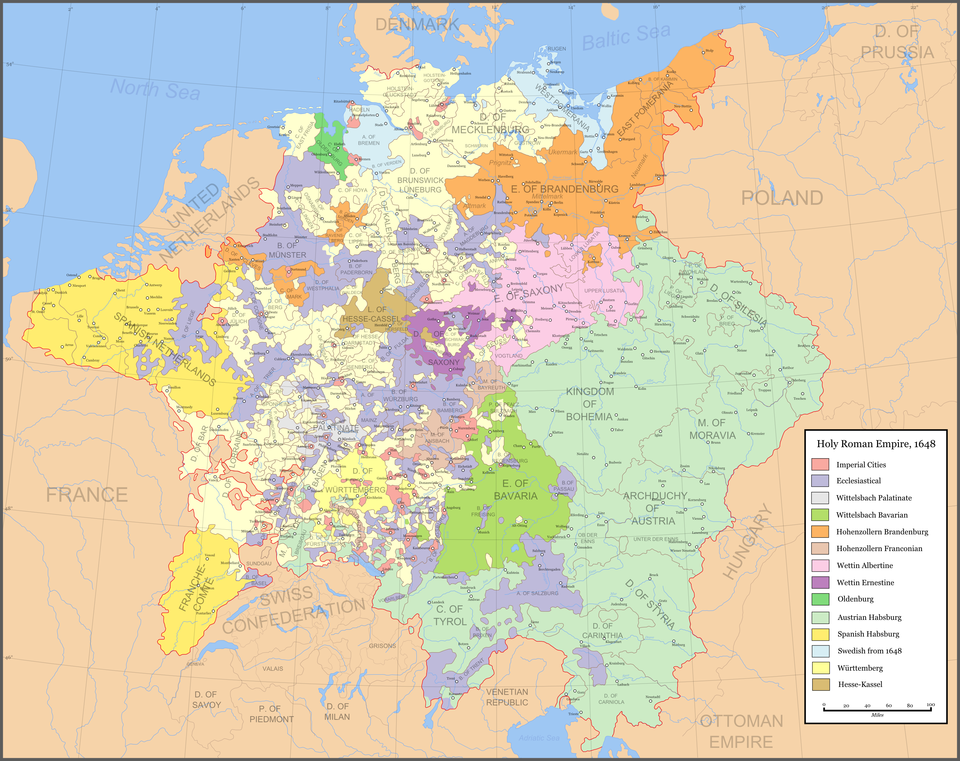
Political map of the Holy Roman Empire in 1648 (post-Westphalia), using distinct colors to differentiate major dynasties, ecclesiastical lands, and free imperial cities. The visual fragmentation helps explain why Westphalia strengthened territorial princes and cities while constraining the emperor’s ability to impose a single religious or political settlement across the empire. Source
Earlier emperors had tried to use religious conflict as a way to strengthen imperial control and restore Catholic unity. Westphalia moved in the opposite direction. It confirmed that the emperor could not simply dictate the religious future of the empire’s territories. Authority was more clearly distributed among the empire’s many princes, cities, and local governments.
This was a major political shift. Medieval and early modern rulers had often imagined Europe as a hierarchy with universal institutions above local powers. Westphalia instead acknowledged that territorial rulers would make many crucial decisions for themselves. In practice, this meant that political order rested less on a common Christian identity and more on negotiated coexistence among separate governments.
Local rulers and control of religion
Religious settlement inside the empire
Westphalia expanded the ability of local rulers to regulate religion within their own territories. It built on earlier precedents but gave them broader legal force. Most importantly, it recognized Calvinism alongside Catholicism and Lutheranism, making three confessions legally acceptable within the empire. That formal recognition showed that religious pluralism had become part of political reality.
Because rulers now had stronger authority over religion in their lands, they gained influence over:
the official confession of the territory
church organization and supervision
religious education
public worship and discipline
This did not mean full religious freedom in the modern sense. Ordinary subjects were still often expected to follow the religion established by their ruler. Yet the settlement did provide a more stable legal framework for confessional minorities than earlier attempts to enforce uniformity. The key change was that religion became increasingly tied to the government of each territory rather than to a single European-wide church order.
Historians often connect this development to sovereignty.
Sovereignty: The principle that a ruler or state exercises supreme authority within its own territory without outside control.
Westphalia did not invent sovereignty from nothing, but it strengthened the principle in practice. A ruler’s legitimacy depended more on recognized authority within a defined territory and less on obedience to universal religious leadership. That helped reshape how Europeans thought about political power.
Political change after 1648
Territorial government and diplomacy
The political changes linked to Westphalia reached beyond religion alone.
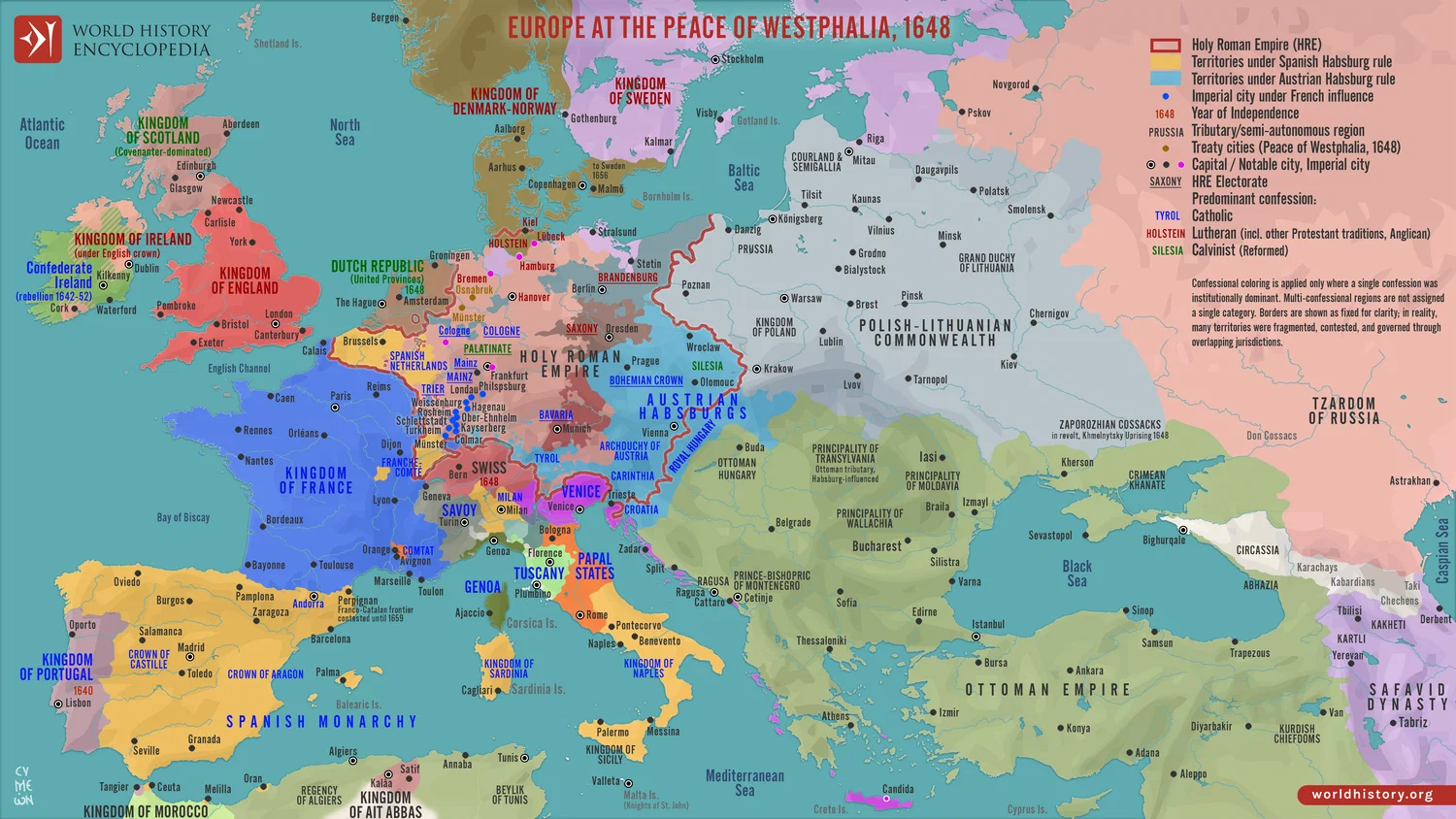
Europe-wide map situating the 1648 settlement within a larger international reordering after the Thirty Years’ War. By emphasizing borders and major political units rather than a single Christian commonwealth, it reinforces how Westphalia helped normalize diplomacy among territorial states as the organizing principle of European politics. Source
The treaties encouraged Europeans to treat states and territories as the main units of international politics. Negotiation among rulers became more important than appeals to a single Christian authority.
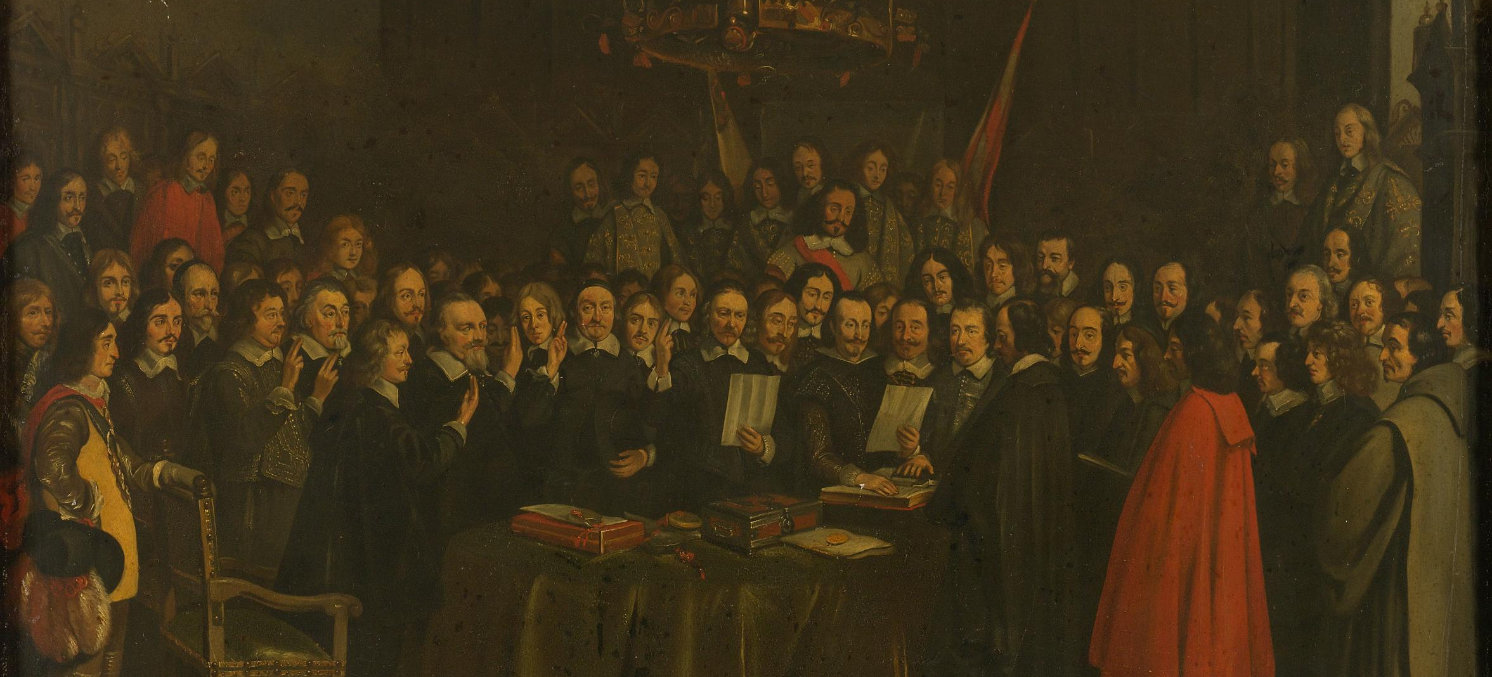
Seventeenth-century depiction of the ratification of the Peace of Münster (part of the wider Peace of Westphalia settlement), showing delegates gathered around the treaty documents during the oath-taking. The scene foregrounds interstate negotiation and legally binding agreements—key mechanisms through which post-1648 order relied more on diplomacy and territorial authority than on papal or imperial universal claims. Source
This helped normalize diplomacy based on the interests of states rather than the unity of Christendom.
Westphalia also reinforced the idea that political order could survive without religious uniformity. That was a profound change. Before the Reformation, many leaders assumed that religious division would inevitably destroy peace. After Westphalia, rulers increasingly accepted that stability might come from legal compromise, territorial rights, and balance among powers rather than from the restoration of one faith.
The settlement also supported a more decentralized political structure in central Europe. Within the Holy Roman Empire, princes and other territorial authorities retained significant independence. They were not fully sovereign in the modern sense, but their rights were stronger and more secure than before. This made the empire less like a centralized monarchy and more like a political framework containing many semi-autonomous states.
What Westphalia did not do
It is important not to exaggerate Westphalia. It did not create modern democracy, universal toleration, or perfectly equal states. Dynastic ambition, religious tension, and war all continued after 1648. Still, the treaties mattered because they made a crucial principle harder to reverse: Europe would no longer be organized around the expectation of one universal Christian authority. Instead, political life increasingly revolved around territorial states, local rulers, and negotiated limits on religious conflict.
Practice Questions
Identify ONE way the Peace of Westphalia changed the relationship between religion and political authority in Europe. (2 marks)
1 mark for identifying a valid change, such as weakening papal authority, limiting the Holy Roman Emperor’s religious power, recognizing multiple confessions, or increasing territorial control over religion.
1 mark for explaining that religious decisions became more closely tied to local rulers or territorial governments rather than to a single universal Christian authority.
Evaluate the extent to which the Peace of Westphalia represented a political turning point in Europe in the mid-seventeenth century. (5 marks)
1 mark for a defensible thesis that evaluates the extent of change.
1 mark for explaining how Westphalia weakened the ideal of universal Christendom.
1 mark for explaining how Westphalia expanded the authority of local rulers over religion.
1 mark for using specific historical evidence, such as recognition of Calvinism, reduced papal influence, limits on imperial authority, or the strengthening of territorial governments.
1 mark for demonstrating complexity, such as noting that Westphalia did not create full religious freedom or end dynastic conflict.
FAQ
The talks were divided largely for practical and confessional reasons.
Münster hosted many Catholic delegations.
Osnabrück was used for many Protestant representatives.
This reduced ceremonial conflict over precedence and protocol.
The split arrangement also shows how difficult it had become to gather all European powers under one religiously unified diplomatic framework.
The “normal year” fixed 1624 as the legal baseline for deciding many disputes over church property and confessional rights within the empire.
This mattered because it prevented endless arguments over every wartime seizure or restoration. Instead of trying to return to some earlier ideal order, negotiators chose a specific reference point that could be used in courts and local settlements.
Imperial free cities were often religiously mixed, so they needed special protection.
In many cases, Westphalia helped preserve arrangements in which:
more than one confession existed in the same city
political offices had to be shared carefully
public worship rights were balanced to avoid renewed unrest
This made some cities important examples of managed confessional coexistence.
Some historians use the phrase because Westphalia clearly strengthened territorial rule and non-universal politics.
Others think the term can oversimplify matters because:
rulers were still constrained by dynastic ties, privilege, and law
the Holy Roman Empire remained a layered political structure
full non-interference did not suddenly appear in 1648
So Westphalia is best seen as an important stage in the development of sovereignty, not a perfect beginning.
No. Its strongest immediate effects were in the Holy Roman Empire and in diplomatic relations among western and central European powers.
Its influence was less direct in regions outside that framework. Even where its principles became famous later, local politics, dynastic structures, and military realities still shaped outcomes more than abstract theory. Westphalia became influential partly because later generations treated it as a model for interstate order.