AP Syllabus focus:
'Some states, such as France, Poland, and the Netherlands, accepted religious pluralism to preserve domestic peace.'
As confessional conflict shattered Christian unity, some governments chose coexistence over religious uniformity. These settlements were usually pragmatic compromises designed to reduce civil disorder, preserve authority, and keep politically divided societies together.
Why Some States Chose Coexistence
The Reformation created deep and lasting religious divisions that many rulers could not simply erase. By the late sixteenth century, some kingdoms and republics contained powerful minorities protected by nobles, town governments, or provincial institutions. Attempts to impose one faith often led to rebellion, economic disruption, and repeated violence. In that context, accepting more than one confession became a practical strategy for survival.
When historians describe this as religious pluralism, they usually mean a political arrangement rather than a celebration of full equality.
Religious pluralism: the acceptance or legal toleration of more than one religious confession within a state in order to maintain order and peace.
This did not usually mean modern freedom of religion. Most early modern governments still believed religion mattered deeply to public life. What changed was the willingness of some rulers to admit that enforcing complete religious unity could be more dangerous than allowing limited diversity.
In these states, pluralism emerged because governments increasingly valued peace, taxation, and loyalty over confessional uniformity. A ruler who could not eliminate religious differences might instead regulate them, hoping to prevent civil war and stabilize political life.
Religious Pluralism as a Political Settlement
Main Characteristics
Religious pluralism functioned as a political settlement because it was meant to end or reduce internal conflict. Instead of demanding total conversion, governments set rules for coexistence and tried to contain violence through law.
These settlements often included:
legal recognition or tolerated existence of more than one confession
limits on where and how minority worship could take place
state supervision designed to keep religion from becoming open rebellion
Such measures were usually cautious and uneven. Rights were often granted to some groups but not to everyone, or in certain regions but not across an entire state. The goal was not broad liberty. The goal was domestic peace: fewer uprisings, less noble resistance, and a more stable political order.
France: Limited Toleration to End Civil Conflict
France offers one of the clearest examples of pluralism used as a peace settlement. Decades of conflict between Catholics and Huguenots divided the kingdom and weakened royal authority. The monarchy eventually accepted that continued warfare threatened the state itself.
The Edict of Nantes in 1598 gave Huguenots limited rights, including permission for worship in specified places and certain civil protections.
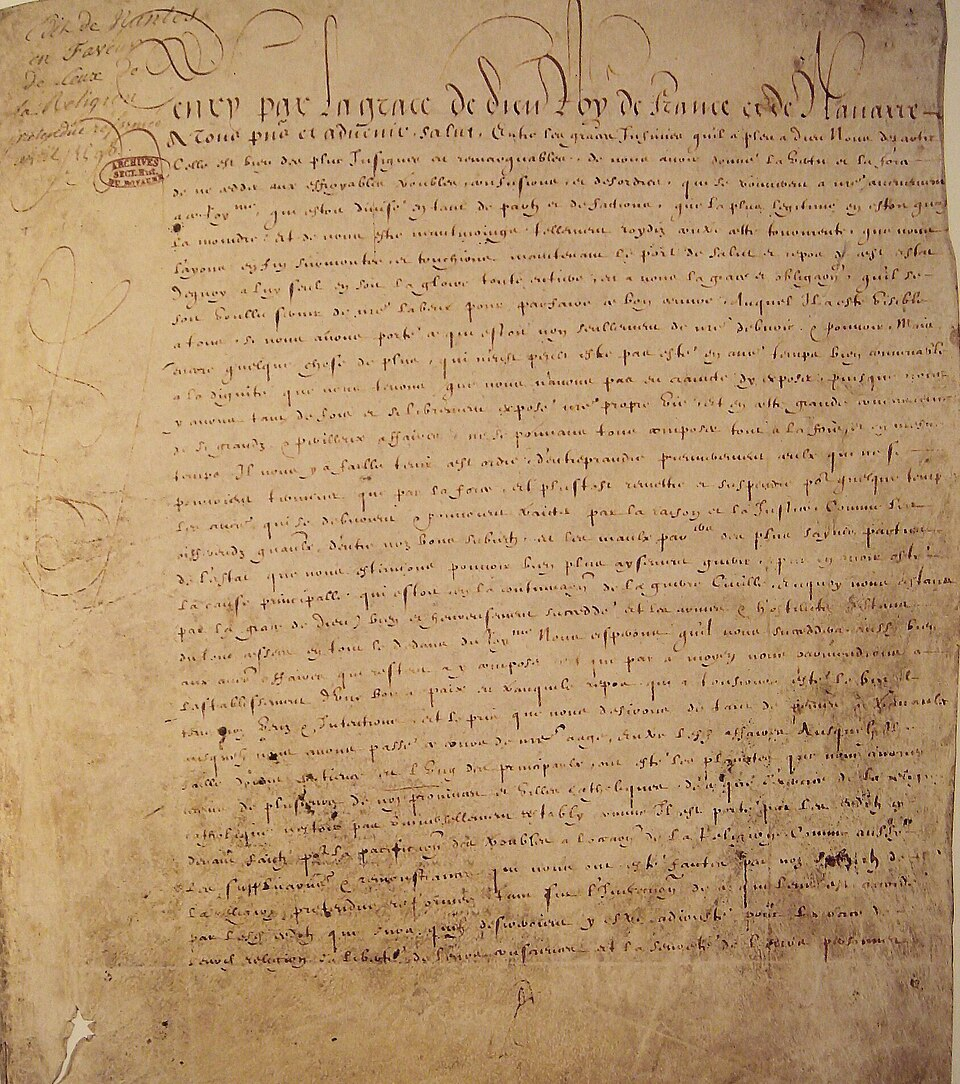
This is a photographed folio of the Edict of Nantes (1598), the royal decree that granted French Huguenots limited legal toleration while keeping France officially Catholic. As a document image, it underscores how religious pluralism often took the form of specific, state-managed rules rather than an abstract principle of equal rights. Source
This was a major political compromise. France remained officially Catholic, but the crown acknowledged that some Protestants would remain within the kingdom.
The settlement mattered because it reduced the immediate pressure for one side to destroy the other. By granting carefully controlled toleration, the monarchy tried to calm noble factions, restore public order, and rebuild royal strength. In France, pluralism was less a statement of principle than a recognition that peace required accommodation.
Poland-Lithuania: Peace in a Multi-Confessional Commonwealth
Poland-Lithuania was especially diverse, containing Catholics, Lutherans, Calvinists, Orthodox Christians, and sizable Jewish communities. Because the state was politically decentralized and the nobility guarded its liberties, rigid confessional uniformity was difficult to impose.
The Warsaw Confederation of 1573 is a key example of pluralism as a political settlement. It promised religious peace among the nobility and aimed to prevent confessional conflict from tearing the commonwealth apart. In a state with many regions and traditions, compromise helped sustain political cooperation.
This arrangement shows that pluralism could emerge where elites believed civil peace depended on mutual restraint. Rather than forcing a single religious identity on a large and varied population, Polish leaders accepted coexistence as a way to preserve stability. Even so, toleration was not equal for all social groups, and much depended on local power and enforcement.
The Netherlands: Pragmatic Toleration and Public Order
In the Netherlands, religious pluralism developed in a highly urban and commercially active society. The Dutch Republic had a public Reformed Church, but in practice it tolerated a wider range of religious communities, including Catholics, Jews, and some Protestant dissenters.
This toleration was often pragmatic. Town governments and provincial authorities recognized that strict persecution could disrupt trade, divide communities, and weaken the republic internally. Allowing minorities to live and worship, often with restrictions and sometimes in private rather than openly, helped maintain social peace.
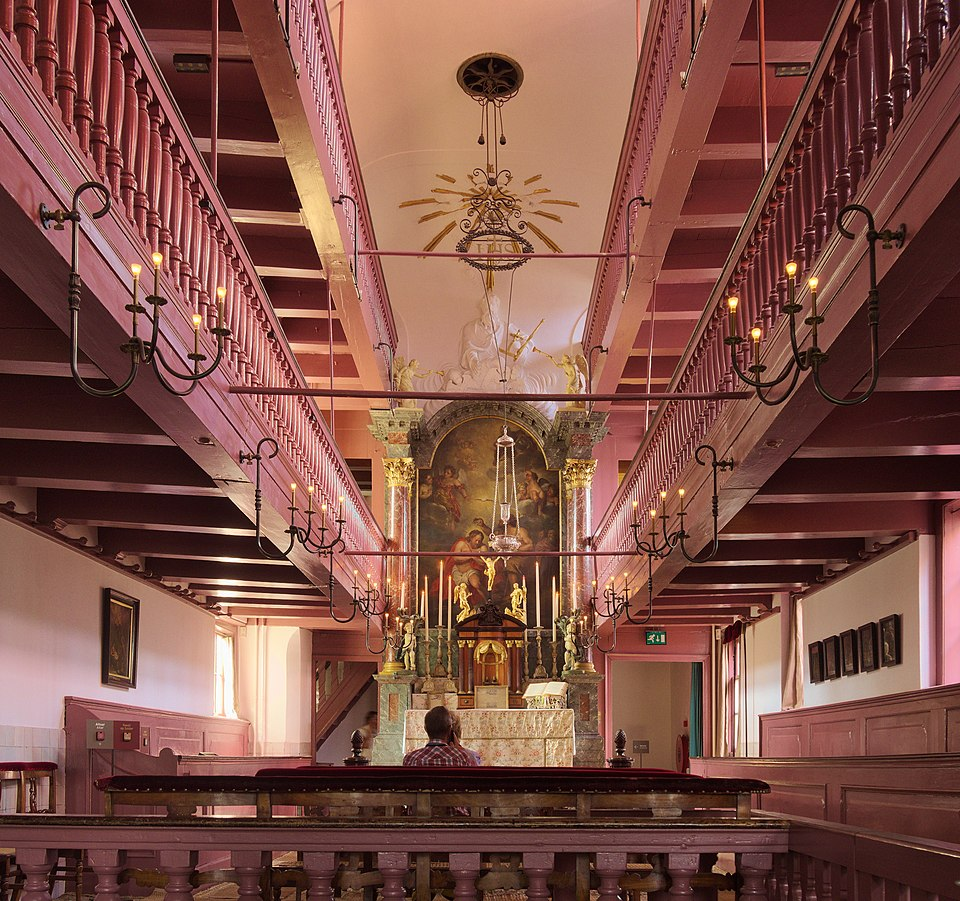
The image(s) on this page illustrate Ons’ Lieve Heer op Solder (“Our Lord in the Attic”), a hidden Catholic house church in Amsterdam created in the seventeenth century. It visualizes the Dutch pattern of pragmatic toleration: minority worship could exist, but often in spaces designed to avoid a public religious presence. Source
The Dutch case is important because it shows that pluralism could coexist with an officially favored church. The state did not remove religious hierarchy, but it accepted that limited coexistence served public order better than attempts at total uniformity.
Limits of Political Pluralism
Early modern pluralism had clear limits. It did not create equal citizenship regardless of faith, and it did not eliminate discrimination. Minority worship might be confined to specific towns, kept out of public view, or tied to political conditions. Governments could still favor one church and restrict access to office or public ceremony.
Even so, these settlements marked a significant shift in political thinking. In France, Poland-Lithuania, and the Netherlands, authorities accepted that a state could survive without complete religious unity. Preserving peace at home sometimes required living with confessional difference rather than trying to destroy it.
Practice Questions
Identify ONE reason why some European states accepted religious pluralism in the sixteenth and seventeenth centuries, and identify ONE state that did so. Short-answer question (2 marks)
1 mark for identifying a valid reason, such as reducing civil conflict, preserving domestic order, maintaining political loyalty, or protecting economic stability.
1 mark for naming a correct example, such as France, Poland-Lithuania, or the Netherlands.
Evaluate the extent to which accepting religious pluralism helped preserve domestic peace in one or more European states during the sixteenth or seventeenth centuries. Extended-response question (6 marks)
1 mark for a defensible thesis that makes a clear argument about how far pluralism preserved peace.
1 mark for relevant context about confessional division or internal instability.
2 marks for specific evidence, such as the Edict of Nantes, the Warsaw Confederation, or Dutch toleration practices.
1 mark for explaining how the evidence supports the argument about domestic peace.
1 mark for demonstrating complexity, such as noting the limits of toleration, uneven enforcement, or the difference between toleration and equality.
FAQ
Its political structure mattered a great deal. The monarchy was relatively weak, and the nobility defended its privileges against central control.
Because no ruler could easily impose a single religious policy across such a large and varied state, compromise was often the safest option. Diversity was not simply tolerated out of kindness; it was built into the commonwealth’s political realities.
Dutch towns depended on merchants, shipping, credit, and skilled migrants. Harsh persecution could drive away people who contributed money, labour, and commercial connections.
Urban regents often preferred quiet coexistence to public religious confrontation. Toleration, especially when worship remained discreet, helped protect business confidence and social calm.
In some places, minority worship was allowed only if it stayed out of public view. Hidden churches let communities practise their faith without openly challenging the official religious order.
This arrangement suited governments that wanted peace without fully endorsing equality. It was a compromise between repression and open recognition.
Not always. In some areas, especially parts of the Netherlands and Poland-Lithuania, Jewish communities found more room to live, trade, and worship than in many other European states.
However, their legal position often remained separate and vulnerable. Protection could depend on local rulers, urban authorities, or economic usefulness rather than any broad principle of equal rights.
Many rulers still believed a single faith was the strongest foundation for political unity. They accepted pluralism because conflict had become too destructive, not because they embraced religious equality.
As a result, toleration could be narrow, conditional, and reversible. A settlement that preserved peace in one generation might later be restricted or withdrawn if political circumstances changed.