AP Syllabus focus:
'Measures such as the Roman Inquisition and Index of Prohibited Books revived Catholic authority but deepened Christian division.'
Catholic renewal did not rely only on persuasion. Church leaders also used institutions of discipline and censorship to defend orthodoxy, strengthen authority, and draw sharper lines between Catholics and Protestants.
Why discipline became central
Defending orthodoxy
Discipline became central to Catholic reform because religious fragmentation threatened the church’s claims to universal truth. If rival doctrines spread unchecked, papal authority, clerical leadership, and the religious unity of communities all seemed at risk. Catholic leaders therefore treated orthodoxy—correct belief—as something that had to be guarded through institutions, not just defended in sermons.
This shift mattered politically as well as spiritually. By defining acceptable belief more clearly and punishing deviation more systematically, the church could present itself as the legitimate guardian of Christian truth. Reform, in this sense, meant both renewal and control.
The Roman Inquisition
Investigating heresy
One of the most important instruments of control was the Roman Inquisition. Unlike informal criticism or local pressure, it gave the papacy a more regularized way to investigate suspected heresy, question witnesses, examine texts, and issue judgments.
Roman Inquisition: A papal tribunal, reorganized in 1542, that investigated suspected heresy and enforced Catholic orthodoxy.
The tribunal targeted people whose ideas appeared to challenge Catholic teaching. These could include Protestants, spiritual dissenters, and intellectuals whose writings raised suspicion. The process was meant to deter open disagreement as much as to punish it. Trials reminded clergy and laypeople alike that belief was not a private matter but something subject to ecclesiastical oversight.
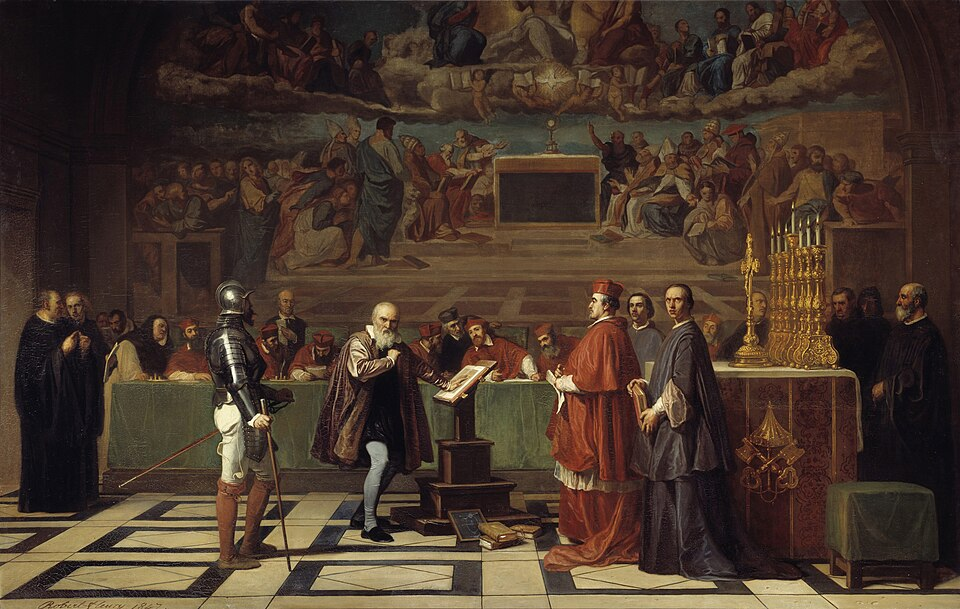
Joseph-Nicolas Robert-Fleury’s 19th-century depiction of Galileo appearing before the Holy Office visualizes the Roman Inquisition as a formal, centralized tribunal. The composition emphasizes institutional authority—clerical officials seated in judgment—while the accused stands isolated, underscoring the coercive pressure that could produce compliance and self-censorship. Source
Interrogation, surveillance, and the threat of punishment encouraged self-censorship. Scholars, preachers, and ordinary believers learned to avoid language that might attract official scrutiny.
The Roman Inquisition also signaled that Catholic reform would proceed under centralized supervision. By claiming the right to investigate error, the papacy reasserted authority over doctrine at a moment when Europe’s religious map was fracturing.
The Index of Prohibited Books
Censorship and control of reading
Alongside tribunals, Catholic authorities relied on censorship. The Index of Prohibited Books listed works Catholics were forbidden to read, print, or own without permission. It aimed to stop heresy at its source by limiting the circulation of dangerous ideas.
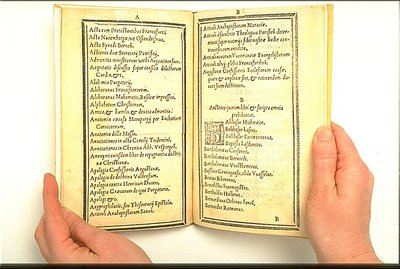
This Cornell University Library exhibit reproduces a page from the 1559 Index librorum prohibitorum, an early edition of the Catholic Church’s official list of forbidden works. Seeing the Index in book form highlights how censorship operated through print bureaucracy—cataloging titles and authors so enforcement could extend across schools, printers, and readers. Source
Index of Prohibited Books: An official list of banned writings that Catholics were not supposed to read or distribute without approval.
Because print allowed arguments to travel quickly across borders, controlling books became a crucial part of religious discipline. The Index targeted openly Protestant writings, but it could also include texts by Catholics judged misleading, irreverent, or doctrinally unsound. Printers, booksellers, teachers, and scholars all felt its effects.
Enforcement was uneven, but uneven enforcement did not make the policy unimportant. Even when banned books still circulated, condemnation warned readers, empowered confessors and bishops, and shaped what could be taught openly in Catholic territories.
Censorship worked symbolically as well as practically. It announced that not every opinion deserved a hearing and that church authorities would decide what counted as safe reading. In this way, the Index extended Catholic authority into schools, universities, and the world of print culture.
Reviving Catholic authority
Restoring institutional control
These measures revived Catholic authority in several ways.
They clarified boundaries. Catholics could more easily distinguish approved teaching from condemned teaching.
They strengthened obedience. Clergy and laity were reminded that religious truth came through authorized channels, not personal interpretation.
They increased institutional reach. Church officials could monitor ideas across dioceses, courts, and printing centers.
They restored confidence among believers. In an age of doctrinal confusion, visible enforcement reassured many Catholics that the church remained capable of defending the faith.
These institutions also connected local religious life more directly to Rome.
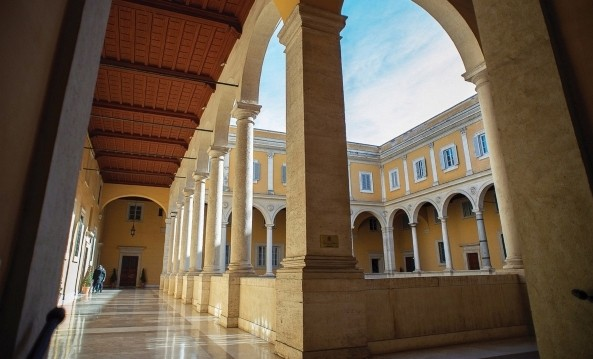
A view of the Palazzo del Sant’Uffizio in Vatican City (Holy Office), the administrative center historically associated with inquisitorial oversight. The image helps students connect ‘centralized supervision’ to a physical bureaucratic space—an institution rooted in buildings, offices, and records rather than only theology. Source
A bishop, printer, or university teacher could no longer assume that disputed ideas would remain local matters. Central oversight reinforced the image of a church capable of governing a transregional Christian community.
Discipline was therefore not separate from reform. It was a method of renewal that linked moral seriousness with doctrinal control. The result was a more self-conscious and better-defended Catholic identity.
Deepening Christian division
Hardening confessional boundaries
Yet the same policies deepened Christian division. Instead of healing the break within western Christianity, they hardened confessional lines. Catholics and Protestants increasingly defined themselves against one another through rival authorities, rival texts, and rival institutions.
The Roman Inquisition made compromise harder because it treated doctrinal deviation as punishable error rather than as a disagreement to be negotiated. The Index had a similar effect in print: it discouraged Catholics from engaging freely with Protestant works and reinforced the idea that Protestant teachings were spiritually dangerous.
This sharpened division affected everyday life. Education, reading, preaching, and public debate all became more tightly tied to confessional loyalty. Mixed religious spaces grew more difficult to sustain, and the hope of restoring a single Christian Europe faded further. Measures designed to protect unity within Catholicism thus contributed to the larger fragmentation of Christianity across Europe.
Practice Questions
Identify one way the Index of Prohibited Books strengthened Catholic authority in the sixteenth (1 mark)
1 mark for stating that the Index strengthened Catholic authority by censoring banned texts and limiting the spread of heretical or unauthorized religious ideas.
Acceptable alternatives include reinforcing church control over reading, warning printers and teachers to follow approved doctrine, or defining orthodox belief more clearly.
Evaluate the extent to which disciplinary measures such as the Roman Inquisition and the Index of Prohibited Books both revived Catholic authority and deepened Christian division in the period c. 1540–1650. (6 marks)
1 mark for a defensible thesis that addresses both revived Catholic authority and deepened Christian division.
1 mark for broader context, such as Protestant expansion, religious fragmentation, or the spread of print.
1 mark for one specific piece of evidence showing revived Catholic authority, such as the Roman Inquisition investigating heresy.
1 mark for one additional specific piece of evidence showing deepened division, such as the Index restricting Catholic access to Protestant writings.
1 mark for explaining how the evidence supports the argument, rather than merely listing facts.
1 mark for complex understanding, such as noting that enforcement could be uneven while still strengthening Catholic identity and hardening confessional boundaries.
FAQ
The Roman Inquisition was directed by the papacy and was closely tied to defending doctrine in Catholic Europe, especially in Italy. Its central purpose was to identify and punish heresy and to supervise belief.
The Spanish Inquisition was more directly controlled by the Spanish monarchy. It also pursued religious conformity, but it was shaped more strongly by royal politics and by concern over converted Jews and Muslims.
The Index could include a wide range of material beyond Protestant writings.
Examples included:
unapproved vernacular Bibles
anticlerical satire
books on magic or occult practices
erotic or scandalous literature
works by Catholic authors judged misleading or irreverent
Some titles were banned completely, while others could be corrected and republished in altered form.
Yes. In some cases, scholars, clergy, or university teachers could receive a licence to consult banned works for study or refutation.
Authorities also sometimes allowed expurgated editions, meaning a book was printed again after objectionable passages had been removed. So censorship was not always absolute; it could be selective and managed.
Its effectiveness depended heavily on local conditions. Church policy alone was not enough.
Important factors included:
cooperation from rulers and magistrates
the strength of bishops and local courts
the presence of universities or major printing centres
access to trade routes and border crossings
Where books moved easily across frontiers, enforcement was harder. Where church and state authorities worked closely together, censorship was usually stronger.
Yes, though not in a simple way. Catholic scholars continued to work in many fields, but they had to be more careful about ideas that might appear to challenge authorised teaching.
This encouraged caution in universities and among printers. Some debates in astronomy or natural philosophy became more sensitive because they could be interpreted as touching doctrine.
The result was not the end of learning, but a scholarly culture shaped more strongly by review, approval, and suspicion.