AP Syllabus focus:
'Mannerist artists used distortion and unusual composition to express tension, instability, and complexity.'
Mannerism marked a major shift in sixteenth-century European art, replacing harmony and balance with deliberate artifice. Its visual tensions reflected a culture increasingly aware of uncertainty, intellectual complexity, and emotional strain.
Defining Mannerism
Mannerism emerged in the early sixteenth century, especially after the peak of the High Renaissance. Where artists such as Leonardo, Raphael, and Michelangelo had often been praised for harmony, proportion, and calm order, Mannerist painters and sculptors moved toward deliberate artificiality. They did not simply fail to imitate classical balance; instead, many chose to stretch forms, complicate scenes, and create a more uneasy visual effect. This style appealed to audiences who valued sophistication, virtuosity, and intellectual challenge.
Mannerism: A sixteenth-century artistic style characterized by distorted proportions, unusual spatial effects, complex poses, and a self-conscious break from the balanced naturalism of the High Renaissance.
The key idea is that Mannerist art often looks intentionally unstable. Its departures from realism were tools for expression rather than signs of poor technique.
Visual Features of Distortion
Distorted Bodies and Space
One major feature of distortion was the treatment of the human body. Figures were often elongated, posed in difficult twists, or arranged in ways that emphasized elegance over anatomical realism. Hands, necks, and limbs might appear too long, while bodies could seem weightless or awkwardly balanced. Artists also manipulated space. Backgrounds might feel compressed, ambiguous, or strangely crowded, making it hard for viewers to locate a stable viewpoint. Instead of offering a clear and rational world, the painting could feel unsettled and difficult to decode.
Unusual Composition
Unusual composition also separated Mannerism from earlier ideals. Rather than centering a scene neatly or guiding the eye smoothly through it, Mannerist artists often packed figures into narrow spaces, tilted the picture plane, or disrupted symmetry. The result was frequently visual tension: viewers sensed motion, imbalance, or emotional strain. Colors could intensify this effect when artists used cool, acidic, or unexpectedly vivid tones rather than the more natural palette associated with earlier Renaissance harmony.
Expressing Tension, Instability, and Complexity
The AP theme emphasizes three linked ideas: tension, instability, and complexity. Mannerist works often feel tense because forms pull against one another rather than settling into calm unity. They feel unstable because space, movement, and proportion resist easy interpretation. They feel complex because meaning is not always immediate; the viewer must study the painting carefully to understand relationships among figures, gestures, and symbols.
This style developed in a period when confidence in a perfectly ordered world was harder to sustain. Political shocks, religious division, and intense intellectual change made artists and patrons more open to styles that suggested uncertainty or strain. Mannerism therefore can be read as a visual language suited to an age less convinced that beauty required serenity. It preserved technical brilliance, but it redirected that brilliance toward ambiguity, display, and emotional unease.
Major Artists and Works
Several artists show these qualities clearly.
Pontormo’s Deposition places brightly colored figures into a compressed, almost gravity-defying space. The bodies seem to float and interlock rather than stand solidly on the ground, producing a mood of spiritual and emotional disorientation.
Parmigianino’s Madonna with the Long Neck is another classic example.
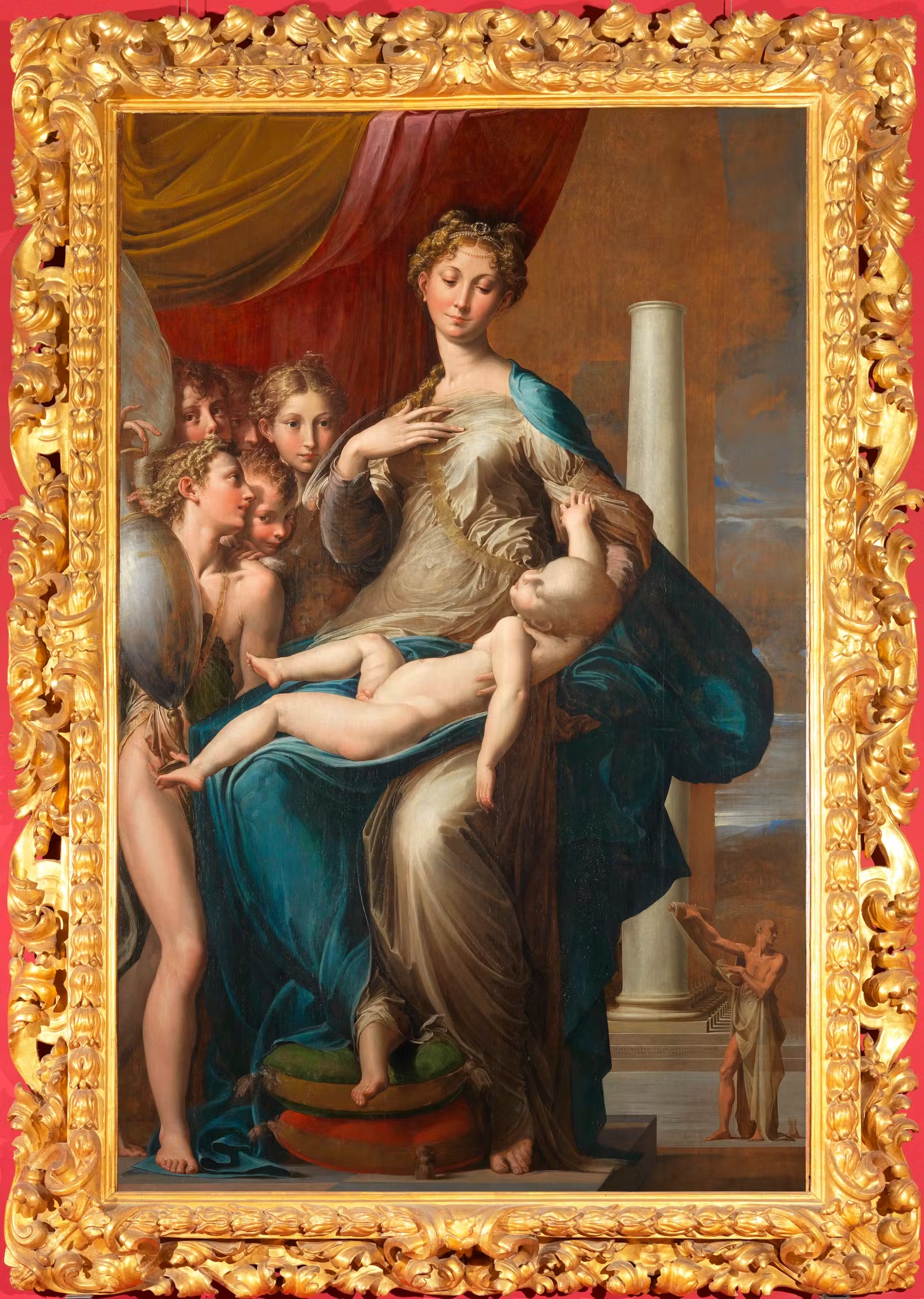
Parmigianino’s Madonna dal collo lungo (Madonna with the Long Neck) (1534–1540) is a textbook Mannerist image of graceful distortion: the Virgin’s elongated neck and the exaggerated scale and anatomy of surrounding figures reject naturalistic proportion. The painting’s architectural setting also feels spatially incoherent, pushing the viewer toward interpretation rather than immediate clarity. Seen alongside High Renaissance ideals, the work demonstrates how virtuosity could be redirected into deliberate artifice and unease. Source
The Virgin’s body is unnaturally extended, the Christ child appears elongated, and the surrounding architecture does not create a fully coherent space. The painting is graceful, but its grace is strange and unsettling, which is exactly what makes it Mannerist.
Bronzino brought Mannerist qualities into portraiture.
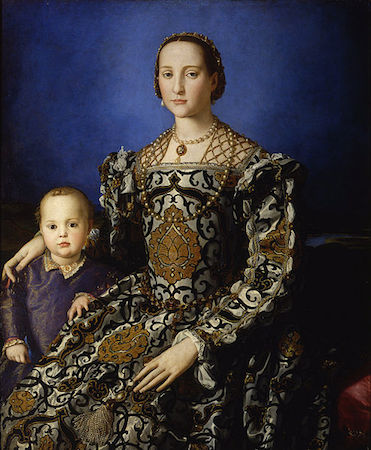
Bronzino’s Portrait of Eleonora of Toledo with her son Giovanni (1544–45) shows Mannerism applied to court portraiture through an intensely controlled, polished surface and a deliberately cool emotional tone. The shallow backdrop and meticulous rendering of textiles prioritize artifice and display over a natural, intimate scene. As a political image, it links Mannerist elegance to elite identity and dynastic messaging. Source
His portraits often project elegance, restraint, and polished surface, yet they can also feel distant or cold. This combination suggests that Mannerism was not only about religious subjects; it also shaped elite self-presentation by emphasizing refinement, control, and studied artifice.
Interpreting Mannerism
Mannerism matters because it shows that Renaissance art did not move in a simple line toward greater realism. Artists could deliberately reject balance and still demonstrate extraordinary skill. For AP European History, the key point is not memorizing every painter but recognizing how form communicates historical meaning. When proportions are distorted, space is unstable, and composition is difficult, the artwork expresses a broader cultural mood of experimentation and uncertainty.
Mannerist art also reminds historians that style can be a response to changing expectations. Patrons and educated viewers often admired works that were challenging, stylish, and visibly complex. In that sense, Mannerism was both an artistic language and a social statement about sophistication.
Practice Questions
Identify two visual characteristics of Mannerist art that distinguished it from the balanced style of the High Renaissance. (2 marks)
1 mark for identifying distorted bodies or proportions, such as elongated figures or twisted poses.
1 mark for identifying unusual composition or unstable space, such as crowded scenes, asymmetry, or unclear perspective.
Analyze how Mannerist artists used visual form to communicate tension and instability in sixteenth-century Europe. (5 marks)
1 mark for a defensible thesis arguing that Mannerist form conveyed unease, uncertainty, or complexity.
1 mark for explaining how distorted proportions or difficult poses created tension.
1 mark for explaining how unusual composition or ambiguous space created instability.
1 mark for using a specific example such as Pontormo's Deposition, Parmigianino's Madonna with the Long Neck, or Bronzino's portraits.
1 mark for linking these visual choices to broader sixteenth-century cultural or intellectual uncertainty.
FAQ
Early art historians often judged sixteenth-century art against the standards of the High Renaissance. Because Mannerist works looked artificial or exaggerated, they described them as a decline from an earlier artistic peak.
The term is now used more neutrally. Scholars generally recognise that the style was often deliberate, inventive, and highly skilled rather than simply “incorrect”.
Courts often preferred art that signalled refinement and exclusivity. Mannerist works rewarded viewers who could appreciate difficult poses, classical references, and visual wit.
Because court culture valued distinction, an unusual and highly polished style could suggest taste, education, and social rank more effectively than straightforward naturalism.
No. It also appeared in sculpture, architecture, decorative arts, and court entertainments. In architecture, designers could bend classical expectations through unexpected proportions, playful façades, and dramatic staircases.
This matters because Mannerism was not just a painting style. It became a broader visual language that shaped elite environments and ceremonial display.
Engravings and etchings allowed poses, compositions, and ornamental designs to circulate far beyond the original workshop. Artists who never travelled to Italy could still study elongated bodies and complex arrangements through printed images.
Prints also encouraged imitation and adaptation, so regional versions of Mannerism developed in different artistic centres.
Although Michelangelo is central to the High Renaissance, some of his later works feature muscular bodies, strained poses, and dramatic spatial effects that strongly influenced Mannerist artists.
For that reason, historians sometimes treat him as both a predecessor and part of the movement’s development. The debate shows that artistic periods do not always have sharp boundaries.