AP Syllabus focus:
'Accusations of witchcraft peaked between 1580 and 1650, reflecting folk beliefs, gender patterns, and periods of upheaval.'
In early modern Europe, witchcraft accusations became a dramatic expression of fear, instability, and local tension, revealing how communities interpreted misfortune through religion, custom, and social suspicion.
The timing of the witchcraft peak
The great wave of witchcraft accusations did not occur evenly across all centuries.
This Cornell University Library exhibition page summarizes how witch trials translated accusations into formal legal punishment, emphasizing that conviction often meant execution and that practices varied by region. It also highlights that historians observe a particularly concentrated surge in persecution around the late sixteenth and early seventeenth centuries. Used alongside your notes, it helps connect the timing of intensified accusations to the machinery of courts and sentencing. Source
It reached its highest intensity between about 1580 and 1650, when many European communities were under severe strain. In this period, accusations often turned ordinary bad luck—failed crops, sickness, infant death, or the loss of livestock—into evidence that an enemy had used supernatural harm.
These accusations were usually local before they became judicial. Neighbors suspected neighbors. A quarrel, a refused request for charity, or a reputation for cursing could be reinterpreted as proof of witchcraft once misfortune followed. The importance of the period lies in the combination of deep popular belief with unstable social conditions.
Why this period was especially volatile
Harvest failures and food shortages increased fear and anxiety.
Disease and high mortality made supernatural explanations more persuasive.
War and displacement weakened trust within communities.
Economic pressure intensified neighborly conflict and resentment.
Folk beliefs and everyday fear
Most early modern Europeans, whether educated or not, accepted the existence of magic and the Devil. Witchcraft was frightening not because it seemed impossible, but because it seemed plausible. Many people believed hidden spiritual forces could affect health, weather, fertility, and household prosperity.
A central idea was maleficium.
Maleficium: Harmful magic believed to cause injury, illness, death, or damage to crops and property.
This belief tied witchcraft closely to everyday life.
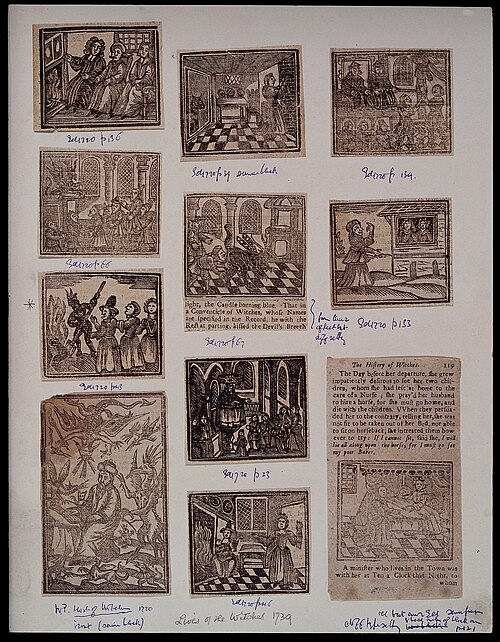
This 1720 woodcut presents multiple scenes associated with witchcraft accusations, including harmful magic (maleficium), encounters with the Devil, and communal rituals imagined as evidence of conspiracy. As a composite image, it helps illustrate how ordinary mishaps could be narratively stitched into a broader case against a suspect. The panels also show how print culture could standardize and spread stereotyped “signs” of witchcraft across communities. Source
A cow stopped producing milk, butter would not churn, a child became ill, or a storm damaged a field; such events could all be explained as deliberate magical attack. Accusations therefore grew out of ordinary material concerns rather than abstract theology alone.
Folk beliefs also gave communities a language for blame. Instead of seeing disaster as random, villagers could locate responsibility in a particular person, often someone already viewed with suspicion. Witchcraft accusations were therefore part of popular culture as well as part of criminal prosecution.
Gender patterns in accusations
Gender patterns were one of the clearest features of the witch hunts. In much of Europe, most accused witches were women, especially older women, widows, or women living on the social margins. This reflected powerful assumptions that women were morally weaker, more vulnerable to temptation, and more likely to engage in secret or disorderly behavior.
Women’s social positions could also make them easier targets. Those who depended on charity, practiced informal healing, quarreled with neighbors, or lacked male protection could acquire dangerous reputations. If misfortune followed an argument, an already unpopular woman might be accused of using supernatural revenge.
Several recurring stereotypes shaped accusations:
Older women were associated with age, dependency, and bitterness.
Widows and single women often lacked protection within patriarchal communities.
Healers or midwives could be feared because they worked near sickness, birth, and death.
Sharp-tongued or socially difficult women could be recast as malicious witches.
Even so, gender patterns were not absolute. Men were also accused in some regions, which shows that witchcraft fears were shaped by local culture as well as by broader assumptions about women.
Social upheaval and local conflict
The peak in accusations coincided with periods of upheaval. Communities facing war, taxation, displacement, epidemic disease, inflation, or repeated harvest failure often experienced intense insecurity. Under such pressure, people searched for explanations that made suffering feel understandable and controllable.
Witchcraft accusations turned broad crisis into personal blame. Instead of confronting forces such as climate problems, economic hardship, or political instability, communities could identify a supposed witch within the village. This did not solve the crisis, but it provided an emotionally satisfying explanation and a target for anger.
Social upheaval also damaged trust. When survival became more difficult, tensions over charity, food, labor, and property sharpened. The result was a climate in which rumor, resentment, and fear could spread rapidly.
How accusations spread
Accusations usually began with reputation. A person thought strange, unfriendly, or threatening might already be feared before any formal charge appeared. Once a suspicious event occurred, old stories could be gathered into a case: curses uttered in anger, unexplained illnesses, or memories of earlier disputes.
Trials became more dangerous when authorities accepted popular fears instead of restraining them. In those settings, rumor could expand into multiple accusations, because one charge encouraged others. A single suspect might be linked to a wider hidden network of witches, making the panic self-reinforcing. The most severe waves of persecution emerged when local anxieties and legal action worked together.
Why historians pay attention to witchcraft accusations
Historians study these accusations as evidence of everyday mentalities. Trial records preserve voices of neighbors, families, and local officials who rarely appear so clearly in other sources. They show how early modern Europeans linked misfortune to moral suspicion, and how social inequality shaped whose fears counted and whose reputations collapsed. Witchcraft accusations therefore offer a window into village life, gender expectations, and the pressures that crises placed on communal relationships.
Practice Questions
Identify TWO factors that contributed to the rise of witchcraft accusations in Europe between 1580 and 1650. (2 marks)
1 mark for identifying widespread folk beliefs in harmful magic, the Devil, or supernatural causation.
1 mark for identifying either gender patterns or periods of upheaval such as war, disease, harvest failure, or economic stress.
Evaluate the extent to which social upheaval, rather than gender patterns alone, explains the peak in witchcraft accusations in Europe from 1580 to 1650. (6 marks)
1 mark for a defensible thesis that makes a clear argument about relative importance.
1 mark for relevant context about the late sixteenth and early seventeenth centuries as the peak period of accusations.
1 mark for specific evidence showing how upheaval such as war, disease, food shortages, or economic insecurity encouraged accusations.
1 mark for specific evidence showing how gender shaped who was most often accused.
1 mark for explaining how folk beliefs turned misfortune into accusations against particular individuals.
1 mark for complexity, such as explaining how these factors interacted or noting that men were also accused in some regions.
FAQ
Regional variation was strongly affected by legal systems, political structure, and the attitude of higher courts.
Areas with fragmented authority and many local courts often saw more intense persecutions, because panics were harder to stop. By contrast, some more centralised states or appellate courts were more sceptical and overturned weak cases.
This helps explain why parts of the Holy Roman Empire saw severe hunts, while other regions experienced fewer large-scale trials.
Torture could turn suspicion into confession. Under extreme pain or fear, accused people might admit impossible acts simply to end the ordeal.
It also encouraged the naming of supposed accomplices. Once one confession produced new names, authorities could widen the investigation, creating chain accusations and larger panics.
Not every court used torture in the same way, but where it was allowed, it often made trials far more destructive.
Yes. Children could be accused, especially during intense local panics, though they were less often executed than adults.
Children also appeared as witnesses. Their statements could carry emotional weight because adults believed children might reveal hidden wrongdoing. At the same time, children were highly vulnerable to pressure, suggestion, and fear.
Their involvement shows how deeply witchcraft fears could enter family and community life.
The “witches’ sabbath” was the alleged secret gathering where witches were said to meet the Devil, renounce Christianity, and perform evil rituals.
This idea mattered because it transformed witchcraft from isolated harmful magic into an organised conspiracy. Judges who accepted the sabbath story were more likely to see accused people as part of a wider hidden network rather than as single offenders.
That made prosecutions more expansive and more dangerous.
Several changes weakened the conditions that had supported the hunts:
higher standards of evidence
greater judicial scepticism
stronger control by central authorities
growing concern about false accusations
Intellectual change also mattered. Educated elites increasingly questioned spectacular claims about demonic conspiracies.
The decline was uneven, but by the later seventeenth century many courts were much less willing to turn local fear into large-scale prosecution.