AP Syllabus focus:
'Religious reform strengthened state control over religion while also justifying resistance to established rulers.'
In the Reformation era, religion and politics became tightly linked. Reform weakened universal church authority, empowered rulers to supervise belief, and at the same time supplied subjects with arguments for resisting ungodly government.
Shifting the Source of Authority
From universal church to territorial control
For centuries, Western Europe had recognized a broad ideal of a unified Christian order under the Roman Church. Religious reform disrupted that ideal. Once reformers denied the pope’s exclusive authority, rulers could claim greater power inside their own territories. Monarchs and princes increasingly decided which form of Christianity would operate publicly, who would preach, and how religious institutions would be supervised.
Historians often describe this change as confessionalization.
Confessionalization: The process by which early modern states and churches worked together to enforce a particular confession and shape social discipline.
In practice, confessionalization tied government and faith together. States used churches to encourage obedience, moral discipline, and social order, while churches relied on rulers for protection and enforcement. Religion did not become less important; instead, it became more deeply embedded in state power. The local church could become an arm of governance, teaching doctrine that also reinforced loyalty.
Concrete ways states gained power
Religious reform gave rulers several practical advantages:
They appointed or closely monitored clergy and church officials.
They regulated preaching, liturgy, and public worship.
They seized church lands and redirected wealth to the crown or territorial government.
They used parish structures to watch behavior and reinforce authority.
In England, the crown made the monarch head of the national church. In many German territories and Scandinavian kingdoms, secular rulers became decisive religious authorities within their lands.
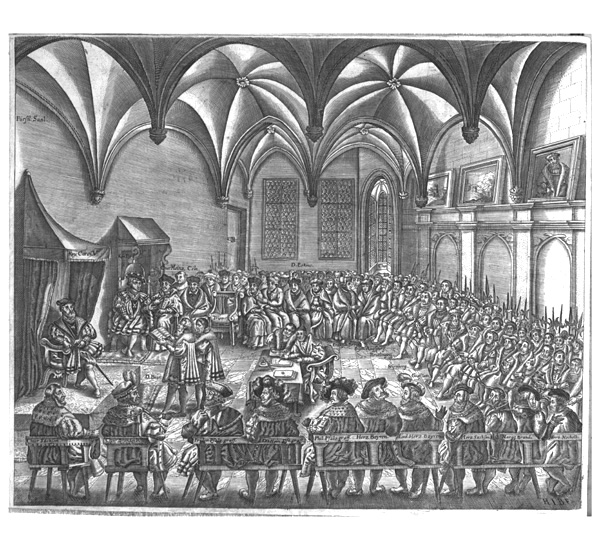
This image depicts the negotiation of the Peace of Augsburg (1555), a landmark settlement that formalized a territorial approach to religion within the Holy Roman Empire. It helps illustrate how religious reform translated into state policy: rulers and political assemblies became central actors in regulating public confession and church governance. Source
Catholic rulers also tightened supervision of clergy and worship, showing that stronger religious administration was a wider early modern trend.
Why rulers wanted religious control
Political and social advantages
Control of religion could strengthen a ruler in several ways. A single official faith encouraged political unity and reduced the independence of outside authorities such as the papacy. Religious institutions also helped governments communicate with local communities, register families, supervise charity, and promote obedience. Reform therefore supported state-building, especially where rulers wanted more centralized administration. Schools and catechisms helped create more uniform religious cultures, which rulers hoped would also produce more predictable subjects.
Church control also had a financial side. Dissolved monasteries, confiscated property, and redirected tithes increased resources available to governments or allied nobles. In this sense, religious reform was not only a matter of belief; it could reshape the balance of power inside a state.
Limits and tensions
State control was never complete. Local nobles, town councils, and ordinary believers could resist official policy, and many populations remained divided in practice. In many places, governments had to bargain with estates, nobles, or city councils before religious policies could be enforced. Still, the Reformation changed expectations. Rulers were increasingly judged responsible for the religion of their territories, and governing meant taking a position on doctrine, worship, and discipline.
Reform and the justification of resistance
Obedience was no longer unconditional
Religious reform did not automatically lead to rebellion. Many reformers feared disorder and at first urged obedience to secular authority. Yet the logic of reform could also undermine unquestioned submission. If scripture stood above church hierarchy, and if rulers themselves were subject to God’s law, then subjects could argue that obedience had limits. A ruler who imposed false worship or persecuted the “true” church could be opposed. Conscience became a political issue because believers were asked to choose between official commands and what they believed God required.
This idea developed into resistance theory.
Resistance theory: The belief that subjects, communities, or lower officials may lawfully oppose a ruler who violates God’s law or breaks established political obligations.
These claims mattered most when rulers tried to force religious conformity on unwilling populations.
Main arguments used by resisters
Resisters often argued that:
God’s law ranked above human commands.
Rulers were bound by laws, oaths, and duties, not free to rule arbitrarily.
Lower magistrates or established political bodies could defend a community against tyranny.
Protecting the true faith could justify collective action.
Such ideas appeared especially in Calvinist circles, but they could influence other groups as well. Resistance was usually framed not as popular democracy, but as lawful defense of religion, privileges, or the commonwealth. That distinction mattered: many early modern opponents of rulers claimed they were preserving legitimate order, not destroying it.
The political paradox of religious reform
Stronger government, stronger opposition
The same religious changes that increased state power also made opposition more ideologically powerful. Because rulers now had greater authority over churches, disputes about worship, clergy, education, and morality quickly became disputes about sovereignty itself. Political loyalty and religious identity became harder to separate. That overlap helps explain why early modern rebellions could be both spiritual and constitutional at the same time.
This is the central paradox of the period. Reform helped create stronger territorial states by weakening universal religious authority and expanding government oversight. At the same time, it provided subjects with new moral and legal languages for challenging rulers who seemed to violate divine law or historic rights. Religious reform therefore reshaped power in two directions at once: it made states more intrusive, and resistance more principled.
Practice Questions
Answer parts a, b, and c.
a) Identify ONE way religious reform strengthened state authority over religion.
b) Identify ONE way religious reform justified resistance to established rulers.
c) Briefly explain ONE reason both developments could occur at the same time.
(3 marks)
a) 1 mark for identifying a specific way, such as rulers appointing clergy, controlling worship, seizing church lands, or creating national or territorial churches.
b) 1 mark for identifying a specific justification for resistance, such as obedience to God’s law over human commands, defense of the true church, or action by lower magistrates against tyranny.
c) 1 mark for explaining that once rulers took direct control of religion, religious disputes became political disputes, so reform could both strengthen government and provoke principled opposition.
Evaluate the extent to which religious reform between 1517 and 1648 strengthened rulers more than it weakened them. (6 marks)
1 mark for a defensible thesis that makes a clear claim about extent.
1 mark for relevant broader context, such as the weakening of universal papal authority or the growth of territorial states.
1 mark for providing one specific piece of evidence showing strengthened rulers, such as royal supremacy in England or princely control of churches in German territories.
1 mark for providing one specific piece of evidence showing limits or opposition, such as resistance theories, confessional conflict, or organised resistance by subjects or elites.
1 mark for using historical reasoning to compare the two sides of the argument.
1 mark for demonstrating complexity, such as explaining that reform strengthened administration while simultaneously making resistance more legitimate.
FAQ
Church visitations let officials inspect parishes, question clergy, and check whether doctrine, schooling, and worship matched official policy.
They also generated information. Reports from visitations showed where ignorance, resistance, absentee clergy, or weak discipline were concentrated, making them useful tools of surveillance as well as reform.
In many Protestant lands, marriage was treated less exclusively as a sacrament overseen by church courts and more as a social institution with civil importance.
That shift gave secular authorities a larger role in questions of legitimacy, inheritance, divorce, and household order. Control of marriage law therefore strengthened state influence over everyday religious life.
Governments could regulate public worship, attendance, speech, and behaviour, but they could not easily measure private belief.
For that reason, many rulers prioritised visible obedience. If subjects attended the approved church and avoided open dissent, authorities often saw that as enough to preserve order, even if private conviction remained uncertain.
Universities trained clergy, teachers, and lawyers who could defend official doctrine and administer policy consistently.
They also standardised learning. A government that influenced university appointments and curricula could shape the next generation of preachers and officials, giving confessional rule a stronger intellectual foundation.
Composite states often contained different laws, privileges, languages, and regional elites, so rulers could not impose one religious policy everywhere with equal ease.
Border regions added further complications through migration, trade, and cross-border worship. These areas often forced governments to bargain, compromise, or tolerate limited diversity rather than enforce complete uniformity.