AP Syllabus focus:
'Religious pluralism challenged the ideal of a unified Europe and changed how Europeans experienced authority and community.'
In the sixteenth and seventeenth centuries, Europe moved from a largely shared religious framework to a divided Christian landscape, transforming political legitimacy, local identity, and the everyday patterns through which people understood belonging.
Study Notes
The breakdown of a unified Christendom
Before the sixteenth century, many Europeans assumed Latin Christendom formed a single religious community under the broad leadership of the Catholic Church. That ideal was never completely real, but it still gave political and social order a shared frame of reference. As Protestant movements spread and survived, Europe no longer appeared to be one Christian body with one final earthly authority. The religious map of Europe became a patchwork of territories, cities, and local communities shaped by different confessions.
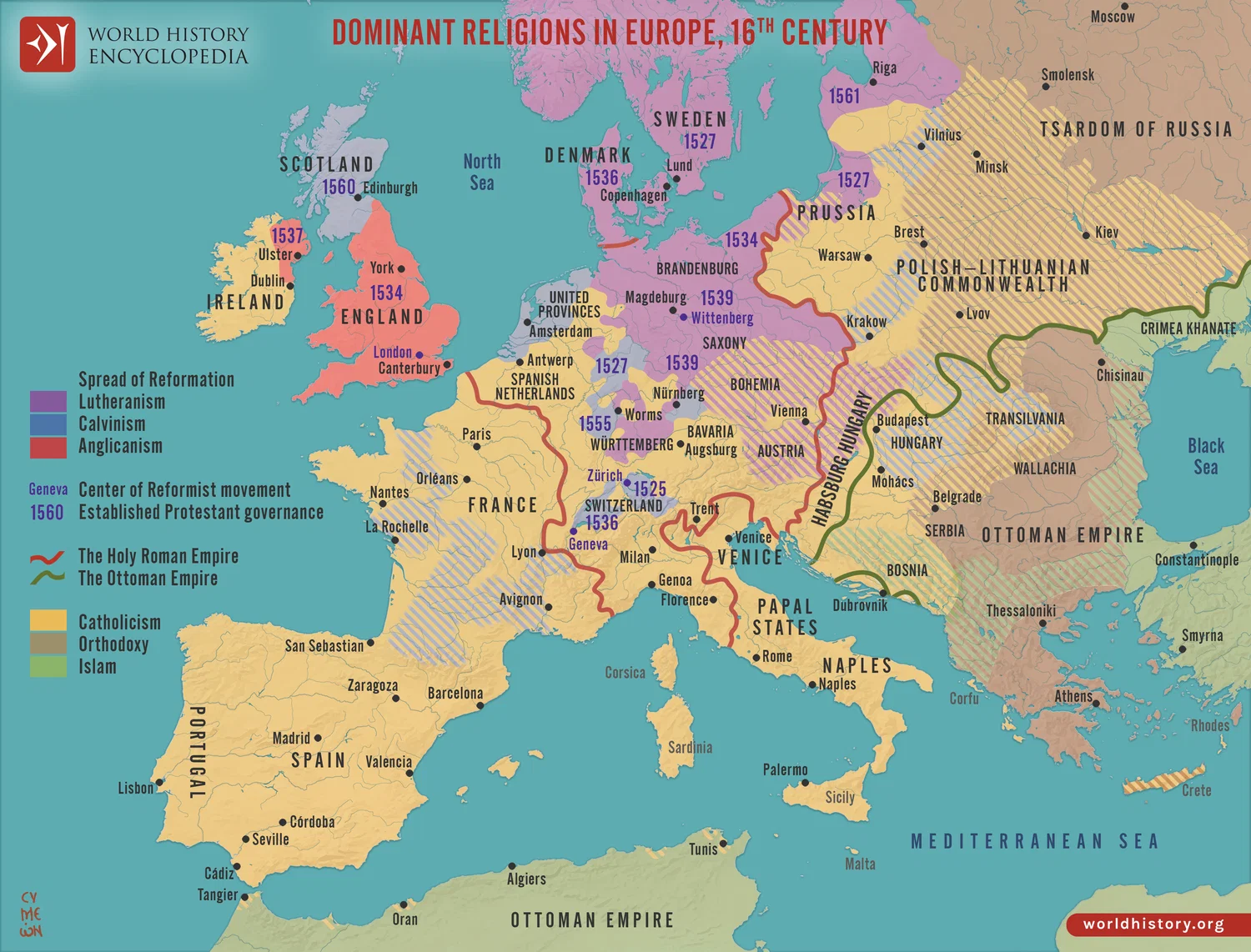
A confessional map of Europe in the sixteenth century, illustrating the geographic fragmentation of Christianity after the Reformation. By showing multiple confessions across neighboring regions, it helps explain how religious pluralism reshaped political identity and community boundaries. Source
Religious pluralism: The coexistence of multiple religious groups within the same society or political space, reducing the ability of any one church to claim unquestioned authority.
Religious pluralism did not mean full equality among religions. In most places, one confession still received official protection. What changed was the durable existence of rival churches across Europe.
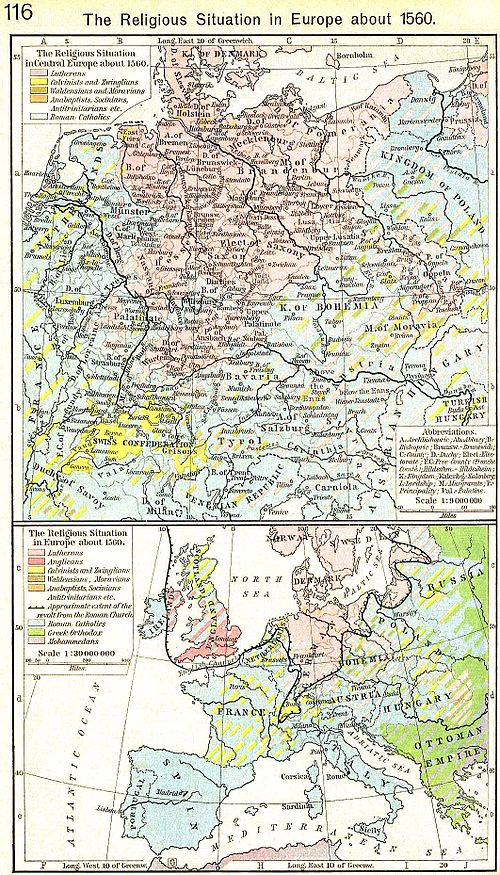
A historical atlas-style map showing the distribution of major confessions in Europe around 1560. Its clear color blocks and labels help students connect doctrinal divisions to political geography—especially in the Holy Roman Empire, the British Isles, and parts of Switzerland and France. Source
Europeans had to live with lasting division, not a brief outbreak of heresy that could simply be removed. This altered both political expectations and social habits, because the old ideal of a single Christian Europe became much harder to sustain.
Authority became contested
The rise of multiple confessions weakened claims that religious truth and public order came from a single universal source. Papal authority remained central for Catholics, but it no longer united all western Christians. In many regions, princes, kings, town councils, and local clergy gained greater power because they supervised worship, appointed ministers or priests, and enforced religious rules inside their territories. This gave local governments a larger role in defining orthodoxy and regulating public life.
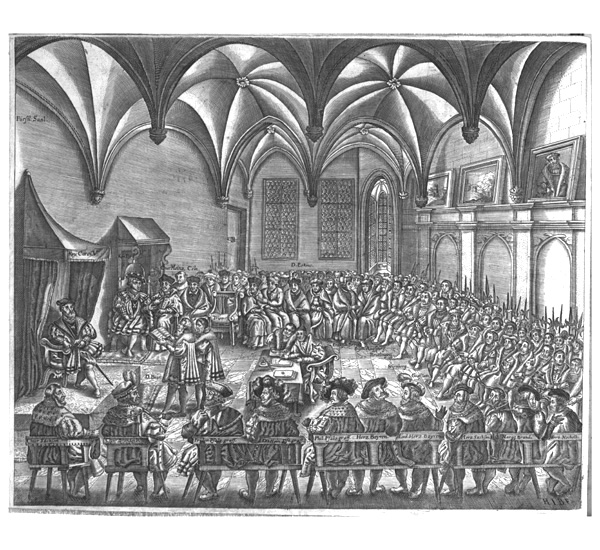
An early modern depiction of negotiations connected to the Peace of Augsburg (1555), which recognized legal coexistence between Catholicism and Lutheranism in parts of the Holy Roman Empire. The scene underscores how religious settlement became a matter of territorial governance and political bargaining rather than a single universal church decision. Source
For ordinary people, authority became less distant and more immediate. Instead of experiencing the Church mainly as a universal institution, they increasingly encountered religion through local sermons, parish oversight, catechism, and discipline. Religion was not only believed; it was administered. Officials and clergy could monitor attendance, moral behavior, and conformity more closely than before.
Religious pluralism also created competing loyalties. A subject might owe political obedience to one ruler while feeling spiritual allegiance to a different confession. This tension changed how people judged legitimacy. Obedience could no longer be assumed simply because ruler and church stood together; it increasingly depended on whether a ruler defended what subjects believed to be the true faith. As a result, authority became more contested at every level, from the village parish to the royal court.
Community life in a plural Europe
Communities were reshaped because religion organized major events of life: baptism, marriage, worship, charity, education, festivals, and burial. Once multiple confessions existed, these practices became visible markers of identity. Belonging to a village or town increasingly meant belonging to a particular confessional culture.
This change appeared in several ways:
Neighborhoods and towns identified themselves by confession.
Schools and systems of poor relief often reflected the values of the dominant church.
Marriage choices carried stronger religious meaning.
Public ritual separated insiders from outsiders.
Sacred spaces such as churches and cemeteries signaled who fully belonged.
Pluralism also changed the experience of time. Religious calendars, holy days, and public ceremonies were no longer the same everywhere. Where confessions differed, the rhythm of communal life could differ as well. In that sense, pluralism reshaped not only belief but also the weekly and yearly structure of everyday life.
Religious minorities often faced restrictions, suspicion, or pressure to conform. Yet pluralism also forced some communities to develop practical habits of coexistence. Shared markets, workplaces, and political institutions sometimes required cooperation even when theological agreement was impossible. Community life could therefore become both more divided and more negotiated at the same time.
Religious difference also encouraged migration. Families, clergy, and skilled workers moved to safer or more welcoming regions, spreading ideas and reshaping urban populations. These movements created wider networks of refugees, merchants, and co-religionists, linking local communities to broader religious identities beyond the immediate town or village.
Social change and everyday experience
Pluralism changed not only institutions but also how Europeans understood themselves. Under the ideal of unified Christendom, many people could imagine membership in one overarching Christian society. In a more plural Europe, identity became more layered. A person might think of himself or herself as a subject of a ruler, a resident of a town, and a member of a specific confession, each identity carrying different obligations.
Households became more important in transmitting belief. Parents, especially fathers in patriarchal societies, were expected to help shape the religious behavior of children. This tied family life more closely to public religious goals and helped create sharper confessional identities across generations. Religious disagreement could therefore enter the home as well as the church.
Pluralism changed emotional life as well. It could produce anxiety, because eternal truth seemed contested and neighbors might worship differently. But it could also strengthen commitment, since competition between confessions encouraged clearer teaching, stronger group boundaries, and deeper attachment to one’s own community. In many places, difference made religion feel more urgent, not less important.
The effects were uneven. Some places remained relatively uniform, while others lived with visible diversity. Some rulers and towns pursued strict conformity, while others accepted limited coexistence for the sake of order. Even so, Europeans increasingly experienced religion through competing institutions, local enforcement, and confessional communities rather than through the older ideal of a single, united Christendom.
Practice Questions
Identify and briefly explain one way religious pluralism changed how ordinary Europeans experienced authority in the sixteenth or seventeenth century. Short-Answer Question (3 marks)
1 mark for identifying a valid change, such as the decline of a single universal religious authority or the increased role of rulers and local churches.
1 mark for explaining how authority shifted to princes, town councils, clergy, or territorial churches.
1 mark for linking this shift to ordinary experience, such as parish discipline, worship rules, education, or competing loyalties.
Evaluate the extent to which religious pluralism transformed community life in Europe from 1500 to 1700. Extended Response Question (6 marks)
1 mark for a clear thesis making a defensible argument about extent.
1 mark for relevant contextualization, such as the earlier ideal of a unified Christendom.
2 marks for specific evidence, such as confessional communities, public ritual, marriage patterns, migration, minority restrictions, or coexistence in towns.
1 mark for analysis explaining how the evidence shows changes in community identity or social organization.
1 mark for complexity, such as noting uneven effects across regions or the coexistence of change and continuity.
FAQ
Borderlands often sat between rival rulers, trade routes, and language groups, so religious differences were harder to isolate there than in more uniform inland areas.
Because people, goods, and information moved frequently across borders, communities in these regions were more likely to encounter mixed worship, refugee settlement, and overlapping legal authority. That made religious identity both more visible and more flexible.
Names could quietly signal confessional identity. Families might choose biblical names, saints’ names, or names associated with respected ministers or local traditions.
Godparent choice also mattered. It helped families build trusted social networks inside their own religious group. In mixed areas, such choices could show solidarity, caution, or a desire to preserve a child’s place within a minority community.
A house church was a private or semi-hidden place of worship used by groups who could not worship openly in public churches.
These spaces mattered because they let minorities preserve communal life without full legal recognition. Worship in houses, workshops, or rented rooms also shaped a more intimate style of religious practice, with tighter internal discipline and a stronger sense of shared risk.
Merchants often valued stability, credit, and access to trading partners over strict religious uniformity. A town that welcomed skilled migrants or foreign traders could gain economically.
Clergy, by contrast, were more likely to prioritise doctrinal purity. This difference did not mean merchants were indifferent to religion; rather, they often treated coexistence as a practical way to protect commerce and civic order.
Yes. Children usually met pluralism through schooling, neighbourhood contact, family instruction, and local ritual before they understood larger political disputes.
In mixed areas, they might hear different prayers, observe different feast days, or notice that friends attended other churches. This could sharpen confessional identity early, but it could also make religious difference seem normal in everyday social life.