AP Syllabus focus:
'Commercial change, urban growth, family structures, and popular culture reshaped everyday life in early modern Europe.'
In early modern Europe, economic change did not stay in markets alone; it altered households, cities, and communal customs, producing new pressures and new ways of organizing work, family life, and social belonging.
Commercial Change and Everyday Life
Market-Oriented Production
The sixteenth and seventeenth centuries saw more economic activity directed toward profit and exchange. Rising population, growing trade, and expanding demand for food and goods encouraged landowners, merchants, and producers to think in more commercial terms. Agriculture in many regions became less purely subsistence-based and more connected to markets, while artisans and rural households increasingly produced for sale.
Commercial capitalism: An economic system in which merchants and producers organized trade and production for profit, linking local labor and goods to wider markets.
Commercial change affected ordinary people unevenly. Some peasants and town dwellers found new chances to earn cash, but others became more vulnerable to debt, rent increases, and price fluctuations. In many places, access to land mattered more than ever, because families without secure landholding depended more heavily on wages or seasonal work.
A growing household economy connected families to commerce.
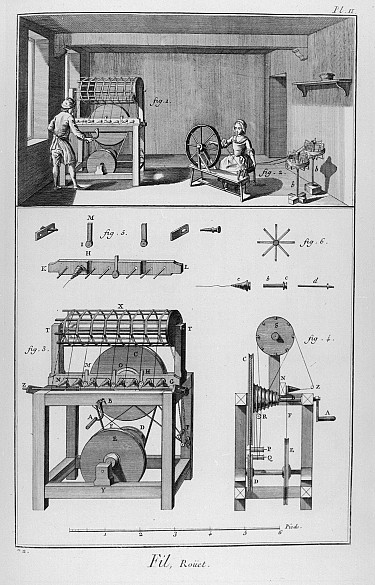
Copperplate engraving (1773) showing a textile “spinning room,” with multiple workers processing fiber into yarn inside a domestic/workshop interior. The image helps illustrate proto-industrial outwork (the putting-out system), where merchant-directed production relied on dispersed household labor rather than centralized factories. Source
Merchants might supply raw materials to rural families, who then spun, wove, or finished goods at home for wages. This blurred the line between domestic life and market labor, since the home remained both a living space and a workplace.
Urban Growth and Social Pressure
Commercial expansion also encouraged urban growth. Towns and cities developed as centers of trade, finance, government, and skilled labor. People migrated from the countryside in search of employment, training, or relief from rural hardship. Cities therefore became places of opportunity, but also of crowding and insecurity.
Urban life sharpened social differences:
wealthy merchants and professionals could gain status and influence
artisans and shopkeepers occupied a middling position
laborers, servants, migrants, and the poor faced unstable incomes and high living costs
As cities grew, authorities had to respond to poverty, begging, and disorder more directly. Urban growth strained older systems of charity and neighborhood oversight, making daily life more regulated and less purely local.
Family Structures and the Household
The Family as a Working Unit
The family remained the basic social and economic unit of early modern Europe. Whether in village or city, the household organized labor, consumption, inheritance, and care for dependents. Families were not simply emotional units; they were practical institutions for survival.
Most households operated under patriarchal assumptions, meaning that adult men usually held legal and formal authority. Yet household survival depended on the labor of all members. Women worked in farming, dairying, brewing, spinning, market selling, and childrearing. Children also contributed through domestic work, craft labor, or service.
Marriage patterns reflected these economic realities. Marriage was often delayed until a couple could support a household, especially in regions where young people worked as servants or apprentices before marrying. Dowries, inheritance customs, and access to property shaped who could marry and how securely a family could live.
Change, Mobility, and Dependence
Commercial change could strengthen some households while weakening others. Families with property, tools, or craft skills might improve their position. Families without these resources could fall into dependence on employers, landlords, or urban wage work. Migration became a common strategy: sons, daughters, and servants moved to towns or other regions to seek work and send resources home.
Urban households were especially flexible. A family might include not only parents and children but also apprentices, servants, lodgers, or widowed relatives. This made the household a social unit broader than the modern nuclear family, even when kinship ties remained central.
Popular Culture and Communal Life
Festivals, Customs, and Shared Experience
Popular culture gave ordinary Europeans a shared rhythm of life. It was shaped by the religious calendar, agricultural seasons, fairs, taverns, games, music, storytelling, and neighborhood traditions. These practices created community identity and offered relief from hard labor.
Festivals and seasonal celebrations were important because they expressed values as well as providing entertainment. They marked harvests, marriages, and local religious observances, and they reminded people that daily life was embedded in custom rather than only in work or state authority.
Popular culture was often collective and public:
people celebrated in streets, marketplaces, churches, and village greens
customs were passed down orally rather than mainly through formal schooling
community participation reinforced belonging and local memory
Rituals of Social Discipline
Popular culture also enforced norms. Communities used ridicule, public shame, and festive rituals to punish behavior seen as disruptive.
Charivari: A noisy public ritual of mockery or shaming used by a community to protest conduct such as adultery, domestic disorder, or socially improper marriage.
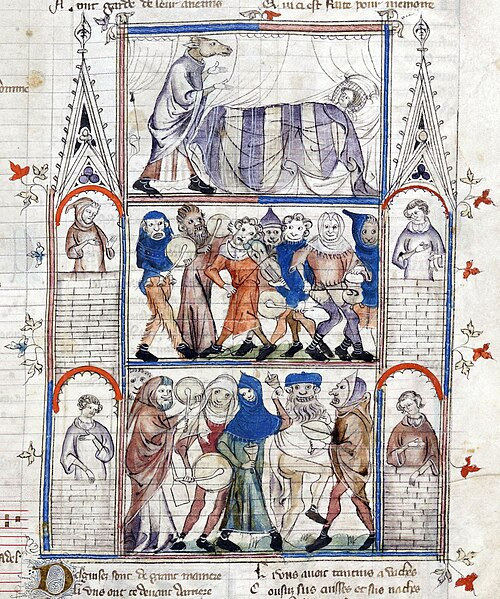
Medieval manuscript illustration (c. 1300) depicting a charivari: a noisy procession using instruments and public spectacle to shame a target for perceived social or moral violations. As a visual source, it concretizes how popular culture could function as informal community enforcement—public, collective, and reputationally powerful. Source
Such rituals show that ordinary people actively policed moral behavior, not just rulers or clergy. Community approval mattered deeply, and public reputation could affect marriage prospects, business dealings, and a family’s standing.
At the same time, commercial growth and urban expansion challenged older communal bonds. In larger, more mobile populations, neighbors did not always know one another as well, and traditional customs could seem harder to maintain. Reforming elites and magistrates increasingly tried to regulate festivals, leisure, and public behavior, seeing them as sources of disorder. This created tension between customary culture and efforts to impose greater discipline.
Patterns of Change in Daily Life
The interaction of commercial change, urban growth, family structures, and popular culture reshaped everyday experience in lasting ways. Work became more tied to markets and money. Cities offered new opportunities while deepening inequality. Families adapted by using every member’s labor and by making marriage, migration, and inheritance more closely connected to economic calculation. Popular culture remained a vital sphere where communities preserved identity, celebrated shared values, and responded to social change.
Practice Questions
Answer all parts.
a) Identify ONE way commercial change reshaped family life in early modern Europe. (1 mark)
b) Explain ONE way urban growth altered everyday social relations in early modern Europe. (1 mark)
c) Identify ONE function of popular culture in maintaining community norms. (1 mark)
(3 marks)
a) 1 mark for identifying a valid effect such as greater dependence on wages, home-based production for markets, delayed marriage, migration for work, or changing inheritance pressures.
b) 1 mark for explaining a valid urban effect such as crowding, weaker personal ties, greater inequality, more migrants, or increased regulation of poverty and behavior.
c) 1 mark for identifying a valid function such as reinforcing local identity, marking seasonal rhythms, publicly shaming offenders, or preserving communal customs.
Evaluate the extent to which commercial change, rather than popular culture, transformed everyday life in early modern Europe in the sixteenth and seventeenth centuries. (6 marks)
1 mark for a defensible thesis that makes a clear argument about relative importance.
1 mark for contextualization that situates the argument in broader developments such as population growth, expanding trade, or urbanization.
2 marks for specific evidence relevant to the argument, such as household wage labor, migration, delayed marriage, urban poverty, festivals, or charivari.
2 marks for analysis and reasoning that explain causation and relative importance, including how commercial change and popular culture interacted or how change coexisted with continuity.
FAQ
Service allowed unmarried young adults to earn wages, learn practical skills, and build savings before forming a household of their own.
In many regions, this stage of life helped families manage limited resources. Parents did not need to support all children at home indefinitely, while sons and daughters gained work experience, social contacts, and sometimes a better chance of marriage.
Guilds often influenced who could enter a trade, how apprentices were trained, and which families could maintain a workshop across generations.
They also mattered socially:
they created networks for marriage and patronage
they sometimes provided charity or burial support
in some towns, widows could keep a husband’s workshop temporarily through guild rules
This made guild membership important not just for work, but for household stability.
Fairs were major social events as well as commercial ones. People gathered there to exchange news, seek employment, arrange credit, and meet potential marriage partners.
They also brought entertainment into economic life:
performers, games, and food stalls drew large crowds
travellers spread information between regions
local communities used fairs to connect with wider markets
A fair could therefore reshape both social relationships and economic opportunities.
Widows could become more publicly active because the death of a husband sometimes gave them temporary legal or economic room to act on their own behalf.
Depending on local custom, a widow might:
continue a shop or workshop
manage debts and contracts
supervise apprentices or servants
protect inheritance for children
This did not mean full equality, but it did make some widows more visible than married women, whose legal identity was often more constrained.
No. It usually changed form rather than vanishing. Some public festivities were reduced, restricted, or more closely supervised, especially in growing towns.
Yet customary practices often survived by adapting:
celebrations moved into smaller neighbourhood settings
old rituals were given new meanings
communities kept songs, stories, and festive habits even when officials disapproved
So the story is less about disappearance and more about negotiation between authority and local custom.