AP Syllabus focus:
'Conflicts among religious groups overlapped with political and economic competition and encouraged stronger sovereign states.'
Religious conflict in early modern Europe was rarely purely theological.
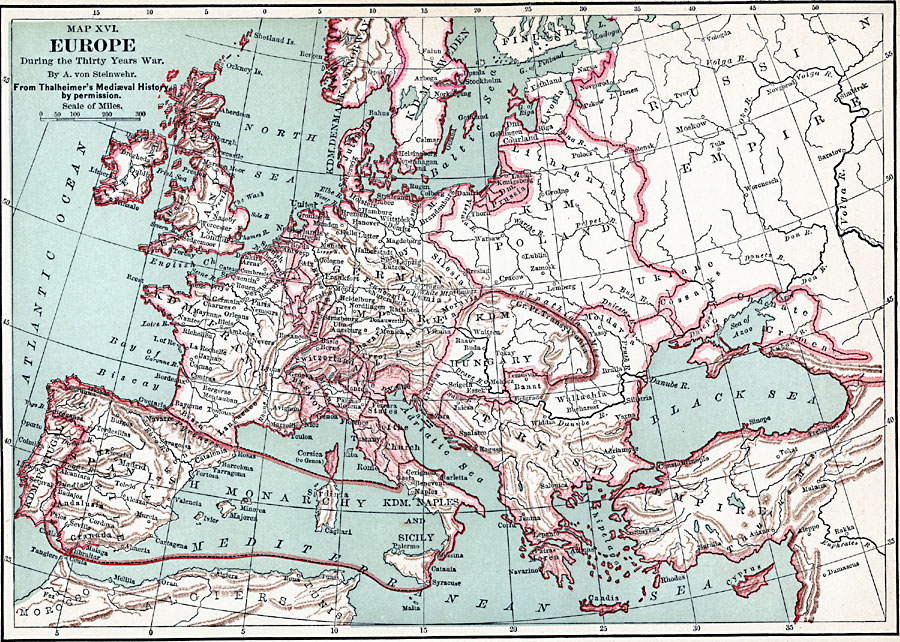
Political map of Europe during the Thirty Years’ War era, providing a big-picture view of the states and boundaries involved in the conflict’s wider strategic setting. Used alongside the narrative, it clarifies why contemporaries experienced these struggles as interlocking dynastic, territorial, and economic contests—not just doctrinal disputes. Source
Wars of religion also involved dynastic rivalry, territorial ambition, taxation, trade, and the growing determination of rulers to control their own states.
Religion and power in the same conflict
During the 16th and 17th centuries, religious division shattered the older ideal of a single Christian Europe. But once that unity broke down, conflict did not remain confined to doctrine. Princes, nobles, and monarchs used religion to mobilize support, justify resistance, and attack rivals.
In practice, many conflicts were driven by mixed motives:
rulers defended a confession while also seeking territory or political independence
nobles used religious language to protect local privileges against centralizing monarchies
states entered wars for strategic reasons even when their allies followed a different religion
merchants and governments recognized that war could reshape trade routes, taxation, and access to wealth
This overlap explains why the age produced both religious wars and stronger states. Warfare forced rulers to organize resources more effectively, while religious division gave governments new reasons to regulate belief and loyalty.
Political and economic competition
Religious conflict intensified existing rivalries between major dynasties and states. The Habsburgs, for example, were not only defenders of Catholic interests; they were also a powerful ruling family with territories across Europe. Their opponents often feared Habsburg political dominance as much as Catholicism itself.
France shows this clearly. Even when religious issues mattered deeply, French rulers also acted to contain Habsburg power. Likewise, the Dutch Revolt was not simply a Protestant rebellion against Catholic rule. It also involved resistance to taxation, defense of provincial liberties, and the protection of commercial interests in a wealthy region.
The Thirty Years’ War began with confessional tension in the Holy Roman Empire, but it widened into a broader struggle for influence in central Europe.
As the war continued, political calculation became increasingly visible. States pursued security, prestige, and strategic advantage, not just religious goals.
Economic competition also shaped conflict:
control of prosperous provinces increased tax revenue
access to ports and waterways supported commercial growth
war disrupted rivals’ trade while protecting one’s own economic position
governments needed more reliable revenue to finance armies and diplomacy
Religious warfare therefore became part of a larger contest over who would dominate European politics and wealth.
Sovereignty and the growth of state authority
As wars expanded, rulers needed more direct control over administration, taxation, and military force. This encouraged the growth of sovereignty.
Sovereignty: The principle that a ruler or state holds supreme authority within its own territory, free from outside interference.
The weakening of a universal Christian order strengthened this idea. If Europe was no longer governed by one shared religious authority, then territorial rulers had a stronger basis for claiming power over law, order, and religion within their own lands.
Governments responded to conflict by building institutions that could sustain war:
larger and more permanent armies
stronger systems of tax collection
expanded bureaucracies to keep records and enforce policy
more regular diplomacy between states
increased efforts to monitor subjects’ loyalty
These changes did not create fully modern states overnight, but they moved Europe toward more centralized and durable political structures.
How war encouraged state-building
War was expensive and continuous. To survive, rulers needed:
dependable revenue rather than occasional feudal dues
officials who served the crown instead of acting only as local magnates
better communication between the center and the provinces
more disciplined military organization
Religious conflict made this process more urgent because governments feared not only foreign enemies but also internal dissent. A ruler confronting subjects of another confession often treated religious difference as a political threat. That encouraged tighter supervision of churches, communities, and local elites.
Sovereignty was uneven, not absolute
The rise of stronger sovereign states was real, but it was uneven. Not every ruler gained full control, and many regions remained politically fragmented. The Holy Roman Empire is the clearest example: hundreds of territories, cities, and princes preserved significant local authority even as larger states elsewhere became more centralized.
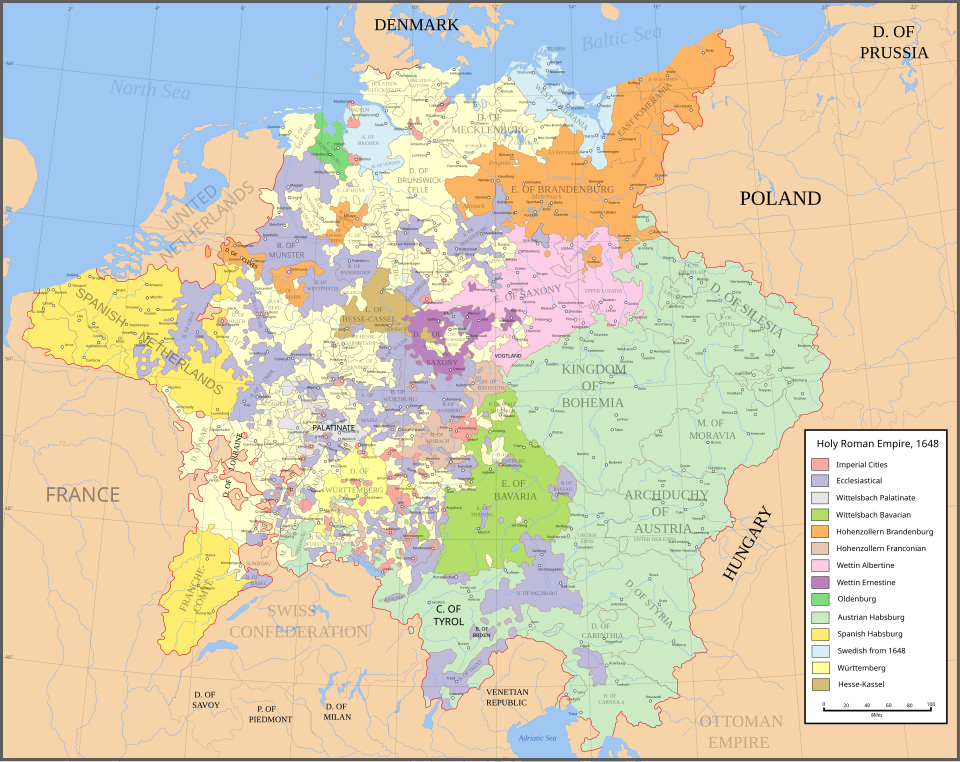
Map of the Holy Roman Empire in 1648 (after the Peace of Westphalia), showing the Empire’s dense patchwork of secular and ecclesiastical territories and free imperial cities. The visual fragmentation helps explain why sovereignty in central Europe often meant negotiated authority rather than uniform rule from a single capital. Source
Representative institutions, provincial privileges, and noble rights also limited rulers. In many places, monarchs had to bargain for taxes and military support. State-building was therefore a process of negotiation as well as coercion.
Still, the overall direction was significant. Religious conflict made it harder to imagine Europe as one political-religious community and easier to think in terms of competing territorial states.
Changing the European political order
By the mid-17th century, European politics increasingly operated through the logic of state interest. Religious identity still mattered, but rulers were more willing to form alliances, wage war, and make peace according to political advantage.
This shift had lasting effects:
diplomacy became more focused on relations between states rather than appeals to universal Christendom
rulers treated control over religion as part of governing territory
war strengthened the link between military power and administrative capacity
political competition helped normalize the idea that each state should manage its own affairs
In this way, conflicts among religious groups did more than divide Christians. They accelerated the emergence of a Europe organized around sovereign states competing for power, security, and resources.
Practice Questions
Answer all parts.
a) Identify ONE way religious conflict overlapped with political rivalry in early modern Europe. (1 mark)
b) Identify ONE economic interest that could shape a state's involvement in a religious war. (1 mark)
c) Briefly explain ONE way these conflicts encouraged stronger sovereign states. (1 mark)
(3 marks)
a) 1 mark for identifying a valid political rivalry, such as dynastic competition, territorial expansion, suppression of noble independence, or resistance to outside control.
b) 1 mark for identifying a valid economic interest, such as control of trade routes, access to ports, tax revenue, commercial dominance, or protection of wealthy provinces.
c) 1 mark for explaining a valid state-building effect, such as stronger taxation, larger armies, expanded bureaucracy, tighter control over religion, or more regular diplomacy.
Evaluate the extent to which political and economic competition, rather than religion alone, drove European conflicts in the period circa 1550 to 1650. (6 marks)
1 mark for a defensible thesis that makes a clear argument about the relative importance of political and economic competition compared with religion.
1 mark for broader historical context, such as the breakdown of Christian unity, the rise of confessional division, or the growing power of territorial monarchies.
Up to 2 marks for specific evidence:
1 mark for one relevant example accurately explained
2 marks for two or more relevant examples accurately explained
Valid examples may include the Dutch Revolt, French involvement against the Habsburgs, the Thirty Years’ War, taxation disputes, or competition over strategic territory and commerce.
Up to 2 marks for analysis and reasoning:
1 mark for showing causation or comparison between religious motives and political or economic motives
2 marks for a more complex explanation, such as showing how religion and state interest reinforced each other or how motives shifted over time within the same conflict
FAQ
Frontier fortresses were crucial because they helped states turn disputed regions into defensible borders.
They mattered for several reasons:
they protected trade routes and supply lines
they made invasions slower and more expensive
they allowed rulers to station troops permanently in contested areas
they symbolised state authority in borderlands where loyalties could be uncertain
A fortress was therefore not just a military site. It was also a tool of sovereignty, because it helped a ruler enforce power physically within a claimed territory.
Resident ambassadors made diplomacy more continuous and professional. Instead of sending envoys only for major events, states increasingly kept representatives at foreign courts for longer periods.
This helped governments:
gather intelligence more quickly
negotiate alliances and peace settlements more efficiently
monitor shifts in military and commercial policy
defend their ruler’s interests without relying on church mediation
This development supported a more state-centred political order, because it treated international politics as an ongoing relationship between governments rather than an occasional meeting of Christian princes.
Mercenaries were useful because they gave rulers access to experienced soldiers without relying entirely on feudal levies or local nobles.
They were dangerous because:
they were expensive to maintain
their loyalty often depended on pay
unpaid troops could mutiny, plunder, or switch sides
they could weaken a ruler’s claim to direct control over violence
For this reason, many governments gradually preferred more disciplined and regular military structures. The problems created by mercenary warfare pushed rulers towards stronger administration and more dependable taxation.
Public borrowing allowed rulers to fight longer wars than ordinary revenue would permit. States borrowed from bankers, merchants, and wealthy subjects to pay troops, buy supplies, and maintain fleets.
This had mixed effects:
it strengthened states by increasing military capacity
it encouraged better financial administration
it tied governments more closely to elite lenders
it could create political dependence if debts became too large
Borrowing therefore supported sovereignty in the short term, but it also meant that state power often rested on bargaining with those who could provide credit.
Smaller states could sometimes survive, or even gain influence, because larger powers needed allies, buffer zones, and strategic corridors.
They might benefit by:
playing rivals against one another
obtaining subsidies or military protection
preserving local privileges in exchange for alliance
avoiding conquest because no major power wanted a rival to control them
This did not make them fully secure, but it gave some smaller polities room to manoeuvre. In a Europe shaped by competing sovereign states, weakness could occasionally become diplomatic leverage.