

AP Syllabus focus: ‘Near Earth's surface, gravitational acceleration is downward, constant, and approximately 10 m/s^2.’
Free fall is a foundational AP Physics 1 situation where motion is driven only by gravity. Mastering its assumptions, direction conventions, and constant-acceleration description helps you interpret signs, graphs, and kinematics in vertical motion.
What “free fall” means near Earth
In AP Physics 1, free fall near Earth’s surface is modeled as motion where the only significant force is gravity, so the object’s acceleration is set by Earth’s gravitational field and treated as constant.
Free fall: Motion in which gravity is the only significant force acting on an object (air resistance and other forces are neglected).
This model applies to thrown objects, dropped objects, and objects moving upward or downward, as long as you treat the environment as near Earth’s surface and ignore drag.
Gravitational acceleration and direction
The key syllabus statement is that gravitational acceleration is downward, constant, and approximately . The “downward” part is about direction; the numerical value is the magnitude used for AP Physics 1 Algebra unless told otherwise.
Gravitational acceleration (): The (approximately constant) magnitude of an object’s acceleration due to Earth’s gravity near the surface, about in AP problems.
You must pair that magnitude with a sign that matches your coordinate choice.
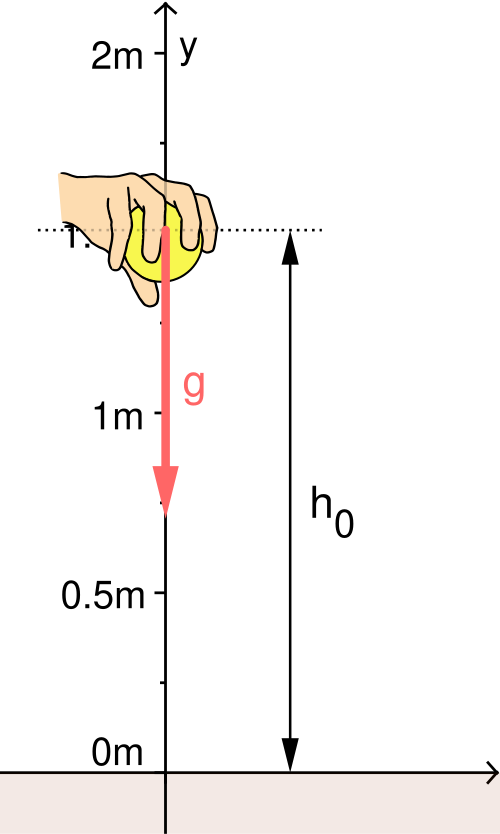
A coordinate-system sketch for a free-fall problem, showing the chosen positive direction and the gravitational acceleration vector pointing downward. This directly supports the idea that is a magnitude, while depends on your sign convention. Source
A common convention is upward as positive, making the acceleration negative during free fall.
Constant-acceleration description (1D vertical motion)
Free fall is a special case of constant acceleration motion in one dimension, where the acceleration stays the same throughout the time interval you analyse.
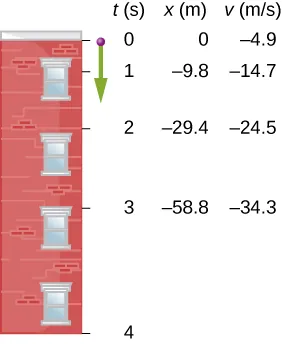
A time-stepped free-fall diagram (1 s intervals) showing an object’s position and velocity becoming increasingly negative as it accelerates downward. This visual ties the constant acceleration model to the idea that velocity changes by equal amounts in equal time intervals under constant . Source
Under the typical “up is positive” choice, the acceleration is constant at .
= vertical acceleration (signed), in
= magnitude of gravitational acceleration near Earth’s surface (AP approximation), in
A constant downward acceleration affects the object’s velocity continuously:
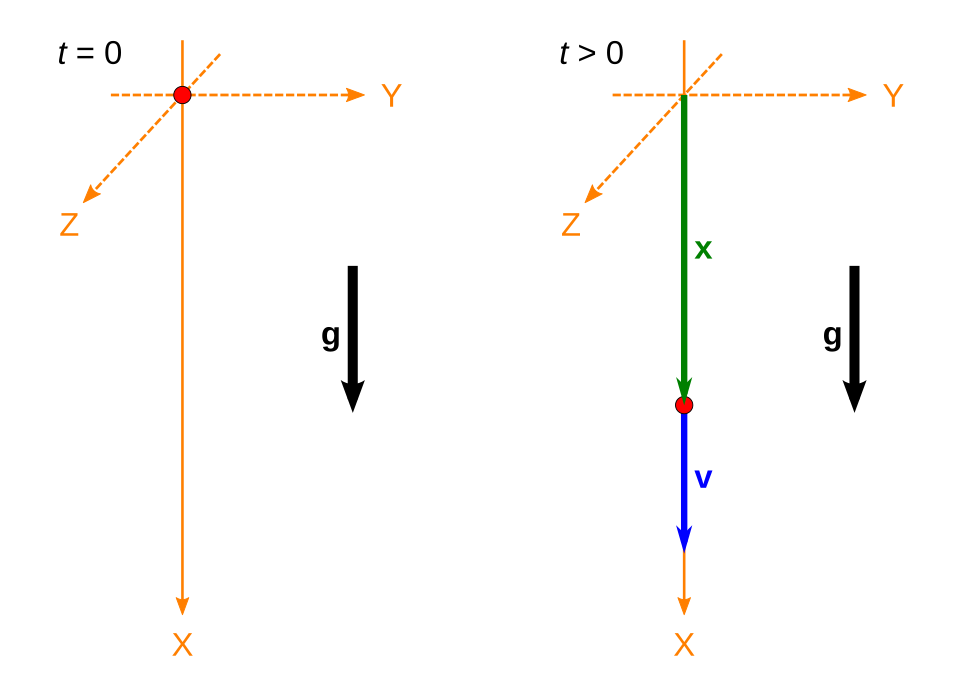
A three-panel representation of free fall showing displacement, velocity, and acceleration as functions of time. The velocity varies linearly with time under constant acceleration, while acceleration remains constant throughout the motion. Source
On the way up, the velocity is upward (positive) but becomes less positive each second because acceleration is downward.
At the top of the motion, the velocity is momentarily zero, but the acceleration is still downward (not zero).
On the way down, the velocity is downward (negative) and becomes more negative each second.
Sign conventions and what stays the same
The physics does not change with your axis choice, but the signs do. To avoid errors:
Choose a vertical axis (declare up or down as positive).
Assign as a magnitude (), then write the acceleration with the correct sign (for example, if up is positive).
Keep that sign choice consistent for displacement, velocity, and acceleration throughout the problem.
Key implications of “constant and downward”
Acceleration is constant: it does not depend on whether the object is moving up or down.
Acceleration points downward: it always points toward Earth during free fall near the surface.
Magnitude is approximately : use this AP value unless a different value is explicitly provided.
Practice Questions
(2 marks) A ball is thrown straight upward. Neglect air resistance. State the ball’s acceleration (magnitude and direction) while it is moving upward.
1 mark: States magnitude (or ).
1 mark: States direction is downward (towards Earth), even while moving upward.
(5 marks) A student chooses upward as the positive direction for vertical motion. An object is in free fall near Earth’s surface (air resistance neglected). (a) Write the value of in terms of . (2 marks) (b) State whether changes sign at the highest point of the motion and justify briefly. (3 marks)
(a)
1 mark: Writes .
1 mark: Uses as the magnitude (stated or implied). (b)
(b)
1 mark: Correctly states does not change sign at the top.
1 mark: Justification: acceleration depends on gravity’s direction, not the object’s direction of motion.
1 mark: States acceleration remains downward (negative with this sign convention).
FAQ
It standardises arithmetic and reduces rounding differences between students.
In marking, consistent method usually matters more than excessive precision unless a question specifies a value.
If the height change is large enough that gravity measurably varies (e.g., very high altitudes), the constant-$g$ model becomes less accurate.
In typical school-scale heights, the change is negligible for AP-style modelling.
Drag adds an upward force (usually) that reduces the magnitude of downward acceleration.
At higher speeds, drag can grow and the acceleration can approach zero as the motion nears terminal behaviour.
Yes. Apparent weight depends on contact forces (like a normal force), not on whether gravity exists.
In free fall, there is typically no supporting contact force, so scales read zero even though gravity accelerates you.
Common methods include timing a falling object over a known distance, analysing video motion, or using a pendulum with period $T$ and length $L$ (with an appropriate model).
Each method relies on careful measurement and controlling systematic errors (reaction time, calibration, and alignment).
