

AP Syllabus focus: ‘AP Physics 1 expects qualitative analysis of nonuniform acceleration, and numerical problems use g = 10 m/s^2.’
These notes clarify what AP Physics 1 Algebra expects you to do (and not do) when analysing motion. The key is recognising when to reason qualitatively versus when exact constant-acceleration equations are allowed.
What “limits for motion analysis” means on AP Physics 1
AP Physics 1 Algebra targets core kinematics ideas without calculus and without requiring advanced modelling of complicated acceleration functions. You are expected to:
Interpret motion using representations (especially graphs) even when acceleration is not constant.
Solve most numerical kinematics with constant acceleration, including free fall, using a standard value of .
Nonuniform acceleration: what you can still do
When acceleration changes over time (nonuniform), AP Physics 1 typically limits you to qualitative analysis rather than exact algebraic prediction over long intervals.
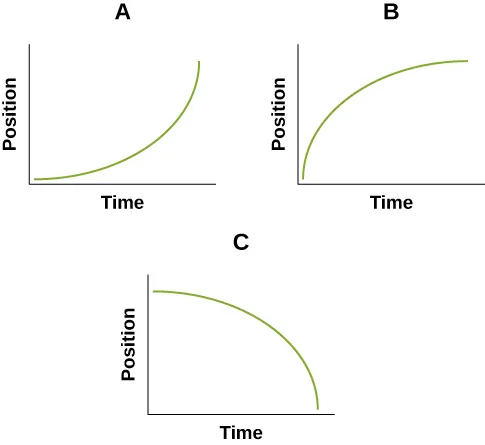
A set of position–time graphs that demonstrate how changing slope corresponds to changing velocity and how that change implies the sign of acceleration. The figures help students practice qualitative reasoning (increasing vs. decreasing slope) rather than forcing constant-acceleration equations onto curved graph segments. Source
Nonuniform acceleration: Acceleration that changes with time (magnitude and/or direction), so it is not constant over the interval of interest.
Even with nonuniform acceleration, you should still be able to make justified statements such as:
When acceleration is positive/negative, the velocity is increasing/decreasing (in the chosen positive direction).
When velocity is positive/negative, position is increasing/decreasing.
Larger slope on a velocity–time graph means larger acceleration at that moment.
Larger area under an acceleration–time graph over an interval means a larger change in velocity over that interval.
What “qualitative analysis” looks like (and what it avoids)
Qualitative analysis means you can compare, rank, and describe without needing an exact computed value from a changing-acceleration function. Typical tasks include:
Determine signs (positive/negative) of velocity and acceleration from a graph.
Compare which interval has the greater displacement by comparing areas on a – graph.
Identify turning points (where velocity changes sign) from a graph.
Decide whether an object is speeding up or slowing down by comparing the directions (signs) of velocity and acceleration.
It generally avoids:
Forcing a single constant when the graph clearly shows changing.
Using constant-acceleration kinematic equations across an interval where acceleration is not constant.
Treating curved graph segments as if they were straight lines unless the problem explicitly states an approximation.
Numerical work expectation: use
For free-fall-type numerical problems in AP Physics 1, you are expected to use an approximate gravitational acceleration magnitude of 10.
In AP problems, the important physics is usually the direction (downward) and the constant nature of near Earth’s surface, not high-precision calculation.
= magnitude of the acceleration due to gravity near Earth’s surface, in
When applying this, you must still choose a sign convention:
If up is positive, then for free fall.
If down is positive, then for free fall.
Practical boundaries you should apply in problems
When constant-acceleration equations are allowed
You can use constant-acceleration algebra when the problem states (or clearly implies) acceleration is constant, such as:
“Moves with constant acceleration”
Straight-line – segments (constant slope)
Free fall near Earth’s surface (with )
When to switch to qualitative or graph-based reasoning
You should rely on qualitative/graph reasoning when:
A – graph is curved (changing slope).
An – graph is not constant over the interval.
The prompt asks you to compare intervals (greater/less) rather than compute an exact number.
Common AP scoring focus under these limits
To earn credit, your work should clearly show:
A stated reference direction (what is positive).
Correct interpretation of slope (rate of change) and area (accumulation) on motion graphs.
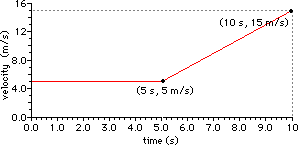
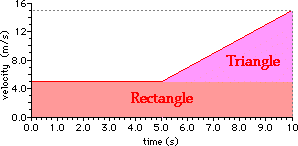
A worked velocity–time (–) graph example where a flat segment represents constant velocity (zero acceleration) and an upward-sloping segment represents positive constant acceleration. The figure supports two key interpretations: slope of the – graph gives acceleration, and the area between the curve and the time axis gives displacement over the interval. Source
Correct use of in numerical free-fall contexts.
Practice Questions
(2 marks) An object’s acceleration is not constant over time. State one type of analysis AP Physics 1 still expects you to do, and one type it typically does not expect you to do for that motion.
1 mark: States a valid expected qualitative/graph-based task (e.g. compare displacement by area under –, determine sign of acceleration from slope).
1 mark: States a valid non-expected exact constant- calculation across the whole interval (e.g. “use constant-acceleration equations to find final velocity over the entire time”).
(5 marks) A ball is thrown straight up. The problem says to use . You choose upward as positive. (a) State the acceleration while the ball is in the air. (1 mark) (b) Explain why the sign is negative. (2 marks) (c) State one consequence of using instead of on numerical answers. (2 marks)
(a) 1 mark: .
(b) 1 mark: Gravity acts downward throughout the motion; 1 mark: with up defined positive, downward corresponds to negative.
(c) 1 mark: Answers are approximate/rounded; 1 mark: calculated times/velocities/heights differ slightly (typically a small percentage error).
FAQ
It standardises arithmetic and reduces calculator dependence.
It also keeps the focus on modelling choices (direction, constant acceleration) rather than precision.
A curved $v$–$t$ graph (changing slope) indicates changing acceleration.
An $a$–$t$ graph that is not a horizontal line indicates nonuniform acceleration.
Only if the question explicitly permits an approximation or the interval is clearly described as “approximately constant”.
If you do approximate, you should state the assumption and restrict conclusions to that interval.
Very strict: marks are often earned/lost on consistent direction choices.
Write a clear statement like “up is positive” early, then keep velocity and acceleration signs consistent with that choice.
Typically 2–3 significant figures is sufficient, unless the question specifies otherwise.
Overly precise reporting (many decimals) is usually unnecessary and can mask sign or reasoning errors.
