

AP Syllabus focus: ‘A gravitational field models a noncontact force, and field strength equals force per unit mass.’
Gravitational interactions act without physical contact, which can feel mysterious. The gravitational field is a powerful model that describes how gravity depends on location and predicts the gravitational force on any mass placed there.
Gravitational fields as a model for noncontact force
When two masses attract, there is no push or pull through direct touching. Instead, physics represents the interaction using a field: a property of space around a mass that can influence other masses.
A mass (like Earth) creates a gravitational field in the space around it.
A second mass placed in that region experiences a gravitational force due to the field at its location.
The field model helps you separate:
the source (the object creating the field)
the test object (the object experiencing the force)
What the field “does”
The gravitational field tells you, at each point in space, the direction a mass would accelerate if released from rest (ignoring other forces). For gravitational fields, this direction is always toward the attracting mass.
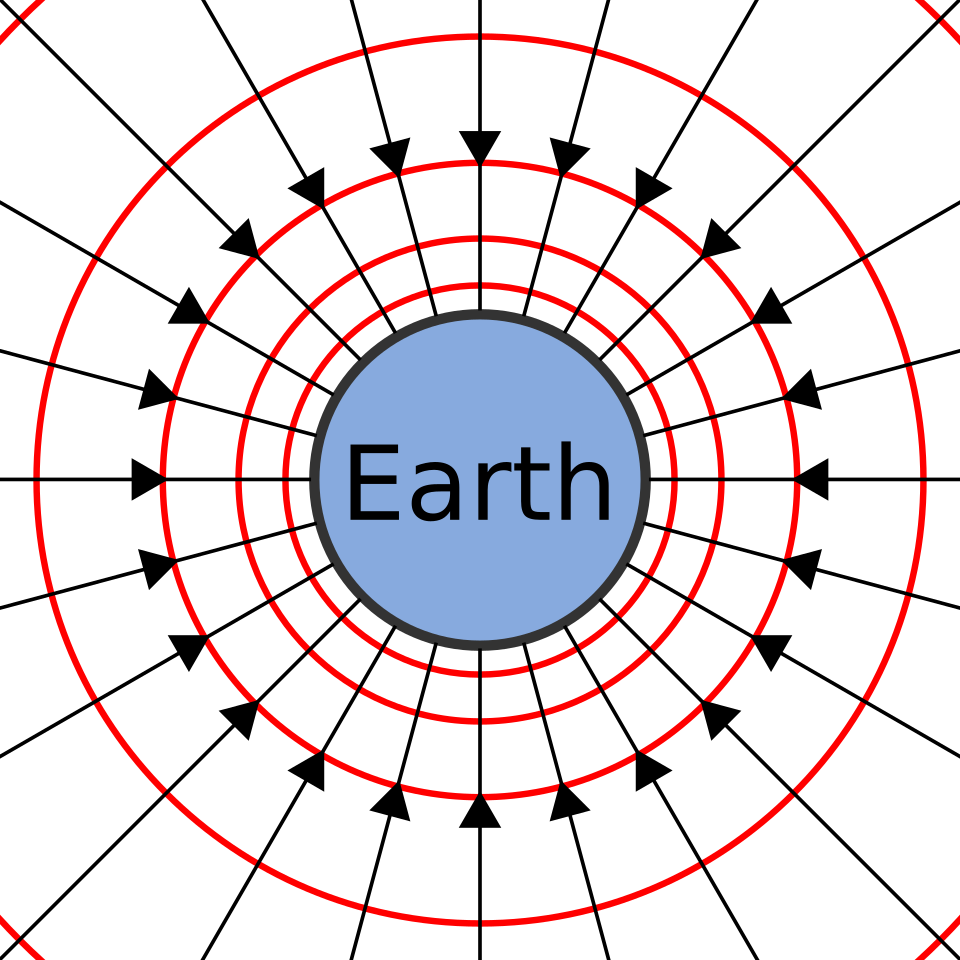
Gravitational field lines (radial) and equipotential lines (concentric) around Earth. Field lines indicate the direction of the gravitational field at each point, while equipotentials show locations of equal gravitational potential. The perpendicular relationship between field lines and equipotentials helps clarify why the field is a directional (vector) quantity tied to position. Source
Field strength: force per unit mass
The key measurable quantity is gravitational field strength, commonly written as in AP Physics 1.
Gravitational field strength: The gravitational force exerted on an object, per unit mass of that object, at a given location.
This definition means the field strength depends on the location in space (set by the source mass and distance), not on the test mass you choose to place there. Using a larger or smaller test mass changes the force, but the ratio “force divided by mass” stays the same at that point.
= gravitational field strength at a location (N/kg)
= gravitational force on the object at that location (N)
= mass of the object experiencing the force (kg)
= gravitational force on an object in a field (N)
= object’s mass (kg)
= gravitational field strength at the object’s location (N/kg)
These equations are algebraically equivalent; choose the form that matches the unknown you are solving for.
Units and meaning
means “each kilogram of mass experiences 1 newton of gravitational force” at that location.
A useful interpretation connects fields to motion:
Because , the unit N/kg is equivalent to m/s².
So field strength also describes the acceleration per unit mass a freely falling object would have if gravity were the only significant force.
Direction of the gravitational field
Field strength is a vector, so it has direction as well as magnitude.
The direction of at a point is defined as the direction of the gravitational force on a positive test mass.
For gravity, that direction is toward the attracting mass (gravity is attractive).
In one-dimensional problems, you often represent direction by a sign choice (for example, downward positive or upward positive), but you must stay consistent with your axis definition.
Using the field model correctly in AP Physics 1
To apply the gravitational field idea without overcomplicating problems:
Treat the gravitational field as a property of the environment at a location.
Use field strength to relate an object’s mass to the gravitational force it experiences.
Remember that the test mass does not change the field (the field is set by the source masses in the environment).
Keep track of vector direction: the field points where the force would point.
Practice Questions
(2 marks) Define gravitational field strength and state its SI units.
1 mark: Correct definition: gravitational force per unit mass at a point.
1 mark: Correct unit: (accept ).
(5 marks) A small object of mass experiences a gravitational force of downward at a point in space. (a) Determine the gravitational field strength at that point. (2 marks) (b) State the direction of the gravitational field at that point. (1 mark) (c) Without introducing any additional forces, explain what would happen to the gravitational force if the object were replaced with a object at the same point. (2 marks)
(a) 1 mark: Uses .
(a) 1 mark: .
(b) 1 mark: Direction downward (towards the attracting mass).
(c) 1 mark: Recognises unchanged at the point.
(c) 1 mark: Force doubles: so (or “twice as large”).
FAQ
They are equivalent in units and meaning when gravity is the only significant interaction.
In practice, $g$ describes the acceleration a freely falling object would have at that location.
Because $g=\dfrac{F_g}{m}$ and gravitational force scales proportionally with mass.
So the ratio stays constant for different test masses at the same point.
Yes, in principle, if gravitational fields from multiple sources cancel.
This can occur at special points between or around masses where vector contributions sum to zero.
Choose a coordinate direction (e.g., up positive), then assign the sign of $g$ accordingly.
Consistency between sign of $g$, force, and acceleration earns the marks.
A gravitational field is a property of space at a location; it exists whether or not an object is there.
A gravitational force acts on a specific mass placed in that field, with magnitude given by $F_g=mg$.
