

AP Syllabus focus: ‘A system appears weightless when gravity is the only force or when no forces act; this connects to the equivalence principle.’
Weightlessness is often misunderstood as “no gravity.” In AP Physics 1, it means no contact forces are felt, so scales read zero, even while gravity may still be acting and accelerating you.
Weightlessness: what you can and cannot “feel”
Physical meaning (forces on you)
When you stand on a floor, you feel a push upward from the floor. That push is a contact force, and it can compress your body and provide a scale reading.
Weightlessness: The condition in which a system has zero apparent weight (no support/contact force), so it feels no “push” from a surface or tension from a support.
Weightlessness is therefore about forces other than gravity being absent (or negligible) on the system, not about gravity being absent.
Apparent weight and free fall
Apparent weight (scale reading)
A scale measures the normal force on you, not the gravitational force directly.
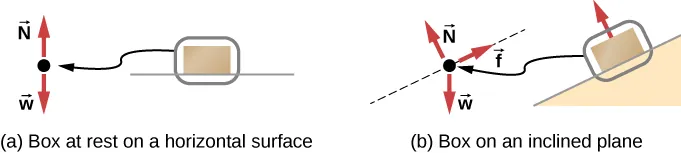
Free-body diagrams showing the normal force and weight on a box. The figure highlights that “apparent weight” comes from the contact force perpendicular to the surface, while gravity acts downward regardless of the surface orientation. Source
If that normal force becomes zero, the scale reads zero and you feel weightless.
In many AP situations, you can model vertical motion with Newton’s second law on the person (or object) and identify the support force.
= normal force (apparent weight), in newtons (N)
= mass, in kilograms (kg)
= gravitational field strength near Earth (), in
= vertical acceleration of the system (upward positive), in
This relationship shows how “heaviness” changes with acceleration:
If (accelerating upward), then (you feel heavier).
If (accelerating downward), then (you feel lighter).
If the system is in free fall, , so : weightlessness occurs even though gravity is still causing the acceleration.
Orbit is continuous free fall
Astronauts in low Earth orbit are weightless because:
Gravity provides nearly all the force on them.
The spacecraft and astronauts accelerate together under gravity, so there is essentially no normal force between them in the “vertical” direction.
Weightlessness when no forces act
The syllabus also notes weightlessness “when no forces act.” In deep space far from significant masses (idealised), if net force is zero:
The object moves at constant velocity.
With no contact forces acting, it has zero apparent weight, so it is weightless.
This is conceptually different from free fall near Earth, but the felt result is the same: no support force.
The equivalence principle connection
Equivalence principle: Locally (in a small region of space and time), the effects of a uniform gravitational field are indistinguishable from those of an accelerating reference frame.
How it explains weightlessness
The equivalence principle ties together two experiences:
In an enclosed elevator in free fall, you float because .
In an enclosed room far from gravity that is accelerating upward at , you feel “weight” because the floor must push on you with to accelerate you.
So, “gravity” and “acceleration” can produce equivalent local outcomes:
Weight (felt support force) can arise from being in a gravitational field or from the floor accelerating into you.
Weightlessness can arise from falling under gravity alone or from being in a region with negligible forces.
Common pitfalls to avoid
Weightlessness does not mean ; near Earth, can be substantial while .
Do not confuse weight () with apparent weight (); the “feeling of weight” tracks .
Weightlessness is about the forces on the system (gravity only, or none), not about being “high up.”
Practice Questions
A student stands on a scale in a lift. The lift then enters free fall. State what the scale reads and briefly explain why.
Scale reads (or “zero apparent weight”). (1)
In free fall the student accelerates downward at so no normal force acts (). (1)
A person of mass is in a lift where upward is positive.
(a) Write an equation relating , , and . (1)
(b) The lift accelerates downward at . Determine whether the person feels heavier or lighter than usual and justify using the equation (no calculation required). (2)
(c) Explain, using the equivalence principle, why the person would feel weightless in a freely falling lift even though gravity acts. (2)
(a) . (1)
(b) Downward acceleration means , so ; lighter. (2)
(c) In a small region, free fall is equivalent to an inertial frame with no gravity; locally there is no support force, so and the person floats. (2)
FAQ
No. Weightlessness usually means no support force acts on you.
Near Earth, gravity can still be close to $mg$ while your apparent weight is zero.
Because the astronaut and spacecraft share essentially the same gravitational acceleration.
With no floor needing to push up on them to prevent “falling,” the normal force is near zero.
Locally, free fall approximates an inertial frame (that is the key link).
Globally, free-fall paths in gravity can curve, so the inertial approximation is only local.
If a spacecraft accelerates so the floor must push on you with $N\approx mg$, you feel “weight” without a planet.
Locally, that feels like being at rest in a uniform gravitational field.
Tidal effects: gravity can vary across an extended region, producing stretching/compression.
Acceleration of a rigid frame is typically uniform across the frame, so differences can appear over large distances.
