

AP Syllabus focus: ‘Inertial mass measures resistance to changes in motion, gravitational mass relates to attraction, and experiments show they are equivalent.’
Mass appears in mechanics in two different ways: it can describe how hard it is to accelerate an object, and it can describe how strongly gravity pulls on that object. AP Physics 1 treats these as experimentally equivalent.
Two meanings of mass in Newtonian mechanics
Inertial mass: “resistance to acceleration”
When a net force acts, objects accelerate. The amount of acceleration produced by a given net force depends on the object’s inertial mass.
Inertial mass: The measure of an object’s resistance to changes in its motion; it is the proportionality constant relating net force to acceleration.
A larger inertial mass means you need a larger net force to produce the same acceleration.
Gravitational mass: “how strongly gravity pulls”
In gravitational interactions, mass also determines the strength of the gravitational force an object experiences (and exerts).
Gravitational mass: The property of matter that determines the strength of its gravitational interaction (how strongly it is attracted by other masses).
In AP Physics 1 Algebra, it is enough to treat gravitational mass as the “mass that appears in gravitational force” and compare it to inertial mass.
Relating the two masses through free-fall acceleration
If an object is only under the influence of gravity, Newton’s second law links gravitational force to acceleration. Writing gravitational force as proportional to gravitational mass and acceleration response as governed by inertial mass leads to a measurable prediction: the acceleration in a given gravitational field would depend on the ratio of the two masses.
= acceleration of the object (m/s)
= gravitational mass (kg)
= inertial mass (kg)
= local gravitational field strength (N/kg, equivalently m/s)
If and were not equal (or at least strictly proportional with the same constant for all materials), different objects would fall with different accelerations in the same location, even with no air resistance.
What “experiments show they are equivalent” means
The syllabus statement “experiments show they are equivalent” refers to repeated tests that compare how objects of different composition respond to gravity while controlling other effects.
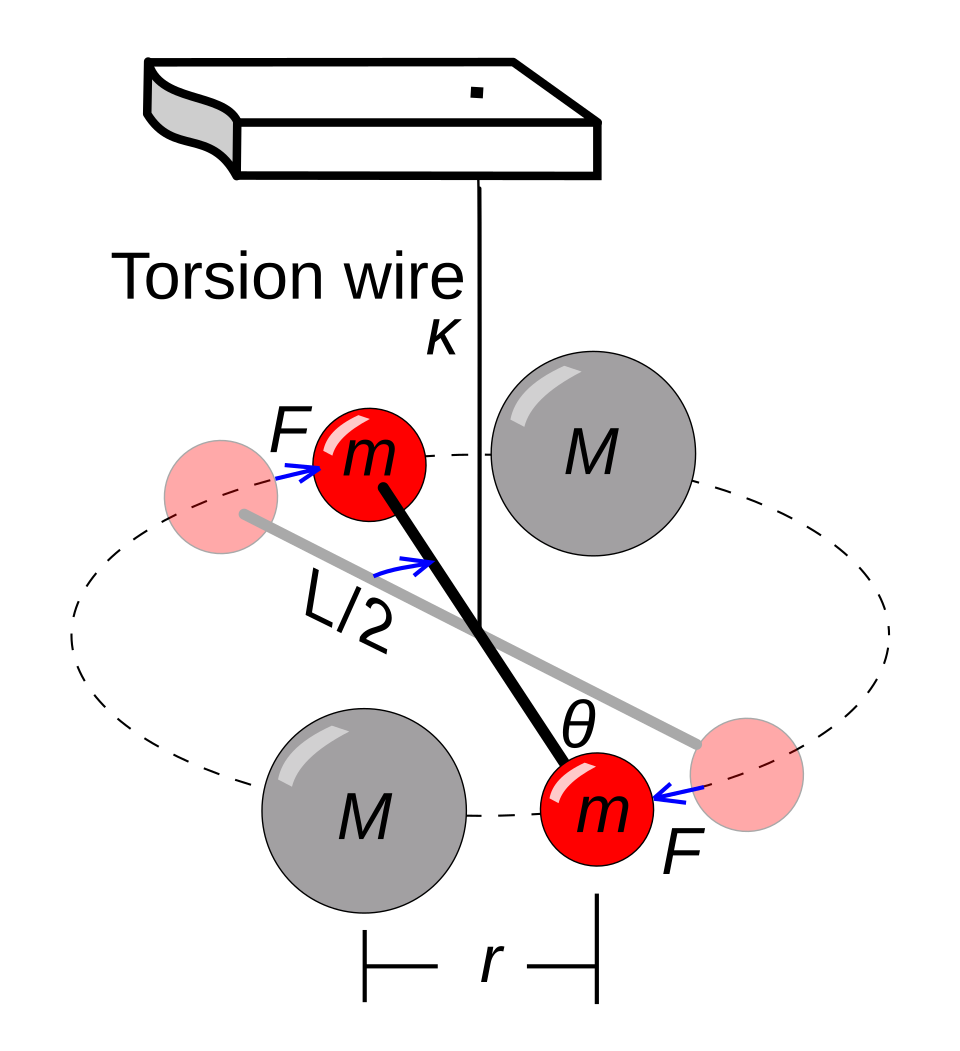
A labeled torsion-balance diagram showing how tiny gravitational forces produce a measurable twist angle in a suspended beam. This is the essential measurement idea behind high-precision gravity experiments: convert a very small force difference into an angular deflection that can be read out accurately. Source
The central outcome is that, to very high precision, free-fall acceleration does not depend on what the object is made of.
Key experimental idea (conceptually):
Compare the motion of two objects with different materials/shapes in the same gravitational environment.
Eliminate or reduce non-gravitational influences (especially air resistance, buoyancy, and electromagnetic effects).
Check whether their accelerations match within experimental uncertainty.
Interpreting the result:
If accelerations match, then must be the same for both objects.
If this holds for all tested materials, it supports the claim that inertial mass and gravitational mass are equivalent for practical physics, including AP-level problem solving.
Implications for AP Physics 1 modelling
For AP Physics 1 Algebra problems:
You typically treat the “mass” in and the “mass” in gravitational force expressions as the same quantity.
Because , the acceleration due to gravity near Earth can be treated as independent of mass for freely falling objects (ignoring drag).
This equivalence justifies why many gravitational-motion results do not require you to know the object’s mass to predict its acceleration.
Common reasoning moves that rely on equivalence:
When only gravity acts, acceleration is regardless of the object’s mass.
When gravity is one of several forces, the same consistently appears in Newton’s second law for each object, avoiding contradictions between “gravitational mass” and “inertial mass” in algebraic setup.
Practice Questions
(1–3 marks) Explain the difference between inertial mass and gravitational mass, and state what experiments indicate about their relationship.
Defines inertial mass as resistance to acceleration / relates force to acceleration (1)
Defines gravitational mass as determining strength of gravitational attraction (1)
States experiments show they are equivalent (equal/proportional so objects fall with same in same field) (1)
(4–6 marks) An object in free fall experiences gravitational force and obeys Newton’s second law . Derive an expression for in terms of , , and , and explain what must be true about and for all objects to share the same free-fall acceleration.
Uses for free fall (1)
Writes (1)
Rearranges to (2)
Explains that for same for all objects, must be the same constant for all objects (1)
States equivalence in practice implies (or constant ratio taken as 1 by choice of units) (1)
FAQ
They describe different roles in theory: one links force to acceleration, the other links matter to gravitational interaction. Different names help clarify which idea is being tested when comparing motion under gravity.
Yes. If $m_g = k m_i$ with the same constant $k$ for all materials, all objects would still share the same free-fall acceleration. In practice, unit choices can absorb $k$, so equality is used.
Different drag forces due to shape/area
Buoyant force differences in air
Timing or distance measurement offsets
Initial velocity differences at release
A balance compares weights, effectively comparing gravitational effects between objects. A spring scale measures force (weight) directly. Consistent results across methods support treating the same “mass” in both inertial and gravitational contexts.
Modern tests indicate agreement to extremely high precision, far beyond AP needs. AP Physics 1 treats equivalence as exact so that $a=g$ in free fall (neglecting air resistance) without additional correction factors.
